
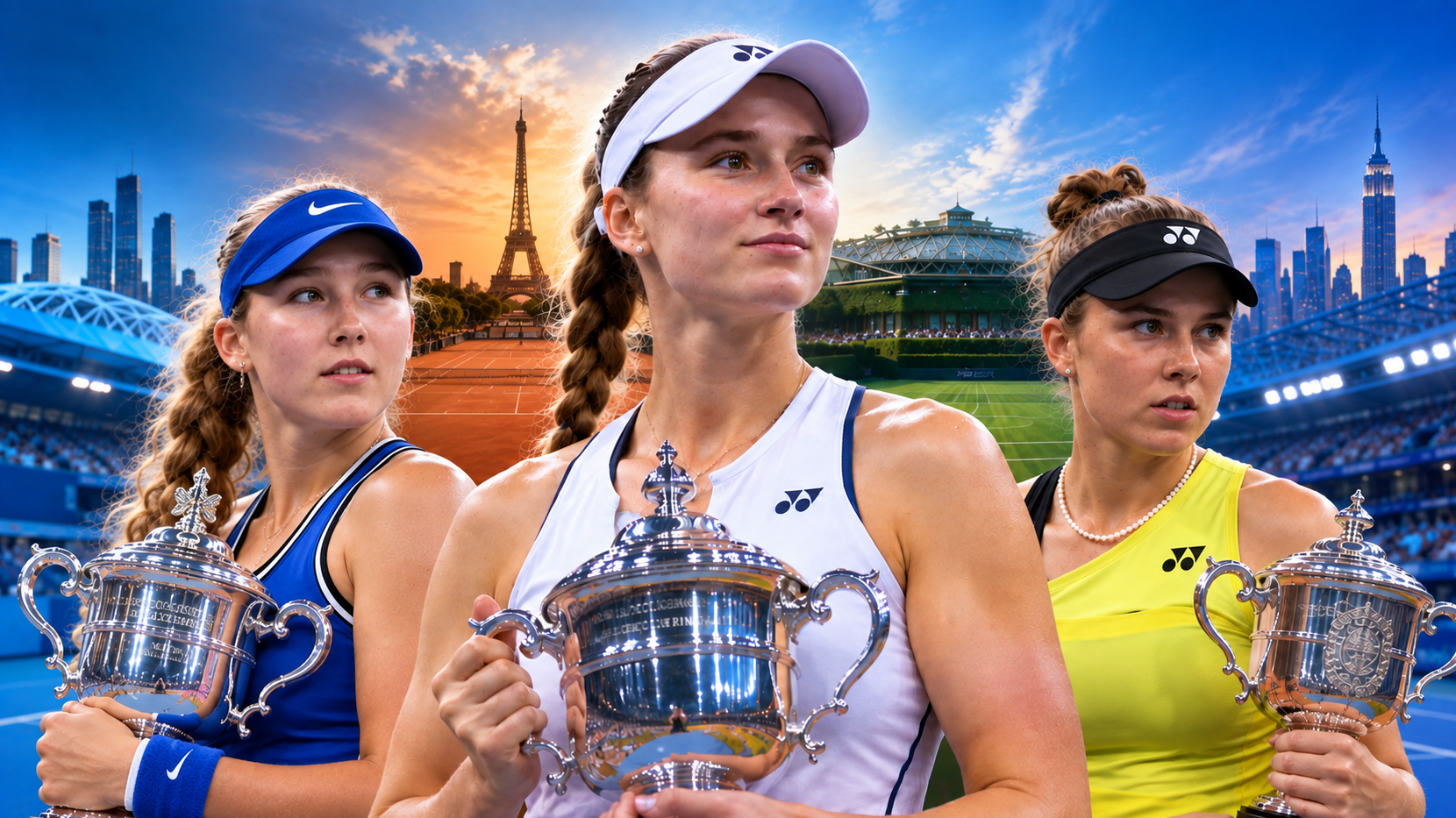
The 2026 Grand Slam Champions: Season Began With Rybakina. It Ended With Rybakina.
The 2026 Grand Slam champions produced a season with remarkable symmetry, beginning with Elena Rybakina lifting the trophy in Melbourne and ending with Rybakina winning again in New York.
Eight months separated those two trophies. But what happened between them may be just as important.
What the 2026 Grand Slam Champions Told Us About Women’s Tennis
Elena Rybakina raised the first women’s Grand Slam trophy of 2026 in Melbourne. Today, she raised the last one in New York.
But what happened between those two victories may be just as important.
Mirra Andreeva won her first Grand Slam title at Roland-Garros.
Linda Noskova followed with her first at Wimbledon.
And by the time the four majors were finished, women’s tennis had produced a remarkably neat summary of its 2026 Grand Slam season:
Four Grand Slams.
Three champions.
Two first-time winners.
One new World No. 1.
Rybakina owned the beginning and the ending.
Andreeva and Noskova made sure the middle belonged to the future.
The 2026 Grand Slam season started in Melbourne
The first major of the year brought Elena Rybakina back to a familiar place: a Grand Slam final.
Waiting across the net was Aryna Sabalenka.
It wasn’t their first championship meeting, and it certainly wouldn’t be their last.
Rybakina defeated Sabalenka 6–4, 4–6, 6–4 to win the Australian Open, giving her a second Grand Slam singles title after her Wimbledon breakthrough.
At the time, Melbourne looked like another major chapter in an already established rivalry.
By September, it looked more like the opening scene of something much bigger.
Because Rybakina and Sabalenka weren’t finished with each other.
Not even close.
Then 19-year-old Mirra Andreeva conquered Paris
When the tour moved onto the clay, the Grand Slam story changed generations.
Mirra Andreeva arrived at Roland-Garros already established as one of the brightest young players in women’s tennis.
She left Paris as a Grand Slam champion.
At 19 years and 39 days, Andreeva became the youngest women’s singles champion at Roland-Garros since Monica Seles in 1992.
The victory mattered beyond the trophy.
For several seasons, women’s tennis had been asking when the newest generation would stop being described as the future and begin taking the sport’s biggest prizes.
In Paris, Andreeva supplied one answer.
The future had arrived.
And it wasn’t finished.
Linda Noskova made it two first-time champions in a row
A few weeks later, Wimbledon produced another breakthrough.
Linda Noskova won her first Grand Slam singles title at 21, becoming the youngest women’s Wimbledon champion since Petra Kvitova in 2011.
Suddenly, the middle of the 2026 Grand Slam season belonged entirely to first-time champions.
Roland-Garros — Andreeva, 19.
Wimbledon — Noskova, 21.
Two majors.
Two champions aged 21 or younger.
Two players lifting a Grand Slam singles trophy for the first time.
It would have been easy to look at Paris and London and declare 2026 the year of a complete generational takeover.
Except the player who started the Grand Slam season had one more statement to make.
New York brought the story back to Rybakina
By the US Open, Rybakina wasn’t chasing only another Grand Slam trophy.
She was also chasing the top of women’s tennis.
And during her run in New York, she secured enough ranking points to take the World No. 1 ranking from Sabalenka.
That created an extraordinary final.
The outgoing No. 1 against the incoming No. 1.
The two-time defending US Open champion against a woman appearing in her first final in New York.
Sabalenka chasing a historic three-peat.
Rybakina chasing another crown.
We framed it before the match this way:
Rybakina took one crown. Now she wants the other.
Then she took the other.
Rybakina defeated Sabalenka 6–4, 5–7, 6–2 to win her first US Open title and third Grand Slam singles championship.
Fittingly for a player whose serve has been one of the defining weapons of her career, she finished the tournament with an ace.
One tournament.
Two crowns.
Both changed hands.
From Melbourne to New York, the hard-court majors belonged to Rybakina
There is another symmetry hiding inside Rybakina’s season.
She didn’t merely win the first and last majors of 2026.
She won both hard-court Grand Slams.
And both finals came against the same opponent.
Australian Open: Rybakina def. Sabalenka, 6–4, 4–6, 6–4.
US Open: Rybakina def. Sabalenka, 6–4, 5–7, 6–2.
Sabalenka reached both championship matches.
Rybakina took both trophies.
Their rivalry now deserves a much bigger conversation than one US Open final, especially after Rybakina also ended Sabalenka’s reign at World No. 1.
That’s a story we’ll be coming back to.
But Rybakina didn’t own the whole Grand Slam season
And that’s what makes the four champions’ results so interesting.
Look at the championship map:
| Grand Slam | Champion | The story |
|---|---|---|
| Australian Open | Elena Rybakina | Second Grand Slam title |
| Roland-Garros | Mirra Andreeva | First Grand Slam title at 19 |
| Wimbledon | Linda Noskova | First Grand Slam title at 21 |
| US Open | Elena Rybakina | Third major, first US Open title and new World No. 1 |
Rybakina took the two hard-court majors.
Andreeva conquered the clay.
Noskova broke through on grass.
Three champions.
Three different championship territories.
And two of those champions were 21 or younger.
So was 2026 the year women’s tennis passed the torch to a new generation?
Not quite.
Rybakina winning half of the season’s majors makes that conclusion difficult.
Perhaps what happened was more interesting.
The established elite didn’t disappear.
The next generation joined them.
And that leaves another group we’re watching
Andreeva and Noskova aren’t the only young players who gave us reasons to pay attention during the Grand Slam season.
At the US Open alone, we found ourselves following a group we started calling our Young Guns.
Some were already major champions.
Others were making their first meaningful runs at this level.
And strangely, their New York finishes formed an almost perfect staircase through the tournament.
That’s another story.
Then there were the players who didn’t begin the US Open in the main draw at all.
Qualifiers fighting their way through three additional matches just to reach Round 1.
Junior players competing far away from the attention surrounding the women’s final.
Players whose names most tennis fans may not know yet.
We went looking for them too.
Because Andreeva and Noskova are reminders of something worth remembering:
Every established Grand Slam champion was once a player most of the world wasn’t watching.
Four Slams finished. The next stories are already beginning.
The 2026 Grand Slam season is over.
The WTA season isn’t.
There is plenty of tennis still to come before the calendar turns to 2027.
But the four biggest tournaments have given us their champions.
🏆 Australian Open — Elena Rybakina
🏆 Roland-Garros — Mirra Andreeva
🏆 Wimbledon — Linda Noskova
🏆 US Open — Elena Rybakina
Four Grand Slams.
Three champions.
Two first-time winners.
One new World No. 1.
The Grand Slam season began with Elena Rybakina.
It ended with Elena Rybakina.
But somewhere between Melbourne, Paris, London and New York, another question appeared.
We know who won the Grand Slams of 2026.
Who is going to appear on this list next?
And that’s the story we’ll keep following.
📌 Story Status: Continuing
The 2026 Grand Slam champions are decided, but several stories created by the season are only beginning.
We’ll continue following Rybakina and Sabalenka’s growing rivalry, the young players already challenging the established order, and some of the qualifiers and juniors whose names may become much more familiar in the years ahead.
Related Stories
- Elena Rybakina World No. 1: Her Remarkable Journey
- Sabalenka Can Win a Historic US Open Three-Peat—and Still Lose World No. 1
- Ice Conquers Fire as Rybakina Wins New York | US Open 2026 Final Roundup