
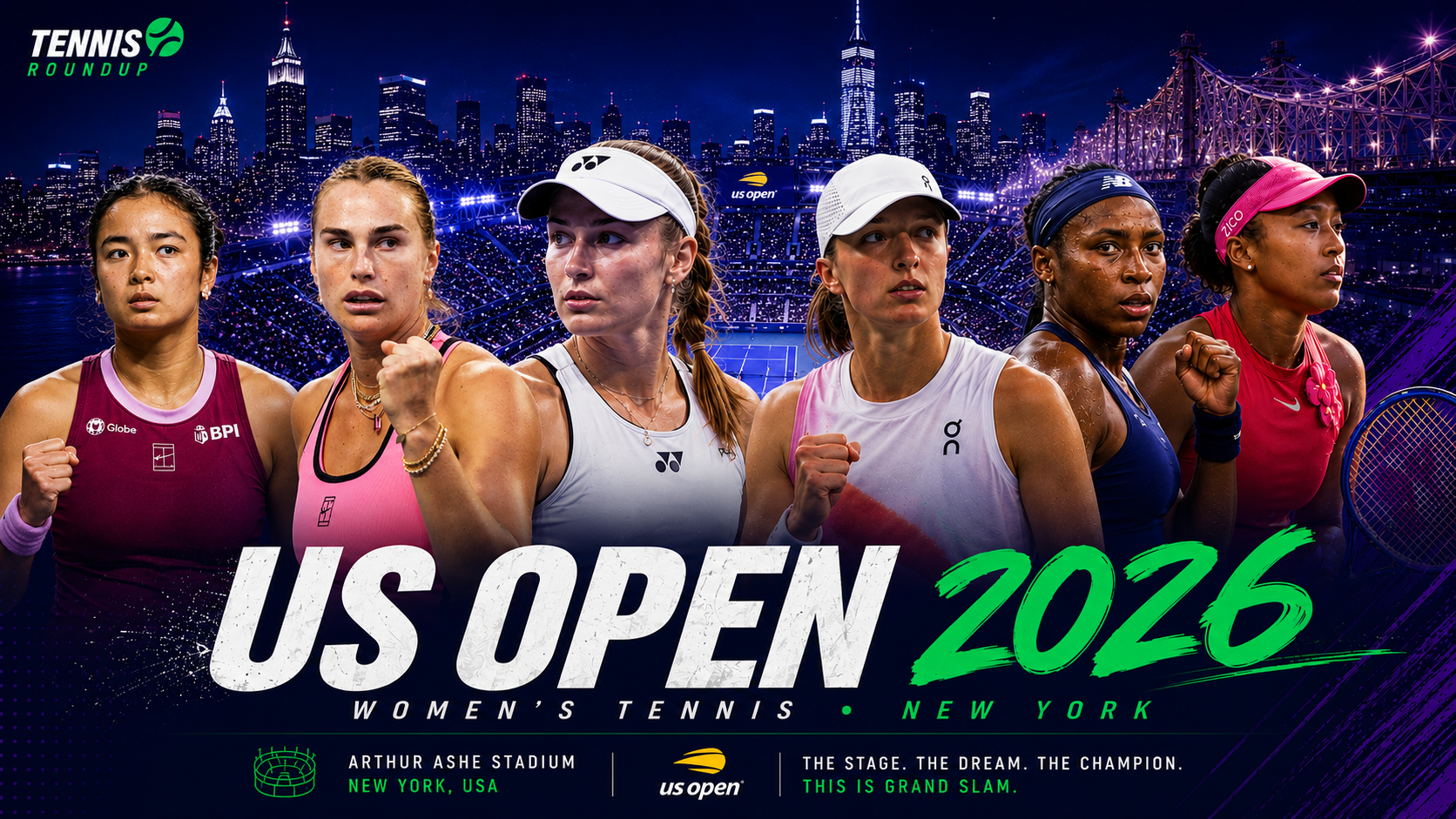
US Open 2026 Women’s Seeds: Alex Eala Earns No. 17 as Sabalenka Leads the Draw
The 2026 US Open women’s singles seeds are confirmed, with two-time defending champion Aryna Sabalenka holding the No. 1 position and Elena Rybakina seeded No. 2.
Jessica Pegula and Cincinnati champion Coco Gauff complete the leading four, while Mirra Andreeva, Linda Noskova, Karolina Muchova and Iga Swiatek form an unusually intriguing group of Top 8 seeds.
Alexandra Eala will contest her first seeded US Open campaign as the No. 17 seed. The Filipina is positioned immediately outside the tournament’s leading 16, giving her protection from every other seed during the opening two rounds.
Further down the list, Cincinnati semifinalist Sara Bejlek enters as the No. 28 seed, while former US Open finalists Leylah Fernandez and Madison Keys are seeded No. 31 and No. 22 respectively.
Complete US Open 2026 Women’s Seedings
| Seed | Player | Country |
|---|---|---|
| 1 | Aryna Sabalenka | — |
| 2 | Elena Rybakina | Kazakhstan |
| 3 | Jessica Pegula | United States |
| 4 | Coco Gauff | United States |
| 5 | Mirra Andreeva | — |
| 6 | Linda Noskova | Czech Republic |
| 7 | Karolina Muchova | Czech Republic |
| 8 | Iga Swiatek | Poland |
| 9 | Elina Svitolina | Ukraine |
| 10 | Amanda Anisimova | United States |
| 11 | Marta Kostyuk | Ukraine |
| 12 | Belinda Bencic | Switzerland |
| 13 | Naomi Osaka | Japan |
| 14 | Iva Jovic | United States |
| 15 | Diana Shnaider | — |
| 16 | Sorana Cirstea | Romania |
| 17 | Alexandra Eala | Philippines |
| 18 | Ekaterina Alexandrova | — |
| 19 | Jasmine Paolini | Italy |
| 20 | Maja Chwalinska | Poland |
| 21 | Anna Kalinskaya | — |
| 22 | Madison Keys | United States |
| 23 | Elise Mertens | Belgium |
| 24 | Anastasia Potapova | Austria |
| 25 | Marie Bouzkova | Czech Republic |
| 26 | Emma Navarro | United States |
| 27 | Barbora Krejcikova | Czech Republic |
| 28 | Sara Bejlek | Czech Republic |
| 29 | Ann Li | United States |
| 30 | Jelena Ostapenko | Latvia |
| 31 | Leylah Fernandez | Canada |
| 32 | Maria Sakkari | Greece |
The seedings are listed in the official WTA US Open tournament guide and on the US Open player page.
How US Open Seedings Work
The women’s singles draw contains 128 players, of whom 32 are seeded.
Seedings are based on the WTA rankings used by the tournament after accounting for the players who actually enter the event. This explains why a player’s seed number may be slightly higher than her current ranking.
A player ranked No. 18, for example, can become the No. 17 seed if one higher-ranked player is absent from the field.
The seeds are distributed through the draw to prevent the leading players from meeting too early:
- The No. 1 and No. 2 seeds cannot meet before the final.
- The Top 4 seeds cannot meet one another before the semifinals.
- The Top 8 cannot meet one another before the quarterfinals.
- Seeds No. 9–16 are positioned to face a Top 8 seed in the fourth round.
- Seeds No. 17–32 can first encounter another seed in the third round.
Seedings provide protection, but they do not guarantee an easy path. Unseeded former champions, qualifiers returning from injury and rapidly improving young players can still appear anywhere in the draw.
Sabalenka Receives Eighth Consecutive Grand Slam Top Seeding
Aryna Sabalenka is the No. 1 seed at a Grand Slam for the eighth consecutive time.
She enters New York as the two-time defending champion after winning the 2024 and 2025 US Open titles. Sabalenka will attempt to become the first woman since Serena Williams to capture three consecutive singles championships at Flushing Meadows.
The leading seed is traditionally placed at the top of the draw, while the No. 2 seed is positioned at the bottom. This ensures that Sabalenka and Rybakina can meet only in the final.
Sabalenka begins against Camila Osorio and is projected to face No. 8 seed Swiatek or No. 7 Muchova only in the championship match because both landed in the opposite half.
Being the No. 1 seed does not mean Sabalenka is secure at No. 1 in the rankings. She is defending 2,000 points from last year’s title, while Rybakina has considerably fewer points to replace.
Sabalenka must win the US Open and hope Rybakina loses before the semifinals to guarantee that she remains ahead.
Rybakina Is No. 2 Seed but Controls the No. 1 Race
Elena Rybakina enters as the No. 2 seed and the player in the strongest position to leave New York at world No. 1.
Rybakina trails Sabalenka by 434 points in the published rankings. Once their 2025 US Open points are removed, however, Rybakina moves into the effective lead because Sabalenka is defending the title while Rybakina reached only the fourth round.
A semifinal appearance would guarantee Rybakina the No. 1 ranking regardless of what Sabalenka, Pegula or Gauff achieves.
Her seeding theoretically protects her from the other seven leading seeds until the quarterfinals. The draw has nevertheless placed Rybakina in a difficult section containing Swiatek, Naomi Osaka and Madison Keys.
The No. 2 seed opens against American wild card Thea Frodin.
Pegula and Gauff Complete the Top Four
Jessica Pegula is seeded No. 3 and Coco Gauff No. 4, maintaining the positions they occupy in the latest WTA rankings.
The Americans recently contested the Cincinnati final, where Gauff prevailed to win her second title at the tournament.
Their Top 4 status guarantees that neither can meet Sabalenka or Rybakina before the semifinals. Pegula and Gauff were also placed in separate halves, meaning an all-American final remains possible.
Pegula occupies the second quarter and is projected to meet No. 7 seed Muchova in the last eight.
Gauff landed in the third quarter, where No. 5 Andreeva is her projected quarterfinal opponent.
Both Americans remain mathematically capable of becoming world No. 1, but each must win the US Open and needs Rybakina to lose before the semifinals.
Andreeva Leads the Next Generation at No. 5
Mirra Andreeva enters as the No. 5 seed, the highest position of any player outside the four established No. 1 contenders.
She opens against Janice Tjen and could meet Gauff in the quarterfinals.
Andreeva already gained useful experience on the New York courts during the US Open mixed-doubles competition. Playing alongside Andrey Rublev, she reached the semifinals and held two match points before losing to eventual champions Karolina Muchova and Jakub Mensik.
The No. 5 seeding means Andreeva cannot face any of the leading four before the quarterfinals. It also establishes her as the highest-seeded player from the younger group attempting to break into the major-title conversation.
Noskova and Muchova Give Czech Tennis Two Top 8 Seeds
Wimbledon champion Linda Noskova is seeded No. 6, one place ahead of fellow Czech Karolina Muchova.
Noskova’s position is another major milestone in her breakthrough season. She climbed to a career-high No. 6 after Cincinnati and now enters the US Open as the third-highest seed in the upper half of the draw.
Muchova, meanwhile, arrives with a title already secured in New York. She partnered Jakub Mensik to win the US Open mixed-doubles championship before turning her attention to singles.
The Czech Republic has four women among the 32 seeds:
- No. 6 Linda Noskova
- No. 7 Karolina Muchova
- No. 25 Marie Bouzkova
- No. 28 Sara Bejlek
Barbora Krejcikova is also Czech, although she is listed here at No. 27, giving the country five seeded representatives in total.
That depth is one of the clearest stories in the 2026 field.
Swiatek Enters as the No. 8 Seed
Iga Swiatek being seeded No. 8 is one of the most unusual features of the tournament.
The former world No. 1 won the US Open in 2022 and captured the Toronto title earlier in August. Her current position, however, places her at the bottom of the Top 8 group.
The practical consequence is significant.
Swiatek could be drawn against any of the Top 4 seeds in the quarterfinals. She landed in Rybakina’s quarter, producing one of the most consequential projected matches of the tournament.
Her section also includes Osaka and Keys, making the bottom quarter much stronger than its seeding numbers alone suggest.
Seed No. 8 may accurately represent Swiatek’s current ranking, but it does not necessarily reflect her probability of winning the title. She remains a multiple Grand Slam champion with the experience to defeat any of the players positioned above her.
Eala Earns Her First US Open Seeding
Alexandra Eala enters as the No. 17 seed, an important milestone in her rapid climb through the rankings.
The Filipina is currently ranked a career-high No. 18. Her seed is one place higher because the tournament’s seeding list includes only eligible players entered in the draw.
Eala’s position immediately outside the Top 16 creates both an advantage and a limitation.
As the No. 17 seed:
- She cannot face another seed in the first two rounds.
- She can meet a Top 16 seed in the third round.
- She is not protected from a Top 8 opponent in the fourth round.
Eala begins against American qualifier Mary Stoiana. If she advances, she will face either Oleksandra Oliynykova or wild card Reese Brantmeier.
Her first projected seeded opponent is No. 14 Iva Jovic in the third round. Coco Gauff would be the leading projected opponent later in the section.
The seeding represents a considerable change from Eala’s 2025 US Open campaign. Last year, she entered unseeded and immediately faced No. 14 seed Clara Tauson.
Eala recovered from 5–1 down in the deciding set to win that match, becoming the first Filipino player to record a Grand Slam main-draw singles victory in the Open Era.
This year, she arrives as the player the unseeded field may want to avoid.
Why Eala Is No. 17 Despite Being Ranked No. 18
Rank and seed are related, but they are not always identical.
Eala is No. 18 in the latest WTA rankings but No. 17 in the US Open draw because seedings are determined from the rankings among players who are actually participating.
If a player ranked above Eala does not enter or withdraws before the seedings are finalized, everyone below that position moves up one place.
This does not mean the tournament has subjectively elevated Eala. The US Open follows the rankings order among the eligible entrants.
The distinction matters because the No. 17 seed is paired within the same draw band as seeds No. 17–24. Those players are separated from the Top 16 until at least the third round.
Osaka Is the Most Dangerous Seed Outside the Top 12
Naomi Osaka is seeded No. 13 and begins against Anastasia Zakharova.
A No. 13 position appears modest for a four-time Grand Slam champion and two-time US Open winner. It also makes Osaka one of the players the Top 8 seeds would least want to encounter in the fourth round.
Osaka landed in the same quarter as Rybakina, Swiatek and Keys.
Her seed gives her two rounds of protection, but it does not shield her from an early second-week meeting with one of the tournament favourites.
The gap between Osaka’s seed and her historical achievements illustrates why seed numbers should never be treated as a simple list of title probabilities.
Keys and Fernandez Carry Low Seeds Into Familiar Territory
Madison Keys is seeded No. 22, while Leylah Fernandez enters at No. 31.
Both have previously reached the US Open final.
Keys was runner-up in 2017 and is also a Grand Slam champion. Her opening meeting with teenage prospect Alina Korneeva is one of the most interesting first-round matches.
Fernandez reached the 2021 final and begins against Zhang Shuai.
Their relatively low seeds mean both could encounter a leading player in the third round. At the same time, their history in New York gives them a level of credibility that their positions alone may not communicate.
No leading seed will consider either player an ordinary third-round opponent.
Bejlek Rewarded After Cincinnati Breakthrough
Sara Bejlek enters as the No. 28 seed following her first WTA 1000 semifinal in Cincinnati.
The Czech defeated former Grand Slam champions Madison Keys and Barbora Krejcikova, former world No. 1 Karolina Pliskova and current No. 1 Sabalenka during the tournament.
Her run lifted her into the Top 30 for the first time.
Bejlek’s current WTA ranking is No. 29, but she is seeded No. 28 because of the composition of the US Open field.
She landed in Gauff’s section and could face the American again in the third round. Gauff defeated Bejlek in the Cincinnati semifinals, making a New York rematch one of the notable projected early meetings.
Former Champions Are Spread Across the Seeding List
Six former US Open champions are entered in the women’s singles field, but they occupy very different positions.
Among the seeded former champions are:
- No. 1 Aryna Sabalenka
- No. 4 Coco Gauff
- No. 8 Iga Swiatek
- No. 13 Naomi Osaka
Other major champions—including Keys, Bencic, Krejcikova and Ostapenko—are seeded outside the Top 16.
Venus Williams and Sofia Kenin entered through wild cards and are unseeded. They face one another in the opening round.
The distribution reinforces the depth of the draw: a seeded player can avoid another seed in the opening two rounds and still encounter a former Grand Slam champion.
Most Dangerous Seeds Outside the Top 16
The No. 17–32 group contains several players capable of defeating the leading contenders:
| Seed | Player | Why she is dangerous |
|---|---|---|
| 17 | Alexandra Eala | Washington champion and seven Top 10 wins in 2026 |
| 19 | Jasmine Paolini | Major finalist with strong movement and consistency |
| 22 | Madison Keys | Grand Slam champion and former US Open finalist |
| 27 | Barbora Krejcikova | Multiple Grand Slam singles champion |
| 28 | Sara Bejlek | Cincinnati semifinalist who defeated Sabalenka |
| 30 | Jelena Ostapenko | Former Roland Garros champion |
| 31 | Leylah Fernandez | Former US Open finalist |
| 32 | Maria Sakkari | Former world No. 3 and US Open semifinalist |
These players can meet a seed from the leading 16 in the third round.
That makes the draw positions of Eala, Keys, Krejcikova, Bejlek and Fernandez especially relevant when identifying potential early upsets.
What the Seeds Tell Us—and What They Do Not
Seedings are designed to distribute the highest-ranked entrants through the draw. They are not predictions.
They reflect ranking points earned over the previous 52 weeks, not necessarily:
- A player’s current physical condition
- Her recent form
- Her historical success at the US Open
- The difficulty of her opening opponent
- Her suitability for the New York courts
Rybakina is seeded above Swiatek, but her fitness remains uncertain following Cincinnati. Osaka is only No. 13 but has won the tournament twice. Keys is No. 22 despite being a Grand Slam champion, while unseeded Venus Williams owns two US Open singles titles.
Eala’s No. 17 position is deserved protection earned through her results. It is not a guarantee of a deep run.
That distinction will become important once play begins: a favourable seed can create an opportunity, but the player must still convert it.
Leading Projected Quarterfinals
If every leading seed advances according to position, the women’s quarterfinals would be:
- No. 1 Aryna Sabalenka vs. No. 6 Linda Noskova
- No. 3 Jessica Pegula vs. No. 7 Karolina Muchova
- No. 4 Coco Gauff vs. No. 5 Mirra Andreeva
- No. 2 Elena Rybakina vs. No. 8 Iga Swiatek
These pairings are projections rather than scheduled matches.
The presence of Osaka, Keys, Eala, Anisimova, Bejlek and several dangerous unseeded players makes it unlikely that the draw will proceed perfectly according to seed.
A Seeding List That Reflects a Changing WTA
The 2026 US Open seeds capture a women’s tour in transition.
Sabalenka remains at the top, but her No. 1 ranking is under immediate threat from Rybakina. Pegula and Gauff complete the established leading group, while Andreeva and Noskova have moved into the Top 6.
Swiatek begins from an unfamiliar No. 8 position. Osaka and Keys sit outside the Top 12 and Top 20 respectively despite their major-winning records.
Eala’s rise to the No. 17 seed may be the clearest symbol of that movement. One year after entering New York as an unseeded breakthrough player, she returns as a WTA champion and one of the 20 highest-ranked women in the world.
The seedings provide the structure. The next two weeks will reveal how much of that order survives.