
Why Alex Eala Gets So Much Attention—and Why Tennis Rankings Don’t Explain It
Why Alex Eala geets so much attention? That’s a big question
As I scroll through tennis social media lately and a familiar argument keeps appearing.
Alex Eala attends a major event. Another feature appears in an international publication. A tournament puts her on a show court. Filipino supporters pack the stands. Ticket demand rises.
Then somebody inevitably asks:
Why her?
The comparison circulating this week makes the question particularly striking.
Linda Noskova is 21 years old. She just won Wimbledon. She is World No. 6.
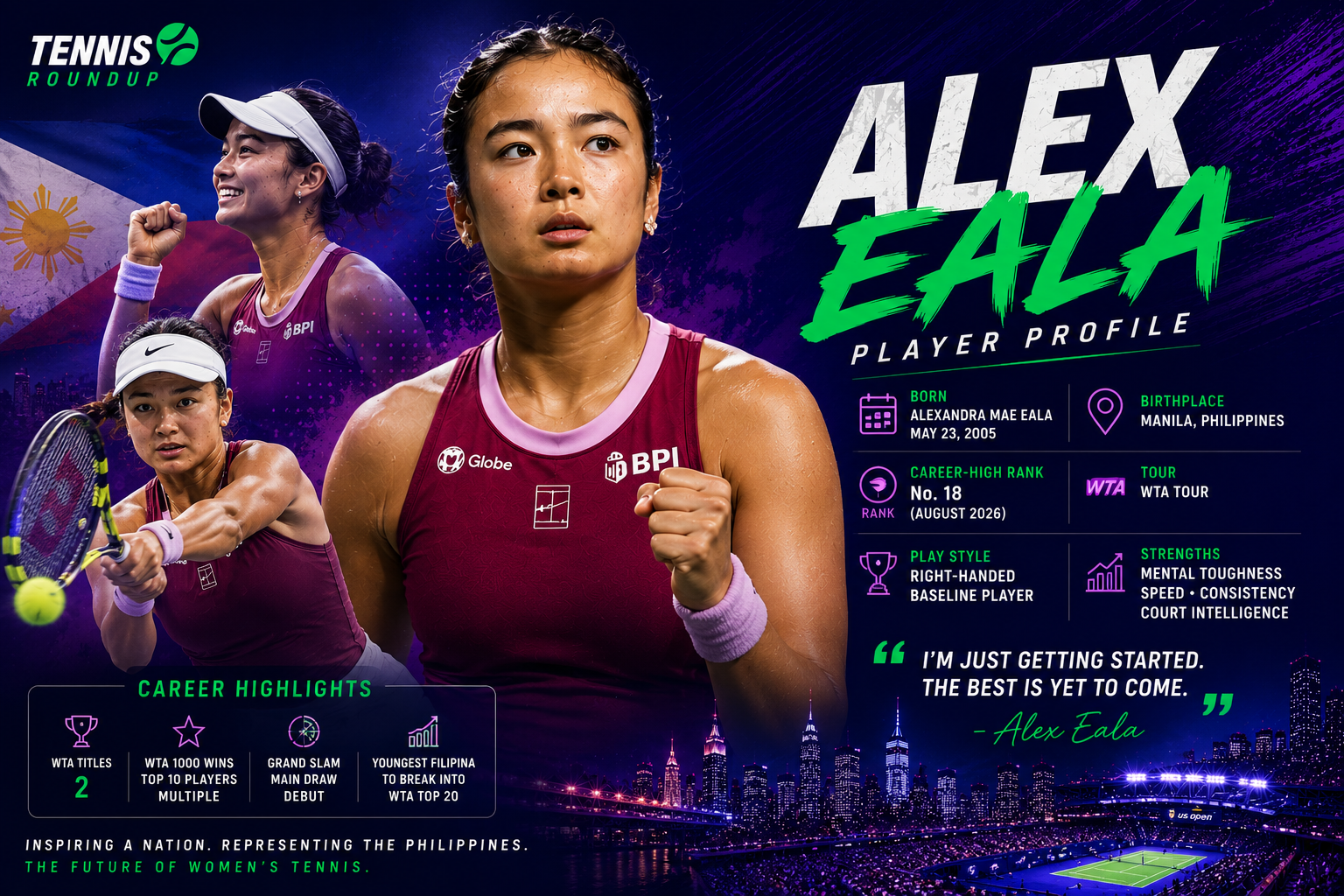
Alex Eala is also 21. She has never won a Grand Slam and enters the 2026 US Open ranked No. 18.
Yet in New York, Eala seems to be everywhere.
International publications are profiling her. Crowds are following her practices. Her appearance during US Open Fan Week drew enthusiastic Filipino support, and tournament organizers have placed her opening match against Mary Stoiana in a Louis Armstrong Stadium night session.
Even resale ticket prices for that session surged after the schedule was announced.
So why does Eala command this level of attention while players with greater tennis achievements sometimes receive considerably less?
The answer becomes clearer once we stop treating attention like another tennis ranking.
Rankings Measure Performance. Attention Measures Something Else.
There is no reasonable tennis argument that Eala has accomplished more than Noskova.
Noskova won Wimbledon in July, defeating Karolina Muchova in three sets to become the youngest women’s champion at the All England Club in 15 years. She arrived at the US Open as World No. 6 and a reigning Grand Slam champion.
Those achievements speak for themselves.
But rankings and tournament results are designed to measure competitive performance.
Media attention isn’t.
Neither are ticket sales, sponsorship opportunities, magazine invitations, television interest or the number of people waiting outside a practice court.
Those things respond to another collection of forces:
performance, personality, story, nationality, representation, audience, timing and marketability.
Eala happens to sit at an unusual intersection of almost all of them.
Eala Represents Something Bigger Than Her Ranking
For decades, the Philippines has produced internationally celebrated athletes.
Tennis has rarely been where those stories happened.
Eala changed that.
Her rise has already taken Filipino tennis into territory it had never previously reached. At the 2025 US Open, she became the first Filipino player in the Open Era to win a Grand Slam main-draw singles match. Twelve months later, she returns as a seeded player after climbing into the world’s Top 20.
That distinction matters.
A talented player emerging from a country with an established tennis tradition is another promising athlete.
A player becoming the first from her country to reach milestones that millions of people have never experienced before can become something else entirely.
She becomes a national story.
And the potential audience behind that story is enormous.
The Philippines has more than 100 million people, accompanied by a large global diaspora stretching across North America, Europe, the Middle East and Asia.
The Wall Street Journal recently described Eala’s following in precisely those terms: not merely as tennis fandom, but as a huge potential audience rallying around a Filipino athlete breaking new ground internationally.
That helps explain why a tournament in Washington, Toronto or New York can suddenly feel like Manila when Eala walks onto court.
The Crowds Are Becoming Measurable
This isn’t merely social-media enthusiasm.
Tournament organizers are seeing it themselves.
At the Mubadala Citi DC Open, tournament chairman Mark Ein said that at least 80 percent of ticket inquiries his team was receiving centered on when Eala would play.
The support followed her north to Canada.
And now it has reached New York.
Before the US Open began, Reuters reported packed Eala practice sessions and growing expectations that organizers would need to place her matches on courts capable of accommodating her following.
That’s exactly what happened.
US Open tournament director Eric Butorac said organizers knew her opening match needed to be placed in a major stadium. After Eala was scheduled at Louis Armstrong, he noted the rapid movement in secondary-market ticket prices for the session.
At some point, popularity stops being merely an online perception.
People are showing up.
Why Doesn’t Every Grand Slam Champion Generate the Same Attention?
Because sporting excellence and celebrity have never been perfectly correlated.
Some athletes dominate their sport without becoming global cultural figures.
Others capture an audience disproportionately large compared with their competitive achievements.
Usually, the biggest stars combine both.
Serena Williams wasn’t important simply because she accumulated ranking points.
Naomi Osaka became globally significant for reasons extending beyond her Grand Slam trophies.
Coco Gauff’s appeal isn’t reducible to her forehand and backhand.
The same principle operates throughout sport.
Performance creates legitimacy.
Story creates connection.
And connection is extraordinarily difficult to manufacture.
This is where comparisons between Eala and Noskova become misleading.
Noskova deserves considerably more credit as a tennis player if the comparison is based on their achievements today.
She’s a Wimbledon champion.
That does not automatically mean she should receive an identical amount of media coverage, sponsorship attention or fan interest.
Those aren’t prizes awarded according to the WTA rankings.
The US Open Itself Is Becoming More Than Tennis
There’s another factor working in Eala’s favor: timing.
Modern tennis tournaments—particularly the US Open—are increasingly becoming entertainment and cultural events rather than collections of matches.
Fashion, celebrities, influencers, food, hospitality and brands now surround the competition.
Vogue recently examined the rapidly growing creator economy surrounding major tennis tournaments, describing how events and sponsors increasingly use personalities and cultural connections to reach audiences beyond traditional tennis fans.
Eala fits naturally into that environment.
She’s young, multilingual, comfortable in interviews and connected to an audience that professional tennis has barely begun to tap.
From a tournament’s perspective, that’s enormously valuable.
A player capable of bringing existing tennis fans is good.
A player capable of bringing new tennis fans is potentially even more interesting.
None of This Guarantees Tennis Success
This is where the conversation needs balance.
Popularity doesn’t make Eala a better player than someone ranked above her.
Magazine covers don’t win matches.
Packed stadiums don’t award ranking points.
And sponsorships won’t carry somebody through the second week of a Grand Slam.
Eala still has to prove herself repeatedly against the best players in the world.
Her first challenge in New York is qualifier Mary Stoiana. If she wins, another challenge follows. Then another.
That’s professional tennis.
And the attention can eventually become a burden as much as an advantage.
Every early defeat becomes louder. Every expectation becomes larger. Every comparison becomes more unforgiving.
The same enormous audience that celebrates victories will inevitably debate losses.
Perhaps We’re Asking the Wrong Question
Instead of asking:
Why is Alex Eala getting more attention than Linda Noskova?
perhaps the more interesting question is:
Why has Alex Eala connected with so many people?
That question doesn’t require diminishing Noskova.
Nor does celebrating Noskova’s Wimbledon championship require dismissing Eala’s popularity as undeserved hype.
They’re simply different forms of success.
One is currently far ahead in Grand Slam achievement.
The other is demonstrating an unusual ability to bring an enormous new audience into women’s tennis.
And professional sport needs both.
Because trophies determine who becomes champion.
But sometimes a player arrives who makes people who weren’t watching before suddenly care about the game.
Alex Eala increasingly looks like one of those players.