
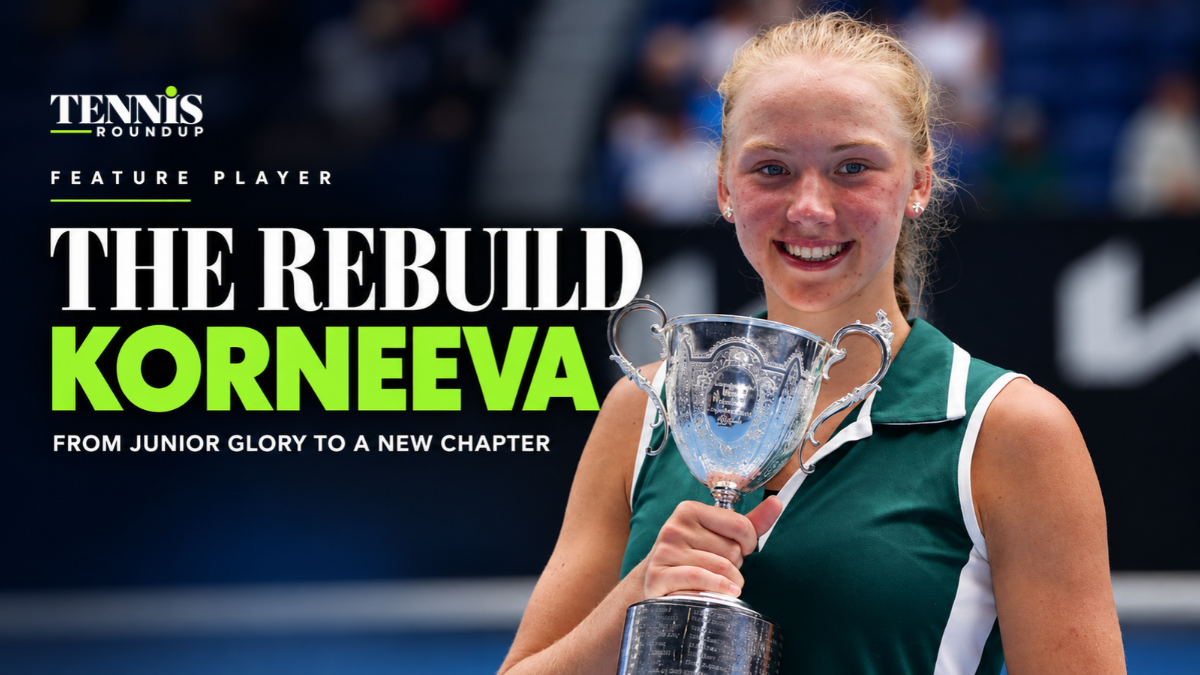
Alina Korneeva: The Junior Champion Rebuilding Her Place in Tennis
On August 7, 2026, Alina Korneeva defeated Iva Jovic 6–3, 6–4 at the Toronto Open. It was the Russian teenager’s first victory over a Top 20 player and sent her into the fourth round of a WTA 1000 tournament for the first time.
Jovic was 18 and ranked No. 16. Korneeva was 19, ranked No. 89, and had come through qualifying.
For anyone who remembered Korneeva’s junior career, the result was another sign of a talent that had once appeared ready to move quickly through professional tennis.
But the journey had been anything but straightforward.
Three years earlier, Korneeva had won the Australian Open and Roland-Garros girls’ singles championships, finished the season as the world’s leading junior and established herself among the most accomplished players of her generation.
Then injuries interrupted her progress.
Toronto was not the arrival of an unknown player. It was a reminder of a young player whose career had already required several fresh starts.
Who Is Alina Korneeva?
Born on June 23, 2007, in Moscow, Alina Korneeva is a Russian professional tennis player and former junior world No. 1.
She began playing tennis at six, entering the Spartak training system in Moscow. Her early development included work with Julia Bekeshchenko and later Andrey Savin. By late 2023, she had also begun working with former Spanish player Anabel Medina Garrigues at the Rafa Nadal Academy.
Her family had a sporting background. Her father, Aleksandr Korneeva, won an Olympic bronze medal in volleyball at Beijing 2008.
But Korneeva’s own sporting identity emerged through tennis.
By 2022, she had won six junior singles titles. In 2023, she began collecting the championships that would make her one of the most closely watched juniors in the sport.
Alina Korneeva’s Junior Breakthrough: Two Grand Slams in 2023
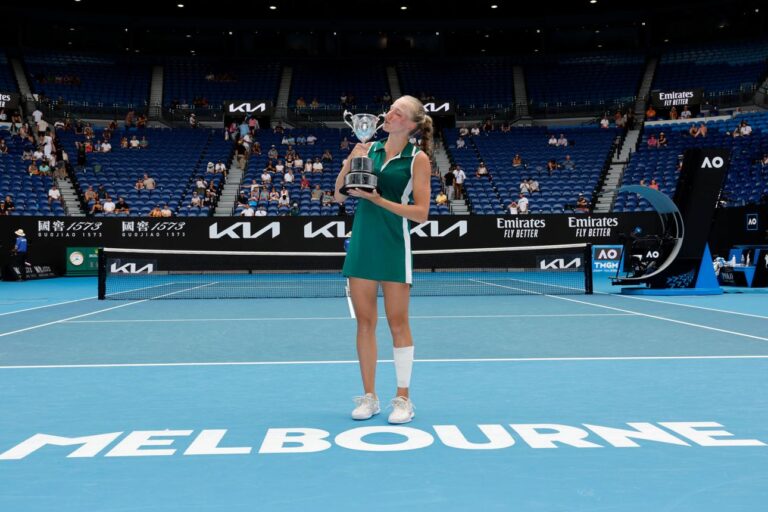
On January 28, 2023, Korneeva defeated another 15-year-old, Mirra Andreeva, 6–7(2), 6–4, 7–5 in the Australian Open girls’ singles final.
The match lasted three hours and 18 minutes.
Both players would eventually become important names in the next generation of women’s tennis, but at that moment, they were two teenagers competing for a junior Grand Slam championship.
Korneeva prevailed after losing the opening set, claiming her first junior Grand Slam singles title.
Less than five months later, she added another.
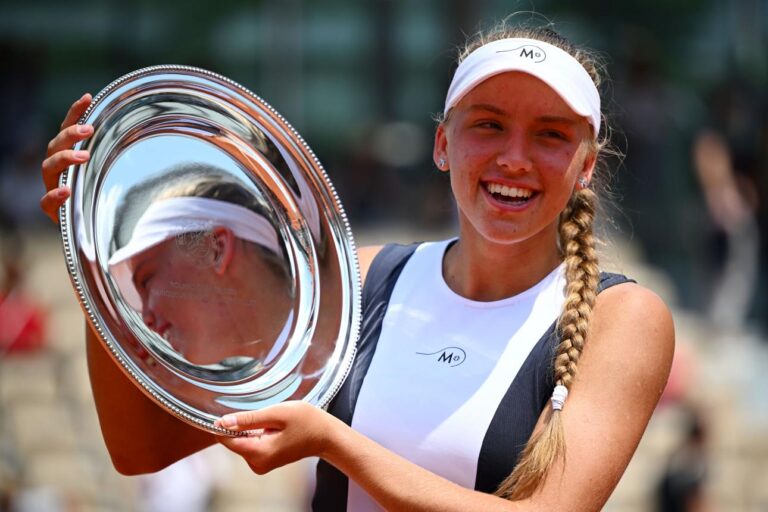
At Roland-Garros on June 10, 2023, she defeated Lucciana Pérez Alarcón 7–6(4), 6–3 to win the French Open girls’ singles title.
Winning on Melbourne’s hard courts and Paris’s clay demonstrated her ability to succeed under different conditions.
She also reached the Wimbledon girls’ semifinals, won the ITF Junior Finals in Chengdu and finished 2023 as the ITF girls’ World Champion and year-end junior No. 1.
It was a remarkable junior season.
But junior Grand Slam championships are not senior Grand Slam titles, and success at one level does not guarantee success at the next.
That distinction would become central to Korneeva’s story.
The Professional Climb Had Already Begun
Korneeva did not wait until her junior career ended to begin competing professionally.
She made her professional debut in 2021 and won her first ITF singles title at Casablanca in September 2022.
In March 2023, while still 15, she defeated Timea Babos to win the ITF W60 tournament in Pretoria.
Four months later, she claimed the W100 title in Figueira da Foz, defeating Carole Monnet 6–0, 6–0 in the final. The ITF identified her as the youngest W100 singles champion at the time.
Later that year, Korneeva made her WTA Tour main-draw debut in Hong Kong and defeated Valeria Savinykh in the opening round.
In January 2024, she qualified for her first senior Grand Slam main draw at the Australian Open, winning her opening match before losing to Beatriz Haddad Maia in the second round.
The transition was producing results.
But progress in professional tennis is rarely a straight line.
When Injuries Interrupted the Climb
In 2024, wrist tendon problems forced Korneeva away from competition. She underwent surgery in April and did not resume tournament play until September.
For a teenager trying to establish herself on the professional circuit, the interruption meant losing valuable opportunities to compete, gain experience and develop consistency.
She returned with encouraging results.
In September 2024, she won the ITF W100 title at Caldas da Rainha. Later that season, she reached her first WTA Tour semifinal in Mérida.
But another injury interrupted her development in 2025, this time involving her adductor.
Korneeva spoke openly about the difficulty of watching other players compete while she could not.
The challenge was no longer simply moving from junior tennis to the senior tour. It was rebuilding competitive rhythm after repeated absences.
Her response came through smaller tournaments and accumulated victories.
In September and October 2025, she won three consecutive ITF titles — Leiria, Évora and Bratislava. The ITF recorded 15 consecutive victories across those events.
They were not WTA 1000 trophies or Grand Slam breakthroughs.
They were evidence of a player finding her way back through competition.
Alina Korneeva’s 2026 Season: From Oeiras to Toronto
The rebuilding continued into 2026.
Korneeva won an ITF W75 title in Manama in January, then captured her first WTA 125 singles championship at Oeiras in February, defeating Darja Vidmanova 7–5, 6–1 in the final.
At Roland-Garros, she qualified for the senior main draw and reached the second round.
On June 8, 2026, she entered the WTA Top 100 for the first time, at No. 96.
Her Wimbledon campaign ended in the first round, but she subsequently reached a WTA Tour semifinal in Athens.
Then came Toronto.
She arrived ranked No. 89 and began in qualifying.
Her main-draw campaign opened with a victory over Polina Kudermetova, who retired while trailing 6–0, 3–0.
Next came Emma Navarro, the No. 23 seed.
Korneeva won 6–2, 6–2, recording her first victory over a Top 30 opponent.
Two days later, she faced Iva Jovic.
Toronto 2026: When Two Teenagers Met
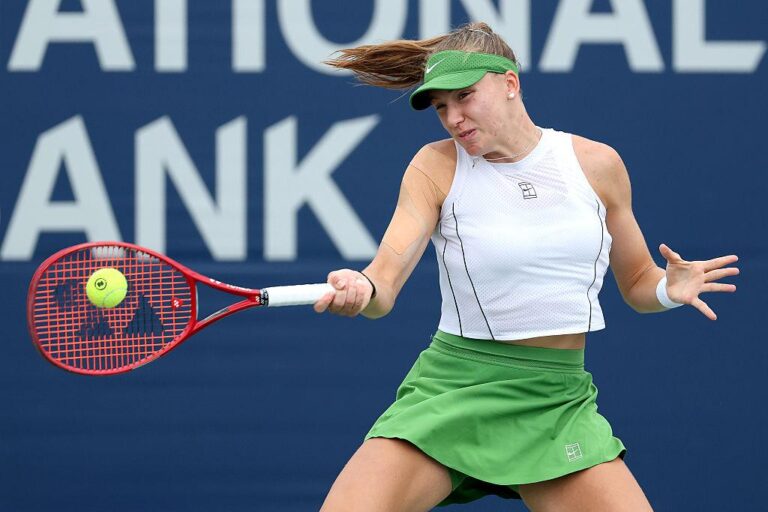
The third-round meeting brought together two players born in 2007 but at different stages of their professional development.
Jovic had already won a WTA Tour singles title in Guadalajara in 2025 and arrived in Toronto ranked No. 16.
Korneeva was still seeking her first Top 20 victory.
On August 7, Korneeva won 6–3, 6–4 in one hour and 22 minutes.
Her return game played an important role. She won 33 of 55 return points and converted seven of eight break-point opportunities.
But the numbers also revealed that the victory was not technically flawless. Korneeva won only four of 16 points behind her second serve.
It was a meaningful win, not evidence that every part of her game had reached the same level.
More importantly, the result came after her victory over Navarro.
For the first time, Korneeva had defeated Top 30 and Top 20 opponents in consecutive rounds at a WTA 1000 tournament.
Tennis Roundup had already identified her as a player to watch during the Toronto tournament.
In our Toronto Day 6 roundup, we observed that junior success guaranteed nothing at WTA level and that her run mattered because she was beginning to demonstrate repeatability.
The next test was even harder.
Coco Gauff Provided the Next Measure
On August 9, Korneeva faced Coco Gauff in the fourth round.
Gauff won 6–3, 6–1.
The result ended Korneeva’s Toronto campaign, but the match provided another opportunity to assess her game against established elite opposition.
Afterward, Gauff praised Korneeva’s ability to put returns into play, move around the court and show variety with her hands and forward movement.
Those observations reinforced some of the qualities visible in Korneeva’s earlier performances.
They did not erase the gap between reaching a WTA 1000 fourth round and consistently competing at the highest level.
Toronto gave Korneeva a significant milestone. It also showed her what the next stage required.
How Does Alina Korneeva Play?
Korneeva’s game has shown an emphasis on return consistency, court coverage and the ability to change direction during rallies.
Her junior performances demonstrated variety, including sharp backhand angles and a willingness to move forward.
During her early professional development, she also described working toward a more aggressive playing style with Medina Garrigues.
Against Jovic in Toronto, her return pressure helped create frequent opportunities to break serve.
Against Gauff, she faced an opponent capable of testing her movement, shot selection and ability to sustain that pressure.
The evidence points to a player with several useful tools and a game still developing against stronger opposition.
A single tournament cannot settle questions about her ultimate playing identity.
That will emerge through repeated performances over time.
What Happened After Toronto?
Korneeva’s season continued with a first-round US Open defeat to Madison Keys, 7–5, 6–4.
In September, she reached the semifinals of the Korea Open in Seoul, her third WTA Tour semifinal after Mérida and Athens.
Her campaign ended when she retired against Maya Joint with Joint leading 6–2, 1–0.
She was subsequently scheduled to make her China Open debut in Beijing but withdrew with a thigh injury before playing a match.
The research available as of October 9 does not establish whether the Seoul retirement and Beijing withdrawal involved the same injury.
Her progress and the interruptions to it remained part of the same developing career.
Alina Korneeva Career Achievements
Verified through October 9, 2026. Junior and senior achievements are listed separately.
| Achievement | Record |
|---|---|
| Birth date | June 23, 2007 |
| Junior Grand Slam singles titles | 2 — Australian Open and Roland-Garros, 2023 |
| ITF Junior Finals | Champion, 2023 |
| Junior year-end ranking | World No. 1, 2023 |
| ITF senior singles titles | 8 |
| WTA 125 singles titles | 1 — Oeiras, 2026 |
| WTA Tour singles titles | 0 |
| Best senior Grand Slam singles result | Second round — Australian Open 2024 and Roland-Garros 2026 |
| First WTA 1000 fourth round | Toronto 2026 |
| First Top 20 victory | Iva Jovic, Toronto 2026 |
| Career-high singles ranking | No. 67, August 24, 2026 |
These numbers represent different levels of competition. Korneeva’s junior Grand Slam championships are significant achievements, but they should not be counted as senior Grand Slam titles.
What Comes Next for Alina Korneeva?
At 19, Korneeva has already experienced several different versions of a young tennis career.
She has been a dominant junior, an emerging professional, a player sidelined by injuries and a competitor working her way back through ITF and WTA events.
Toronto demonstrated that she could defeat established opponents at WTA 1000 level.
Seoul offered further evidence that she could reach the later stages of tour-level tournaments.
But the question ahead is not whether she can reproduce her junior achievements immediately.
It is whether she can remain healthy, compete consistently and continue translating her ability into results against stronger fields.
Her career does not need to follow the path of Mirra Andreeva, Iva Jovic or any historical teenage champion.
Those players provide context, not a timetable.
Korneeva’s own story is still being written.
And Toronto gave us a compelling reason to keep following it.
Sources & Further Reading
Here is the recommended section to add at the bottom of the article. I’ve selected nine official sources, arranged chronologically and by editorial relevance.
- Australian Open — Korneeva Wins the 2023 Junior Final — Her victory over Mirra Andreeva, including the score and match duration.
- Roland-Garros — Back-to-Back Junior Grand Slam Titles — Her second junior major championship, against Lucciana Pérez Alarcón.
- ITF — Korneeva Named 2023 Junior World Champion — Her junior No. 1 ranking, ITF Junior Finals title and breakthrough season.
- ITF — Youngest W100 Champion in History — Her professional breakthrough at Figueira da Foz in 2023.
- ITF — Korneeva Returns After Seven Months Away — Her 2024 wrist surgery and comeback victory in Portugal.
- ITF — Third Consecutive Title in Bratislava — Her 2025 recovery, three tournament victories and 15-match winning streak.
- WTA — After Injury Setbacks, Korneeva Rebuilds Her Career — A particularly valuable August 2026 player interview covering her injuries, personality and Toronto breakthrough.
- WTA — Korneeva vs. Jovic, Toronto 2026 Official Match Results — Confirms her 6–3, 6–4 victory on August 7, 2026.
- WTA — Toronto 2026 Tournament Review — Documents Korneeva’s victories over Emma Navarro and Iva Jovic and her fourth-round loss to Coco Gauff.