
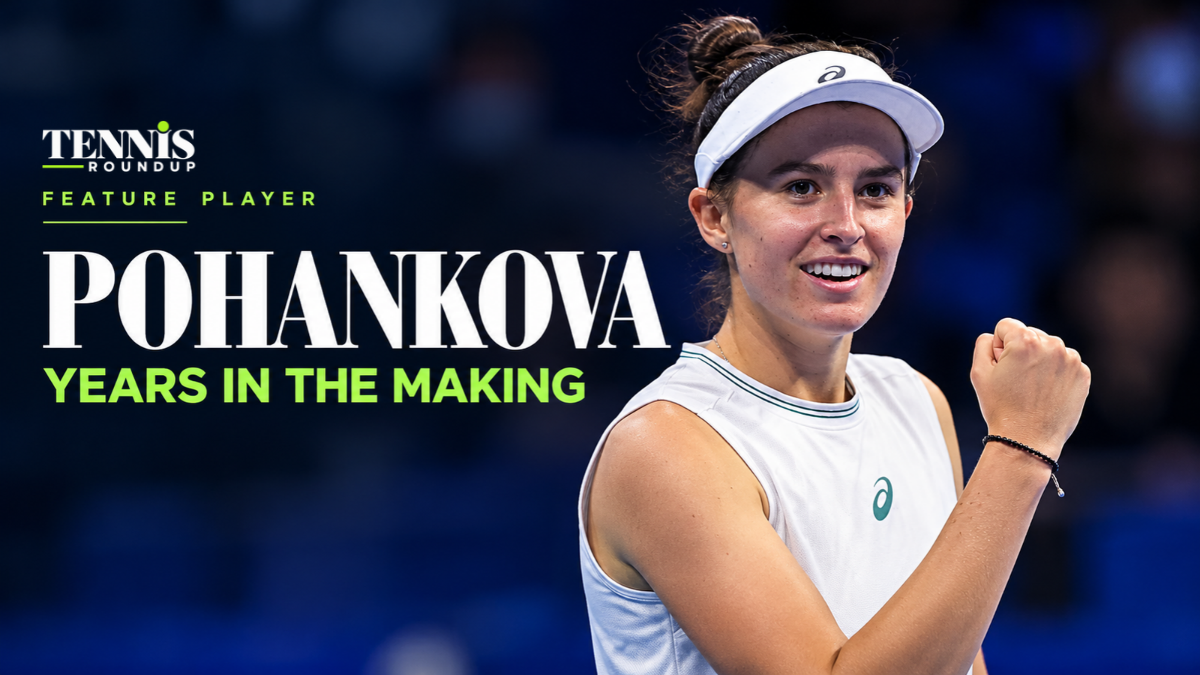
Mia Pohankova: The Breakthrough That Was Years in the Making
At 18, Mia Pohankova has reached her first WTA Tour semifinal after defeating Naomi Osaka at the Toray Pan Pacific Open. But the Slovak teenager’s rise began long before Tokyo—and her biggest junior achievement came after she had already won a professional title.
Tokyo Finally Noticed
Naomi Osaka had won four Grand Slam singles titles. Mia Pohankova was playing in only her fourth WTA Tour main draw.
On October 29, 2026, the two met in the second round of the Toray Pan Pacific Open in Tokyo.
Osaka, ranked World No. 18, was the established champion. Pohankova, an 18-year-old Slovak wildcard ranked No. 144, was still introducing herself to the wider tennis audience.
Ninety-five minutes later, Pohankova had won 6–3, 7–5.
It was the biggest victory of her young professional career.
The teenager had recovered from an early 0–2 deficit, held her nerve through a competitive second set and secured the decisive break in the final game.
But the victory was not an isolated moment.
Two days earlier, Pohankova had defeated fellow junior Grand Slam champion Tereza Valentova 6–1, 6–4.
And on October 30, she followed her Osaka victory by beating American qualifier Alycia Parks 7–6(3), 6–3, advancing to her first WTA Tour semifinal.
Three matches. Three victories. Six sets won. None lost.
For many tennis followers, Tokyo was their introduction to Mia Pohankova.
For those who had followed her development, the signs had been appearing for years.
Before Wimbledon, There Was Bratislava
The conventional story of a teenage tennis prospect often begins with junior success.
A promising player wins a junior Grand Slam, attracts attention and begins the difficult transition toward professional competition.
Pohankova’s journey followed a different sequence.
She won her first senior professional title before becoming a junior Grand Slam champion.
In October 2024, eight days before her 16th birthday, Pohankova entered the ITF W75 tournament in Bratislava as a wildcard.
It was only her third professional tournament.
Yet she advanced all the way to the final, where she defeated fellow Slovak prospect Renata Jamrichova 2–6, 6–4, 6–2.
The victory gave Pohankova her first senior singles title at just 15.
It also offered early evidence that her abilities were beginning to translate beyond junior competition.
During the same tournament, she defeated established French player Océane Dodin, then ranked inside the world’s Top 100.
The Bratislava title was significant for another reason.
Pohankova and Jamrichova were developing within the same Slovak tennis environment. Their paths would remain connected as both pursued success on the international junior stage.
But for Pohankova, the professional breakthrough had already arrived.
The junior Grand Slam trophy would come nine months later.
Mia Pohankova: From Levice to the International Stage
Mia Pohankova was born on October 21, 2008, and grew up in Levice, Slovakia.
Tennis entered her life early.
She began playing at four years old, developing her game in Levice before moving to stronger training environments as her potential became clearer.
Sport was already part of the family.
Her father, Ľuboš Pohánka, had played professional basketball, while her older brother, Jakub, also pursued basketball.
Mia chose tennis.
At approximately 11, she moved to the Empire Tennis Academy in Trnava, where she worked with coach Róbert Gašparetz.
In December 2022, she continued her development at Slovakia’s National Tennis Centre in Bratislava.
These moves reflected an increasingly demanding training pathway.
From local tennis in Levice, Pohankova progressed toward national-level facilities, stronger competition and the international junior circuit.
Her family helped support those transitions, including the practical arrangements required for training away from home.
There is no need to invent a dramatic childhood struggle to explain her progress.
The documented story is one of sustained development, family support and increasingly competitive environments.
And through those changes, Gašparetz remained an important figure in her tennis journey.
The Wimbledon Champion Who Wanted More
By 2025, Pohankova was establishing herself among the leading junior players in international tennis.
She reached the Australian Open girls’ singles semifinals in January, losing a close three-set match to Kristina Penickova.
But her defining junior achievement came at Wimbledon.
In July 2025, Pohankova entered the girls’ singles competition unseeded.
Her path included victories over several accomplished junior opponents, including Mika Stojsavljevic, Ksenia Efremova and top seed Emerson Jones.
She lost only one set throughout the tournament.
In the final, she defeated American Julieta Pareja 6–3, 6–1, becoming the 2025 Wimbledon girls’ singles champion.
It was another important moment for Slovak tennis.
A year earlier, Renata Jamrichova had won the same title.
Now Pohankova had followed her.
According to the International Tennis Federation, Pohankova became the fifth Slovak player to win a junior Grand Slam singles championship.
But even while celebrating her achievement, she was already thinking about the senior game.
Speaking to the ITF after her Wimbledon victory, she made her ambition clear:
“I need to win the real Wimbledon, not just juniors.”
It was an expression of ambition, not a guarantee of what would follow.
Winning junior Wimbledon had confirmed her ability at that level.
The challenge was proving herself against established professionals.
Building a Professional Career Beyond Junior Success
Pohankova’s transition to the professional tour did not begin in Tokyo.
Nor did it begin after Wimbledon.
Her first WTA Tour main-draw appearance came in Chennai in October 2025.
There, she defeated Nao Hibino and Diane Parry before losing to Janice Tjen in the quarterfinals.
The tournament gave her valuable experience competing against established professionals.
She carried that development into 2026.
In January, Pohankova won her second senior ITF singles title at W75 Leszno, defeating Julia Avdeeva 6–3, 6–2 in the final.
She then reached the W100 Wiesbaden final in early May.
In June, she produced another notable result on grass, defeating Clara Tauson 6–4, 6–4 at ‘s-Hertogenbosch.
Tauson was ranked World No. 24 at the time.
It was Pohankova’s highest-ranked WTA Tour victory before she faced Osaka in Tokyo.
Her progress continued through the second half of the season.
In September, she reached WTA 125 semifinals in Caldas da Rainha and Porto.
The Porto tournament also provided an example of her ability to recover under pressure.
Against Katie Swan in the quarterfinals, Pohankova trailed 3–6, 3–5 and faced two match points.
She recovered to win 3–6, 7–5, 6–1.
It was one match, not proof that she would always thrive under pressure.
But it demonstrated a quality that would become relevant again in Tokyo: the ability to respond when a match begins moving against her.
Wuhan Was the Warning Before Tokyo
Just two weeks before her Tokyo breakthrough, Pohankova had already made an impression at the Wuhan Open, a WTA 1000 tournament.
It was her first appearance at that level.
She defeated Anna Bondar 6–1, 6–3 in her opening match.
Then came a more demanding test against China’s Wang Xiyu.
Pohankova won the first set in a tiebreak, lost the second after another tiebreak and recovered to take the deciding set.
The final score was 7–6(2), 6–7(7), 6–1.
The victory carried her into the last 16.
Her run ended against former World No. 3 Maria Sakkari, who won 6–1, 6–4.
Wuhan did not produce a semifinal or a title.
But it showed that Pohankova was beginning to win matches at a level considerably higher than the ITF events where she had built her professional foundation.
By the time she arrived in Tokyo, the evidence was accumulating.
The breakthrough was becoming less surprising—even if its scale remained unexpected.
What Tokyo Changed for Mia Pohankova
Pohankova arrived at the Toray Pan Pacific Open ranked World No. 144.
She entered the WTA 500 tournament as a wildcard.
Her first opponent was Tereza Valentova, another player whose junior Grand Slam achievements had created expectations.
Pohankova won comfortably.
Then came Osaka.
The four-time major champion presented a different kind of challenge: experience, power and the ability to compete on the sport’s biggest stages.
Pohankova’s 6–3, 7–5 victory was her first against a Top-20 opponent.
Against Parks in the quarterfinals, she encountered another test.
After winning the opening set in a tiebreak, she recovered from an early second-set deficit and closed out the match in straight sets.
The result secured her first WTA Tour semifinal.
As of this writing, her official ranking remains No. 144, while live projections following her quarterfinal victory suggest a substantial improvement.
The ranking numbers will change.
The milestone will not.
At 18, Mia Pohankova had reached her first WTA semifinal by defeating three opponents without dropping a set.
Tokyo had given her something that earlier achievements could not provide on the same scale: wider recognition.
But it had not created the player who earned those victories.
What Makes Mia Pohankova a Player to Watch?
It is tempting to describe every emerging teenager as fearless, powerful or destined for greatness.
Pohankova’s results deserve a more careful assessment.
What we can establish is that she has already succeeded across several competitive levels.
She has won senior ITF titles, competed in WTA 125 semifinals, reached the last 16 of a WTA 1000 tournament and advanced to a WTA 500 semifinal.
She has also demonstrated the ability to recover from difficult situations in individual matches.
Her comeback against Swan in Porto, three-set victory over Wang Xiyu in Wuhan and composed finishes against Osaka and Parks provide specific examples.
However, detailed conclusions about her technical strengths remain premature.
The available evidence does not yet establish that she possesses an elite serve, an exceptional forehand or a particular tactical signature.
Those assessments require more sustained observation.
Her most convincing quality so far is not a single spectacular shot. It is the progression of her results.
And that progression has become increasingly difficult to ignore.
The Next Chapter Is About Consistency
Pohankova’s Tokyo performance is a genuine breakthrough.
But a breakthrough and an established career are different things.
Before Tokyo, she had played only three WTA Tour main draws.
She had not yet appeared in a senior Grand Slam singles main draw.
Her strongest achievements were spread across junior competition, the ITF circuit and a relatively small number of WTA appearances.
That is not a criticism.
It is the reality of an 18-year-old player still developing her professional career.
The next challenge will be reproducing her best tennis across more tournaments, against stronger opponents and under greater expectations.
A victory over Osaka demonstrates that she can defeat an established champion.
It does not establish how often she will do so.
A semifinal appearance confirms that she can compete deep into a WTA 500 tournament.
It does not guarantee that she will immediately become a regular contender.
Those questions remain unanswered.
And they are precisely what makes the next stage of her career interesting.
Mia Pohankova’s Story Is Only Beginning
In 2024, Mia Pohankova won a professional tournament before turning 16.
In 2025, she became a junior Wimbledon champion.
In 2026, she began collecting victories at increasingly demanding levels of professional tennis.
Then came Tokyo.
For a wider audience, the victory over Naomi Osaka may become the moment her name first entered the conversation.
But the foundations were already there.
The training in Levice, Trnava and Bratislava.
The early professional title.
The Wimbledon triumph.
The victories at ITF and WTA events.
The matches that taught her what competing against stronger opposition required.
Tokyo was not the beginning of Mia Pohankova’s story.
It was the moment more people began paying attention.
And now comes the question that will define her next chapter:
How far can she take what she has already built?