
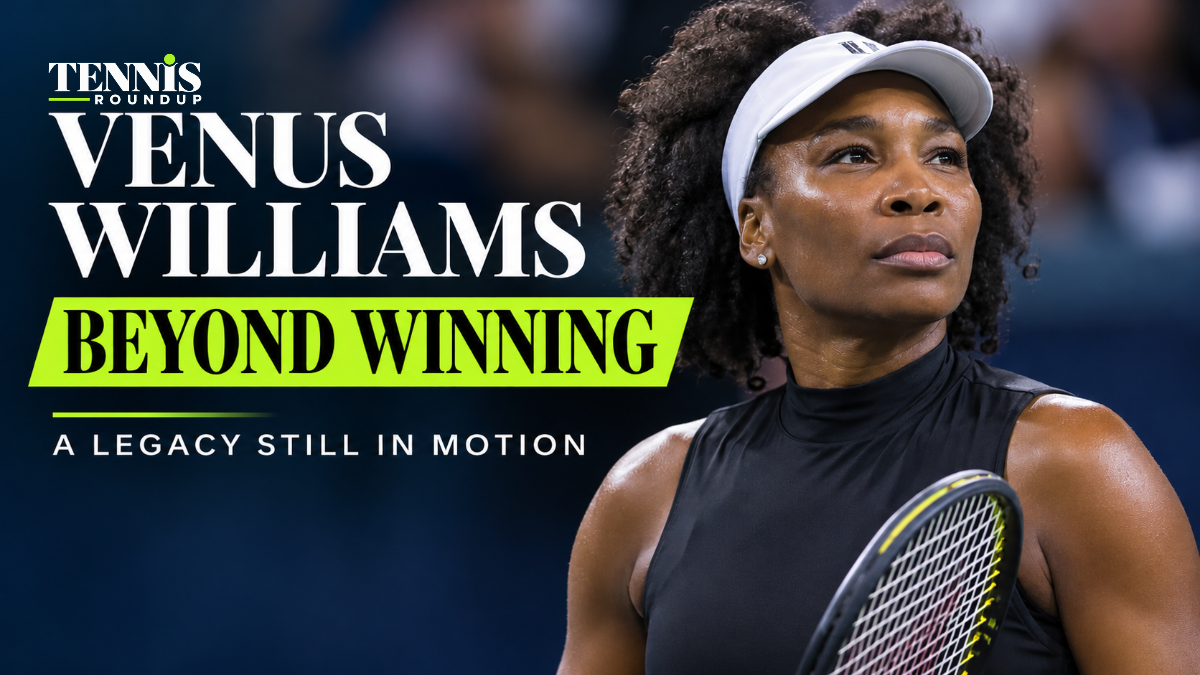
Venus Williams: Feature Player
Venus Williams: Beyond Winning
At 46, Venus Williams has won almost everything tennis can offer. But after 17 consecutive singles defeats, her decision to keep competing raises a question that cannot be answered by results alone.
On November 2, 2026, Venus Williams walked onto the court at the Hong Kong Open to face Mary Stoiana.
For much of her career, a Venus Williams appearance meant watching one of the most formidable competitors in women’s tennis. Her powerful serve, aggressive groundstrokes and extraordinary movement had helped her conquer Wimbledon, the US Open and the Olympic Games.
This time, the result told a different story.
Stoiana defeated Williams 6–2, 6–3, extending the American’s run to 17 consecutive completed singles defeats since her last victory in July 2025.
At 46, Williams was no longer collecting titles or climbing toward the top of the rankings. She was accepting wildcards, returning to practice and facing opponents from generations that had grown up watching her play.
For some observers, the question seemed obvious.
Why continue?
Yet that question assumes that a champion’s relationship with tennis must end when victories become scarce.
Venus Williams’ career suggests something more complicated.
The Venus Williams Story Began Long Before the Championships
Born on June 17, 1980, in Lynwood, California, Venus Ebony Starr Williams grew up in a family whose ambitions extended far beyond conventional expectations.
Her development became closely associated with the public tennis courts of Compton, where her parents, Richard Williams and Oracene Price, played important roles in shaping the tennis futures of Venus and her younger sister, Serena.
Their pathway was unusual.
Rather than following an uninterrupted schedule of junior tournaments, the family increasingly emphasized training and education. The sisters developed their games away from much of the traditional junior competition structure.
Venus was introduced to a sport in which Black women had already established an important history, notably through Althea Gibson and Zina Garrison.
Years later, Venus would recall following Garrison’s run to the 1990 Wimbledon final while practicing as a child.
The ambition was there early.
But so was the understanding that becoming a champion would require years of work, setbacks and belief.
A Professional Debut at Fourteen
On October 31, 1994, Venus made her professional debut in Oakland.
She defeated Shaun Stafford in her opening match before losing to Arantxa Sánchez Vicario.
The result was modest compared with what followed, but the attention surrounding her arrival was extraordinary.
Here was a 14-year-old American whose reputation had developed without a conventional junior tournament résumé.
Three years later, she reached the 1997 US Open singles final in her first appearance at the tournament.
Martina Hingis defeated her for the championship.
For Venus, the final was both a breakthrough and a reminder of the distance between promise and achievement.
Her first WTA singles title followed in Oklahoma City in March 1998.
The transformation from highly anticipated teenager to established champion was underway.
Wimbledon 2000: When Venus Williams Reached the Summit
On July 8, 2000, Venus defeated Lindsay Davenport 6–3, 7–6(3) to win her first Wimbledon singles championship.
It was the defining achievement of her early career.
The powerful teenager who had entered professional tennis amid enormous expectations was now a Grand Slam champion.
She followed that triumph by defeating Davenport again in the US Open final that September.
Then came the Sydney Olympic Games, where she captured gold medals in both singles and women’s doubles, partnering Serena.
In a matter of months, Venus had become one of the dominant figures in women’s tennis.
But something she said after winning Wimbledon is particularly revealing when viewed from 2026.
“You realise that winning isn’t everything.”
Venus made that observation in her July 2000 Wimbledon press conference while discussing Serena’s earlier US Open success and happiness beyond tennis.
It matters because the idea that life contains something beyond winning was not a lesson Venus discovered only after her victories became less frequent.
She was already considering it when she stood at the beginning of her championship years.
That distinction changes how we understand the player still competing more than a quarter-century later.
Seven Grand Slam Singles Titles and a Career That Changed Tennis
Venus ultimately won seven Grand Slam singles championships: five at Wimbledon and two at the US Open.
Her major singles titles came in 2000, 2001, 2005, 2007 and 2008.
She also reached nine additional major singles finals, giving her 16 appearances in Grand Slam singles championship matches.
On February 25, 2002, Venus became the world’s No. 1 singles player, the first Black woman to lead the computerized WTA singles rankings.
Across her career, she accumulated 49 WTA singles titles.
Those achievements alone would secure her place among the sport’s great champions.
But the numbers tell only part of her influence.
The Power That Helped Define an Era
Venus brought a formidable combination of height, reach, movement and attacking tennis to the women’s game.
Her serve could establish immediate control of a point. Her groundstrokes could force opponents into defensive positions. Her movement allowed her to cover the court with an athleticism that challenged established expectations.
She was not the inventor of powerful women’s tennis. Earlier champions and contemporaries had already contributed to its development.
But Venus became one of the defining figures of an increasingly physical, aggressive era.
Her presence changed what opponents had to prepare for.
And her influence extended far beyond the baseline.
Venus and Serena: Rivals, Partners and Sisters
Any account of Venus Williams must include Serena Williams.
But their story cannot be reduced to Serena’s achievements or Venus’s role in helping her younger sister succeed.
Both became extraordinary champions.
They competed against one another in nine Grand Slam singles finals, with Venus winning two and Serena seven.
Their rivalry placed two sisters at the center of women’s tennis during some of its most important championship moments.
At the same time, they built one of the greatest doubles partnerships in the sport’s history.
Together, Venus and Serena won 14 Grand Slam women’s doubles titles, completing the career Grand Slam as a team.
Venus also reached world No. 1 in doubles in 2010.
Their Olympic partnership produced three women’s doubles gold medals, while Venus’s singles gold in Sydney brought her personal Olympic total to four gold medals.
She later added mixed doubles silver with Rajeev Ram at Rio 2016.
The sisters’ shared achievements were remarkable because they combined two relationships that professional sport often keeps separate: fierce competition and close partnership.
Their careers followed different paths, but each became an essential part of the other’s tennis history.
And even in 2026, their partnership was not confined to memory.
The sisters reunited in doubles at Cincinnati and the US Open, adding another chapter to a relationship that had already spanned decades.
Venus Williams and the Fight for Equal Prize Money
Some of Venus Williams’ most consequential victories did not appear on a scoreboard.
During the 2000s, she became an influential public advocate for equal prize money at Grand Slam tournaments.
Her efforts included addressing tennis decision-makers in 2005 and publishing a prominent newspaper essay in 2006.
Wimbledon introduced equal prize money for men and women in 2007.
That summer, Venus won the women’s singles championship.
The symbolism was powerful: one of the sport’s leading advocates for equality became champion in the first year Wimbledon awarded equal prize money.
Her contribution was part of a longer campaign involving many players, advocates and institutions.
The US Open had already introduced equal prize money in 1973, while Roland Garros completed its equalization across rounds in 2007.
Venus did not accomplish the transformation alone.
But she used her standing as a champion to help advance an issue whose significance extended beyond her own earnings.
Her legacy was becoming larger than the trophies she collected.
The Challenges Behind the Champion
Great careers are often remembered through their victories.
The years between those victories can be more revealing.
In August 2011, Venus withdrew from the US Open and publicly disclosed a recent diagnosis of Sjögren’s syndrome, a condition she said had been associated with fatigue and joint pain.
It introduced a new dimension to a career already marked by demanding physical competition.
The diagnosis did not end her achievements.
She won the WTA Elite Trophy in 2015, returned to the Top 10 and captured her 49th WTA singles title in Kaohsiung in February 2016.
In 2017, she reached both the Australian Open and Wimbledon singles finals.
At the Australian Open, Serena defeated her for the championship. At Wimbledon, Garbiñe Muguruza prevailed.
Venus was 37 when she reached that Wimbledon final.
It was evidence that her championship-level tennis had endured long after many players would have left the tour.
But subsequent seasons became increasingly interrupted.
Another Health Challenge, Another Return
In July 2025, Venus publicly discussed undergoing surgery for uterine fibroids in July 2024.
She described the difficulty of having her symptoms appropriately recognized and later spoke about gradually rebuilding her physical capacity.
Her return to tournament tennis followed a 16-month absence from tour competition after Miami 2024.
The preparation was not simply a matter of deciding to enter another tournament.
She had to rebuild the amount of time she could spend practicing and preparing for competition.
Her experience with fibroids was separate from her earlier Sjögren’s diagnosis. Neither medical history establishes the cause of any particular defeat in 2026.
What the documented record does show is that returning to competition required a deliberate rebuilding process.
Washington 2025: One More Singles Victory
On July 22, 2025, Venus Williams defeated Peyton Stearns 6–3, 6–4 in Washington.
She was 45.
It was her first singles victory since Cincinnati in August 2023 and made her the oldest woman to win a tour-level singles match since Martina Navratilova’s Wimbledon victory in 2004.
The achievement did not signal a return to the top of women’s tennis.
But it was a genuine competitive success.
Venus had returned after surgery, rebuilt her preparation and defeated an established tour opponent.
Two days later, Magdalena Fręch beat her in straight sets.
That defeat began the singles losing streak that would extend through Hong Kong in November 2026.
The Washington victory and the losses that followed belong to the same story.
One demonstrates that Venus could still win a tour-level singles match.
The others reveal how difficult sustaining that level had become.
Venus Williams in 2026: Seventeen Defeats, but Not Seventeen Identical Stories
By November 2, 2026, Venus had lost 17 consecutive completed singles matches.
Three came after her Washington victory in 2025. The remaining 14 occurred during 2026.
Her opponents included Magda Linette, Tatjana Maria, Olga Danilović, Ajla Tomljanović, Diane Parry, Francesca Jones and Sofia Kenin.
Some matches ended decisively.
Others were more competitive.
At the Australian Open, Venus took the opening set against Danilović before losing in three.
At Bad Homburg, she pushed Irina-Camelia Begu to a deciding-set tiebreak.
At Guangzhou, she lost to emerging teenager Lilli Tagger before traveling to Hong Kong, where Stoiana handed her the seventeenth defeat.
The record cannot be dismissed.
Professional tennis is competitive, and results remain an important measure of performance.
Seventeen consecutive singles defeats represent a sustained absence of singles victories.
Yet describing Venus’s entire 2026 season as a year without winning would also be inaccurate.
The Doubles Results Tell Another Part of the Story
Through November 3, Venus had compiled a 5–11 record in women’s doubles during 2026.
She reached the quarterfinals at Bad Homburg with Alexandra Eala and at Washington with Diana Shnaider.
At Guangzhou, she partnered Janice Tjen and reached the semifinals.
She also competed alongside Leylah Fernandez, Katie Boulter and Serena Williams during the season.
Those results did not erase her singles struggles.
But they demonstrated that her competitive participation extended beyond the losing streak that dominated discussion of her return.
There was still preparation, partnership and match-winning tennis in another discipline.
The distinction matters.
The Wildcard Question: Should Venus Williams Keep Receiving Invitations?
Venus’s continued appearances have also raised a legitimate debate about tournament opportunities.
During 2026, she accepted and played 14 singles main-draw wildcards, including invitations to the Australian Open and US Open.
Critics have questioned whether repeated invitations to a former champion with limited recent singles success might be better used to support younger players.
Supporters point to her extraordinary career, her continuing appeal to spectators and the value of bringing an iconic champion back to competition.
Both perspectives deserve examination.
Under the 2026 WTA rules, former Grand Slam singles champions qualify for an exception to the ordinary numerical restriction on singles wildcards. Grand Slam entries are governed separately.
Venus’s invitations therefore cannot be characterized as a breach of the ordinary wildcard limit.
But eligibility does not settle the broader question of how tournament organizers should allocate opportunities.
A wildcard can recognize a returning champion, encourage a developing player or generate interest in an event.
The tournament makes that choice.
Venus decides whether she wants to accept the invitation.
The results then determine what happens on court.
There is no need to pretend that all three considerations always point toward the same answer.
Respecting Venus’s right to pursue competition does not require ignoring the competitive questions surrounding her invitations.
Equally, criticizing a tournament’s wildcard decision does not establish that Venus herself has done anything improper.
Beyond Tennis: A Life With More Than One Ambition
Venus Williams has pursued substantial interests outside professional competition.
She founded the interior-design business V Starr in 2002 and developed fashion work through EleVen.
She also pursued higher education, completing a Bachelor of Science in Business Administration through Indiana University East in 2015.
In September 2024, she published Strive, a book exploring approaches to personal well-being.
Her public work has also included advocacy for equal prize money and discussion of women’s health.
These activities reveal a life containing more than tournaments and rankings.
But they do not prove that tennis has become unimportant to her.
If anything, they make the question of her continued participation more interesting.
A woman with accomplishments and pursuits beyond professional sport still chooses to prepare for matches and enter tournaments.
The evidence does not establish a private reason for that decision.
It does, however, challenge the assumption that continuing to play must mean having nothing else to do.
What Does Winning Mean to Venus Williams Now?
In July 2025, before her return to competition in Washington, Venus spoke about enjoying the experience and getting the best from herself.
She said:
“My personal goal is to have fun”
But in the same answer, she made another point equally clear:
“Of course I love winning. I want to win.”
Those statements should be read together.
Venus was not announcing that victories no longer mattered.
She was describing a relationship with competition in which enjoyment and ambition could coexist.
In March 2026, after losing at Indian Wells, she acknowledged another reality:
“Of course losing isn’t fun”
And in Toronto that August, she spoke about finding joy in the process while continuing to describe the work and focus required.
There is no contradiction in those remarks.
A player can enjoy preparing, competing and participating while being disappointed by the outcome.
A champion can still want to win without making victory the only reason to step onto a court.
That distinction may be the most important part of the Venus Williams story in 2026.
A Perspective That Was There All Along
It would be tempting to describe Venus’s later career as a transformation from someone who once cared only about winning into someone who now plays purely for enjoyment.
But her own words complicate that narrative.
Back in 2000, after winning her first Wimbledon title, she already recognized that happiness and sporting success were not identical.
More than 26 years later, she continued to express both ambition and an appreciation for the experience of playing.
The circumstances had changed dramatically.
The trophies were no longer arriving.
The defeats had become more frequent.
The competitive landscape was filled with players who had not even been born when Venus first became a major champion.
But the relationship between achievement and personal fulfillment had never been as simple as the scoreboard suggested.
Who Gets to Decide When a Champion Is Finished?
Professional sport often treats retirement as the natural conclusion to declining results.
When a champion stops winning, spectators begin asking when the farewell will come.
Sometimes the player agrees.
Sometimes the player chooses another path.
Venus Williams has repeatedly emphasized the importance of making her own choices.
In August 2025, she expressed that outlook in a simple statement:
“Your terms should be yours.”
It does not mean tournament organizers must always offer her a place in the draw.
Nor does it mean her results are beyond criticism.
But it suggests that Venus does not regard public expectations as the sole authority over her career decisions.
Her competitive future remains subject to invitations, preparation and performance.
Her willingness to pursue that future is a decision she continues to make for herself.
Hong Kong 2026: An Ending That Has Not Been Written
After losing to Mary Stoiana in Hong Kong, Venus was asked about what might come next.
According to remarks reported by AFP, she said:
“I haven’t made any plans for next year”
It was not a retirement announcement.
Nor was it a commitment to another full season.
It was an open answer.
And perhaps that is the most appropriate place to leave her story.
Venus Williams has been a teenage phenomenon, a world No. 1, a Wimbledon champion, an Olympic gold medalist, an advocate for equality and one half of a historic sister partnership.
She has experienced extraordinary victories and difficult interruptions.
At 46, she is experiencing something different: the challenge of continuing to compete when the results no longer resemble those of her championship years.
Whether she wins another singles match remains uncertain.
Whether she plays in 2027 remains her decision to make, within the opportunities available to her.
But her career has already established something that a losing streak cannot undo.
Venus Williams’ place in tennis history does not depend on how her final matches turn out.
The championships explain why she became one of the sport’s great figures.
Her willingness to continue raises a different question about ambition, enjoyment and the freedom to choose when a journey ends.
And until Venus decides otherwise, that journey remains unfinished.