
Before the Teenage Clock: Three Champions, Three Different Roads
We thought we knew what we were going to find.
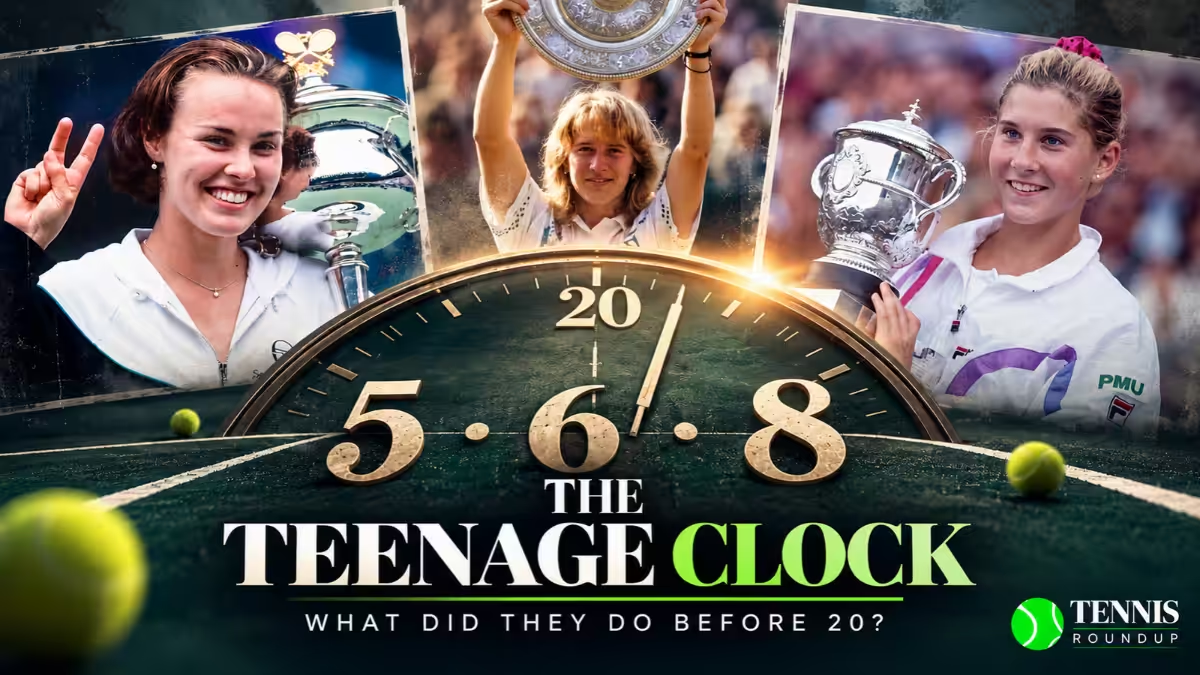
After looking at what the greatest women in tennis had accomplished before turning 20, three numbers stood apart.
Monica Seles: 8.
Steffi Graf: 6.
Martina Hingis: 5.
Eight, six and five Grand Slam singles titles while they were still teenagers.
That raised another question.
If Seles, Graf and Hingis were already so far ahead of almost everyone else before their teenage years ended, what did they look like even earlier?
Surely three teenagers who would eventually dominate the Grand Slam record books had also spent their childhoods collecting the same kinds of trophies.
So we moved the clock backward.
Before 20.
Before their first senior Grand Slam titles.
Before 16.
And almost immediately, our assumption fell apart.
These weren’t three versions of the same tennis prodigy.
They were taking three very different roads.
Martina Hingis Conquered the Junior World
If we were looking for the classic junior prodigy, Martina Hingis was it.
At just 12 years old, Hingis won the girls’ singles title at Roland Garros.
Then she did it again at 13.
And she added the Wimbledon girls’ title.
Before most young players her age were anywhere near professional tennis, Hingis had already accumulated three Junior Grand Slam singles championships.
Her progression was extraordinary even before her famous senior career began.
But Hingis didn’t remain in junior tennis for long.
She turned professional at 14 and made her senior Grand Slam debut that same year.
By the time her 16th birthday approached, the junior champion was already testing herself against adults.
Hingis had climbed the junior ladder extraordinarily quickly.
Then she stepped off it.
Steffi Graf Took a Different Road
Graf’s early career doesn’t fit that pattern nearly as neatly.
She had significant junior success, including winning the Junior Orange Bowl, but a long list of Junior Grand Slam trophies isn’t what defines her pre-16 story.
Something else does.
She was already playing the adults.
Graf turned professional at 13.
At the same age, she appeared in the senior Roland Garros main draw, becoming the youngest player to compete there at the time.
And while she was still only 14 and 15, Graf was already progressing through rounds at senior Grand Slam tournaments, including runs to the round of 16 at the Australian Open and Wimbledon.
There was no need to wait for a glittering Junior Slam résumé to announce what was happening.
Graf had already moved onto another test.
The senior tour.
Monica Seles Started Converting
Then there was Monica Seles.
Seles had shown exceptional promise extremely early, winning the Junior Orange Bowl at 11 and establishing herself among elite older juniors while still remarkably young.
She played her first professional event at 14.
But what separates her pre-16 story is how quickly potential became senior results.
At 15, Seles won her first WTA singles title.
Then came Roland Garros in 1989.
She didn’t merely enter the tournament as a precocious teenager.
She reached the semifinals.
Before her 16th birthday, Seles had already demonstrated that she could contend deep into one of the biggest tournaments in tennis.
Her transition wasn’t simply underway.
It was accelerating.
Three Players. Three Roads.
That was the surprise.
We went backward expecting to find three similar junior résumés.
Instead, we found three different forms of precocity.
Hingis conquered the junior ladder.
Graf raced ahead to senior competition.
Seles converted early promise into major senior results with astonishing speed.
None of those routes guaranteed what happened afterward.
That’s important.
Looking backward from legendary careers makes childhood achievements appear almost inevitable. They weren’t.
Plenty of exceptional young players have dominated junior tennis without becoming all-time senior champions. Others have developed later. Some barely had conventional junior careers at all.
A junior trophy is evidence of what a player accomplished at that moment.
It isn’t a prophecy.
And that’s precisely why these three careers become more interesting when viewed together.
Then the Teenage Clock Started Ticking
By 16, Seles, Graf and Hingis had reached very different places.
Hingis carried the most extraordinary Junior Grand Slam résumé of the three.
Graf had already spent years confronting senior competition.
Seles had already won on the WTA Tour and reached a Grand Slam semifinal.
Different beginnings.
Different development paths.
Different evidence of what might come next.
And yet, before each eventually turned 20, those three paths produced the numbers that sent us backward in the first place:
Martina Hingis — 5.
Steffi Graf — 6.
Monica Seles — 8.
Three women separated themselves from the rest of the Open Era teenage Grand Slam landscape.
But they didn’t arrive there the same way.
Perhaps that’s the first lesson of the Teenage Clock.
There isn’t one road to getting there early.
Related Reading
The Teenage Clock: What Did Tennis Greats Do Before 20?
The Rising Sun: Sun Xinran