
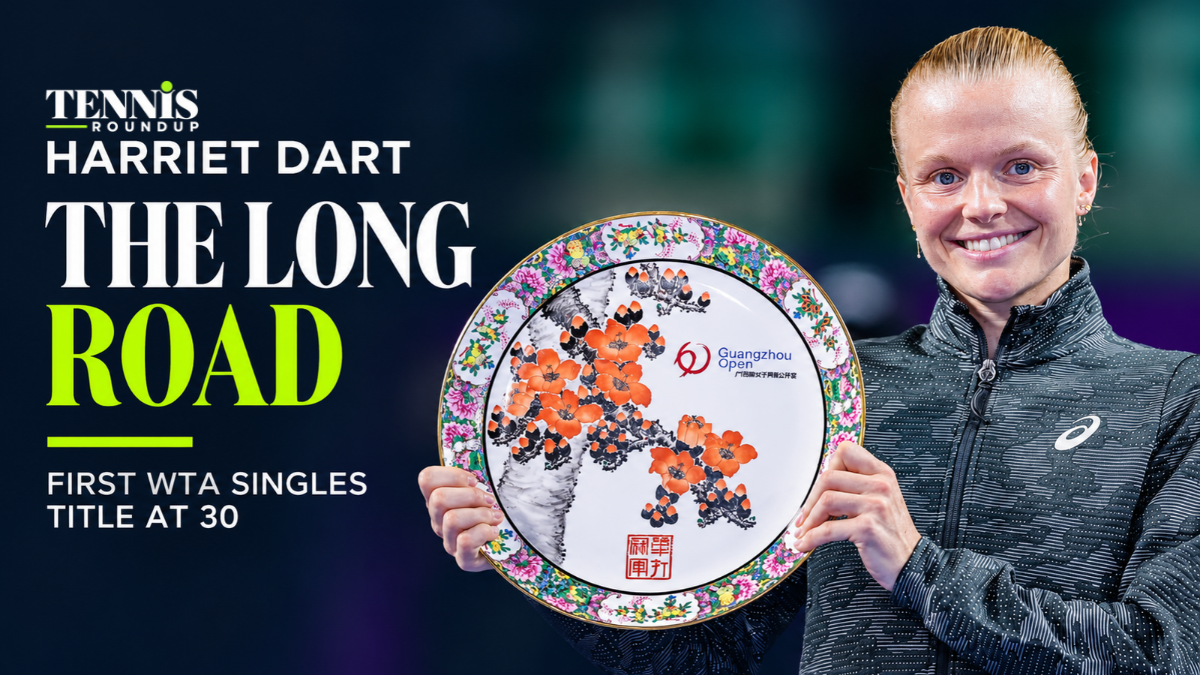
Harriet Dart: The Long Road to a First WTA Singles Title
At 30, Harriet Dart finally won her first WTA Tour singles championship. But the journey to Guangzhou was about much more than one trophy.
A Championship Eleven Years After Her WTA Debut
Harriet Dart stood one point away from the biggest singles achievement of her professional tennis career.
Across the net was 18-year-old Austrian Lilli Tagger, who had already beaten her in an ITF final earlier in 2026.
Dart had lost the opening set of the Guangzhou Open final. She had recovered to force a decider, survived another difficult passage, and earned two championship points on Tagger’s serve.
Both disappeared.
But Dart still had an opportunity to serve for the title.
On her third championship point, she finished the match.
Harriet Dart defeated Lilli Tagger 4–6, 6–3, 6–4 on November 1, 2026, to win her first WTA Tour singles title.
She was 30 years old.
It had been eleven years since her WTA main-draw debut at Eastbourne in 2015.
And although she had already won professional singles titles on the ITF circuit, competed in a Grand Slam mixed doubles final, represented Great Britain, and reached the world’s Top 100, a WTA Tour singles championship had remained beyond her reach.
Until Guangzhou.
The trophy marked a new career milestone.
But to understand why it mattered, we need to look at the years that came before it.
Harriet Dart at a Glance
| Player Information | Details |
|---|---|
| Full name | Harriet Dart |
| Nationality | Great Britain |
| Born | July 28, 1996 |
| Birthplace | Hampstead, London, England |
| Age at first WTA singles title | 30 |
| Height | 1.75 m |
| Playing hand | Right-handed |
| Backhand | Two-handed |
| WTA main-draw debut | Eastbourne, 2015 |
| Career-high singles ranking | World No. 70 — September 9, 2024 |
| First WTA Tour singles title | Guangzhou Open, 2026 |
| WTA Tour singles titles | 1 |
| WTA Tour doubles titles | 2 |
| Best Grand Slam singles result | Wimbledon third round, 2019 and 2024 |
Career statistics and title counts are current through November 1, 2026.
The Beginning: A Young Girl at a London Tennis Club
Harriet Dart’s tennis journey began long before professional rankings and international tournaments.
Born in Hampstead, London, she started playing tennis at seven years old at Cumberland Lawn Tennis Club.
Tennis was already part of her family’s life.
Her parents, Nick and Susie, played the sport and had met at the club.
For Dart, tennis gradually became more than a childhood activity.
By around age 13, she had decided that she wanted to pursue a professional career.
Her development followed a familiar but demanding route: junior competition, lower-level professional tournaments, and the challenge of earning opportunities against increasingly experienced opponents.
She competed in the Wimbledon girls’ singles draw in 2012, 2013, and 2014.
In 2013, she defeated a young Jelena Ostapenko before losing to Ana Konjuh.
Those early matches offered experience against players who were also trying to establish themselves.
But junior results were only the beginning.
The next challenge was finding a place in professional tennis.
From the ITF Circuit to the WTA Tour
Dart’s first appearances in ITF professional competition date back to 2011.
In 2014, she won an ITF singles title in Sharm El Sheikh and made her WTA qualifying debut at Eastbourne.
Her first WTA Tour main-draw appearance came the following year.
At Eastbourne in 2015, Dart received a wildcard but lost to Dominika Cibulkova 6–1, 6–3.
It was an important opportunity, even though it ended in defeat.
A first appearance at tour level was not the same as establishing a career there.
That would take more time.
And the years immediately following her debut brought physical interruptions.
According to the Lawn Tennis Association, a foot injury beginning in October 2015 kept Dart away from competition for approximately six months.
A serious hip injury followed in September 2016.
These were genuine setbacks during an important period of her development.
But they were not the end of her career.
Dart continued competing.
At Wimbledon qualifying in 2016, she lost a deciding set 13–11 to Ekaterina Alexandrova.
The following year, another qualifying match ended in a narrow deciding-set defeat against Çağla Büyükakçay.
Neither result gave her the Grand Slam main-draw breakthrough she was seeking.
Yet those matches formed part of her growing experience.
Progress in professional tennis does not always arrive as a visible breakthrough. Sometimes it consists of returning, competing, and earning another opportunity.
For Dart, the next significant step came in 2018.
2018–2019: The First Tour Victory and a Wimbledon Breakthrough
In June 2018, Dart defeated Kristýna Plíšková 7–5, 3–6, 6–3 at Eastbourne.
It was her first WTA Tour main-draw singles victory.
Three years had passed since her debut at the same tournament.
Later that summer, Dart made her first Grand Slam singles main-draw appearance at Wimbledon.
She lost to Karolína Plíšková in three sets.
The following year, she returned to Wimbledon and went further.
Dart defeated Christina McHale in the opening round, then overcame Beatriz Haddad Maia to reach the third round of Wimbledon 2019.
Her run ended against eventual champion Ashleigh Barty.
The result represented her best Grand Slam singles performance to that point.
She had progressed from qualifying defeats to winning matches on one of tennis’s most recognizable stages.
But another milestone remained ahead.
Dart had not yet entered the world’s Top 100.
That breakthrough would come in 2022.
2022: Breaking Into the World’s Top 100
In March 2022, Dart produced one of the most important runs of her early career.
At Indian Wells, she came through qualifying and advanced to the fourth round.
Along the way, she defeated Elina Svitolina, recording her first victory over a Top 20 opponent.
The result helped her reach a new ranking milestone.
On March 21, 2022, Harriet Dart entered the WTA Top 100 at World No. 99.
It was a significant achievement for a player who had spent years working through professional competition.
But Dart’s perspective on progress was already broader than rankings alone.
Speaking to the Lawn Tennis Association during that breakthrough, she said:
“I think everyone’s trajectory is very different.”
It was a simple observation, but one that would become increasingly relevant to her career.
Later in 2022, Dart defeated Daria Kasatkina at the US Open for her first victory over a Top 10 opponent.
She also represented Great Britain in the Billie Jean King Cup Finals, defeating Paula Badosa and Ajla Tomljanović as Britain reached the semifinals.
These achievements demonstrated that Dart could compete successfully against established players.
But reaching the Top 100 did not mean she would remain there without interruption.
Her career continued to move forward—and backward.
The Breakthroughs and the Difficult Periods
Professional tennis careers rarely follow a straight line.
Dart’s ranking history illustrates that reality.
After reaching the Top 100 in 2022, she finished 2023 ranked World No. 138.
The following season brought another advance.
In January 2024, Dart reached the final of the Canberra WTA 125 tournament despite having experienced food poisoning and hospital treatment during her preparation.
She lost the final to Nuria Párrizas Díaz.
A month later, she reached the semifinals of the Cluj-Napoca tournament.
It was her first WTA Tour singles semifinal.
The achievement represented another step forward.
But one of her most memorable performances that year came at Wimbledon.
Wimbledon 2024: The Work Behind One Victory
In the second round, Dart faced fellow British player Katie Boulter.
The match went to a deciding match tiebreak.
Dart trailed 2–6 in that tiebreak before recovering to win 4–6, 6–1, 7–6(8).
She had turned a difficult position into one of her most significant victories of the season.
Afterward, Dart spoke about what such moments represent.
She referred to:
“months, years of the work that you put in.”
The words offered a glimpse of how she viewed achievement.
A victory might be recorded on one particular day.
But the work behind it extends much further.
Dart reached the Wimbledon third round again that year, matching her 2019 result.
Then, on September 9, 2024, she achieved a new career-high singles ranking.
World No. 70.
It was her highest position to date.
Yet the following year would bring a substantial reversal.
2025: From No. 70 to No. 261
By September 8, 2025, Dart had fallen to World No. 261.
The ranking represented a significant decline from her career high.
It would be easy to turn that number into a dramatic story about lost confidence or a career approaching its end.
But the ranking alone cannot tell us exactly what Dart was experiencing.
What it does establish is that she had moved considerably further away from the position she had achieved a year earlier.
And she needed to rebuild her results.
Later in 2025, Dart won ITF singles titles in Monastir and Toronto.
She also reached the semifinals of the Tampico WTA 125 tournament.
Those results did not immediately return her to her career-high ranking.
But they demonstrated that she was still competing and winning matches.
The next stage of her career was not about beginning again from nothing. It was about building on the experience she already possessed.
2026: Progress Before the Championship
Dart entered 2026 without a WTA Tour singles title.
But she was far from an inexperienced professional.
She had already played Grand Slam matches, defeated Top 10 opponents, represented Great Britain, and reached significant milestones in doubles.
Her season included both encouraging results and difficult defeats.
Early in the year, she reached an ITF W100 singles final in Fujairah.
Her opponent was Lilli Tagger.
Tagger defeated Dart 6–4, 6–2.
Neither player knew that they would meet again in a much bigger final later that season.
Dart also reached another ITF singles final in Porto.
But her most significant WTA Tour achievements before Guangzhou came in doubles.
Partnering fellow Briton Maia Lumsden, she won titles at Nottingham and Prague.
They were Dart’s first two WTA Tour women’s doubles championships.
Those victories mattered.
They demonstrated that she was already a tour-level champion in another discipline.
But the singles title remained missing.
Learning to Finish Difficult Matches
In June 2026, Dart lost a close match against Kamilla Rakhimova at Queen’s.
Afterward, she reflected on the challenge of finishing tight contests.
“I guess I just need to find ways to be able to close a lot of these tight matches out.”
The comment was not a prediction of what would happen in Guangzhou.
But it provides an important insight into how Dart was assessing her game during the season.
Several months later, she would face another series of difficult matches.
This time, she would find ways to finish them.
Guangzhou 2026: Seven Matches to a First WTA Singles Title
Harriet Dart arrived at the Guangzhou Open ranked World No. 115.
She was not seeded in the main draw.
She had to qualify.
Her first qualifying match nearly ended her tournament before it had properly begun.
Against Hong Kong wildcard Cheuk Ying Shek, Dart lost the opening set and trailed 4–2 in the second.
She recovered to win 5–7, 7–6(5), 6–1.
The victory kept her tournament alive.
Her second qualifying match was more straightforward.
She defeated Mei Yamaguchi 6–2, 6–1 to reach the main draw.
Then came five more matches.
Harriet Dart’s Guangzhou Championship Run
| Round | Opponent | Result |
|---|---|---|
| Qualifying R1 | Cheuk Ying Shek | 5–7, 7–6(5), 6–1 |
| Qualifying R2 | Mei Yamaguchi | 6–2, 6–1 |
| First Round | Tatiana Prozorova | 6–4, 2–6, 6–2 |
| Round of 16 | Janice Tjen [2] | 6–4, 3–6, 6–3 |
| Quarterfinal | Paula Badosa [5] | 3–6, 6–2, 6–4 |
| Semifinal | Sun Xinran [WC] | 5–7, 7–6(1), 6–0 |
| Final | Lilli Tagger [4] | 4–6, 6–3, 6–4 |
Seven matches. Seven victories. Six deciding sets.
Four of those victories came after Dart lost the opening set.
She defeated three seeded main-draw opponents: Janice Tjen, Paula Badosa, and Lilli Tagger.
The run required more than one kind of recovery.
Against Tjen, Dart had to finish the match after her opponent reduced a third-set lead.
Against Badosa, she was broken while serving for the match before breaking again to secure victory.
But her greatest escape came in the semifinals.
The Semifinal: Two Match Points From Defeat
Dart’s semifinal opponent was 16-year-old Chinese wildcard Sun Xinran.
Sun had enjoyed a breakthrough tournament in front of a home crowd.
She entered the week ranked World No. 405 and had advanced to her first WTA Tour semifinal.
Against Dart, she came remarkably close to reaching the final.
Sun won the opening set 7–5.
In the second set, she led 5–4 and earned match points on Dart’s serve.
According to the official WTA point-by-point record, Dart saved two match points before holding for 5–5.
The set eventually reached a tiebreak.
Dart won it 7–1.
Then she took the deciding set 6–0.
Harriet Dart def. Sun Xinran 5–7, 7–6(1), 6–0.
The victory sent Dart into her first WTA Tour singles final.
It also brought an emotional reflection from the British player.
Speaking after the semifinal, she said:
“It’s been a really long journey. It’s been really hard, I’ve wanted it so much so badly, sometimes too much.”
The words carried the weight of her experience.
They also made clear that the significance of reaching a first tour final was not something observers needed to invent.
Dart herself understood how long she had been working toward that moment.
And she was now one victory away from an even bigger achievement.
The Final: Harriet Dart vs. Lilli Tagger
The Guangzhou final brought together two players at very different stages of their careers.
Harriet Dart was 30 and competing in her first WTA Tour singles final.
Lilli Tagger was 18 and playing her third.
Tagger had already won a WTA Tour singles title in Prague earlier in 2026.
She had also defeated Dart in the Fujairah ITF final.
Their Guangzhou meeting offered another opportunity to compete for a championship.
First Set: Tagger Takes the Advantage
Tagger began strongly.
She broke Dart’s opening service game and moved ahead 2–0.
Dart recovered the break to level the set at 4–4.
But Tagger broke again and served out the opening set 6–4.
Once more, Dart faced the challenge of recovering from a set down.
She had already done it three times during the tournament.
Now she needed another comeback.
Second Set: Dart Finds a Way Back
The second set remained on serve until its closing stages.
At 4–3, Dart earned the break that changed the set.
She moved ahead 5–3 and served it out 6–3.
The final was level.
For the fourth time during the tournament, Dart had recovered after losing the opening set.
But the championship would require one more set.
Third Set: The Final Challenge
The deciding set became a contest of shifting service games.
Five consecutive breaks between the third and seventh games left Dart ahead 4–3.
She then faced two break points on her own serve.
Dart saved both and held for 5–3.
Tagger was not finished.
Serving to stay in the match, the Austrian saved two championship points and held for 4–5.
Dart still had the opportunity to serve for the title.
This time, she completed the task.
On her third championship point, Harriet Dart became a WTA Tour singles champion.
The final score:
Harriet Dart def. Lilli Tagger 4–6, 6–3, 6–4.
Match duration: 2 hours, 16 minutes and 28 seconds.
It was her seventh victory of the tournament.
Her sixth three-set match.
And her first WTA Tour singles championship.
What the Guangzhou Championship Changed
The Guangzhou title was a new achievement in an already substantial professional career.
Dart had previously won seven ITF singles titles.
She had reached a WTA 125 singles final.
She had won WTA Tour doubles titles and competed in a Wimbledon mixed doubles final.
But she had never won a WTA Tour singles championship.
Guangzhou changed that.
The title also strengthened her ranking position.
Dart entered the main-draw week ranked No. 115, and the WTA projected that the championship would return her to the world’s Top 100.
Her exact post-title ranking would be confirmed in the next official weekly rankings.
The Lawn Tennis Association also identified Dart as the 14th British woman to win a tour-level singles title in the Open Era.
But beyond rankings and records, the championship offered something more personal.
It was an achievement she had spent years pursuing.
And it came after a season in which she had spoken openly about the difficulty of closing tight matches.
Guangzhou did not erase the defeats that came before it. It added a new chapter to a career that had already contained many different kinds of success.
Success Does Not Follow One Timetable
There is something striking about the ages of the players Dart encountered during Guangzhou’s final weekend.
Sun Xinran was 16.
Lilli Tagger was 18.
Harriet Dart was 30.
Each player reached a different milestone.
Sun experienced a breakthrough WTA Tour semifinal.
Tagger reached another tour final after already winning her first title earlier in the season.
Dart finally reached—and won—her first WTA Tour singles final.
Their journeys were different.
Their achievements were different.
And their ages did not determine the value of what they accomplished.
Dart is not the only player to win a first WTA Tour singles title after turning 30.
Arantxa Rus, for example, won her maiden title in Hamburg in 2023 at 32.
Alberta Brianti won her first tour singles championship in Fès in 2011 at 31.
These examples do not establish a universal pattern.
They simply demonstrate that meaningful career milestones can arrive at different stages.
Dart had expressed that perspective years before Guangzhou.
In 2024, she said:
“Everyone is on their own path and that’s a massive thing.”
Her own career offers a compelling example.
She reached the Top 100 before winning a WTA singles title.
She played a Grand Slam mixed doubles final before reaching her first WTA singles final.
She won two WTA Tour doubles championships before claiming her first singles crown.
There was no single timetable governing all those achievements.
What Harriet Dart’s Journey Can Teach Us
Tennis offers no guarantee that persistence will eventually produce a championship.
Many players work for years without winning a WTA Tour singles title.
Some reach finals and lose.
Others achieve their greatest successes in doubles, team competitions, or lower-level tournaments.
And a player’s value cannot be measured solely by the number of trophies she collects.
That is why Dart’s story is worth telling carefully.
Her Guangzhou victory was not proof that every setback leads to success.
It was not evidence that every difficult moment had been necessary.
But it was the culmination of a career in which she had continued competing through changing circumstances.
There were injuries.
There were ranking breakthroughs and declines.
There were significant victories and painful defeats.
There were achievements in singles, doubles, and team tennis.
And eventually, there was Guangzhou.
At 30, Harriet Dart achieved something she had never accomplished before.
Not because the previous years had been empty.
But because her career still had room for another first.
Harriet Dart Career Highlights
| Year | Career Milestone |
|---|---|
| 2011 | First ITF professional appearances |
| 2014 | First ITF singles title and WTA qualifying debut |
| 2015 | WTA Tour main-draw debut at Eastbourne |
| 2018 | First WTA Tour main-draw singles victory |
| 2019 | Wimbledon third round; Billie Jean King Cup debut |
| 2021 | Wimbledon mixed doubles runner-up with Joe Salisbury |
| 2022 | First WTA Top 100 ranking; first Top 10 victory |
| 2024 | First WTA Tour singles semifinal; Wimbledon third round; career-high No. 70 |
| 2025 | Ranking decline followed by ITF singles titles |
| 2026 | First two WTA Tour doubles titles with Maia Lumsden |
| 2026 | First WTA Tour singles title — Guangzhou Open |
Career milestones verified through November 1, 2026.
The Road Ahead
Harriet Dart leaves Guangzhou with a title that had remained beyond her reach throughout her WTA Tour singles career.
It does not guarantee another championship.
It does not determine what the next season will bring.
But it changes one important fact about her career.
She is now a WTA Tour singles champion.
The achievement belongs alongside her previous milestones, rather than replacing them.
Her Wimbledon performances still matter.
Her Top 100 breakthrough still matters.
Her doubles titles and Billie Jean King Cup victories still matter.
And so do the years she spent competing before Guangzhou.
The trophy gives those years a new perspective.
But they were already part of a meaningful career.
Conclusion: A First Title, Not a First Achievement
On November 1, 2026, Harriet Dart lifted the Guangzhou Open trophy.
She was 30.
Eleven years had passed since her WTA main-draw debut.
She had played seven matches that week, survived six deciding sets, and recovered from a set down in the championship match.
It was her first WTA Tour singles title.
But it was not her first achievement.
And perhaps that is what makes her story so compelling.
A career can contain years of meaningful progress before one particular dream becomes reality.
Dart’s journey reminds us that success does not always arrive in the order we expect.
Sometimes the breakthrough comes early.
Sometimes it comes later.
And sometimes the most meaningful moment is not simply winning.
It is understanding how much of the journey came before it.
Harriet Dart’s first WTA singles title arrived at 30.
Her story began long before Guangzhou.