
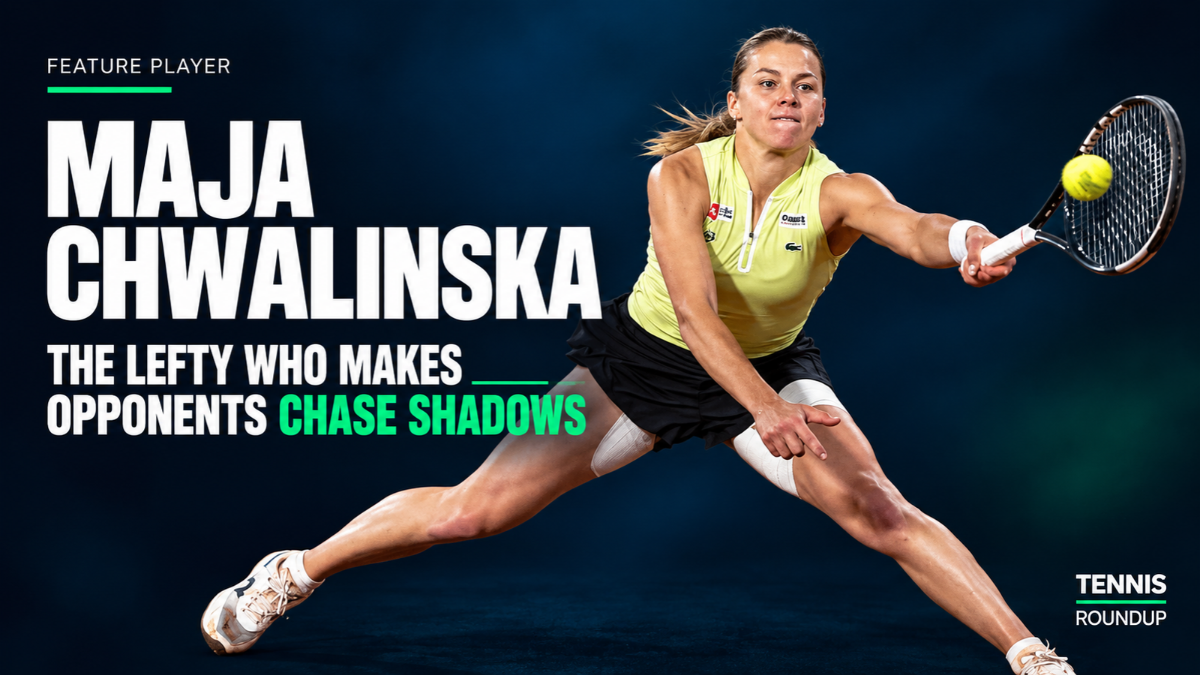
Maja Chwalinska: The Lefty Who Makes Opponents Chase Shadows
A drop shot brings an opponent forward. A lob sends her scrambling backward. A slice changes the height of the ball, and suddenly a comfortable rally becomes a guessing game.
Maja Chwalinska doesn’t always need to hit harder to take control of a point. Sometimes, she simply makes her opponent run in the wrong direction.
The Polish left-hander has developed a game built around touch, variation and anticipation. Against opponents accustomed to powerful baseline exchanges, she offers something different: changes of pace, unexpected angles and carefully constructed points.
Her journey to the highest levels of women’s tennis has been equally unconventional.
While childhood friend Iga Swiatek became one of the sport’s biggest stars, Chwalinska followed a longer road through qualifying tournaments, injuries, personal challenges and gradual breakthroughs.
By October 2026, that journey had taken her to a Roland-Garros final, a Singapore semifinal and the Wuhan Open semifinals.
But to understand what makes Chwalinska different, the best place to begin is on the court.
Maja Chwalinska’s Playing Style: The Art of Making Opponents Move
Chwalinska is a left-handed player whose tennis relies on more than one way of winning a rally.
She can lift a high, looping forehand deep into the court, then follow with a low backhand slice. She can absorb pace, change direction or invite an opponent forward with a drop shot.
And when that opponent moves toward the net, another possibility opens: the lob.
It is tempting to describe this as a simple sequence — slice, drop shot, lob.
But Chwalinska’s game is more sophisticated than a predetermined combination.
The important question is not which shot comes next. It is where the opponent will be when that shot arrives.
A deep ball can push an opponent behind the baseline. A short ball can pull her forward. A lob can exploit the space she has left behind.
If she anticipates the lob, a passing shot may become available instead.
This is tennis played through positioning as much as power.
The Drop Shot Is Only the Beginning
Chwalinska’s ability to change the length of a rally has been part of her game for years.
In a 2022 WTA interview, she explained that her touch was not something that appeared overnight:
“I was practising dropshots and all the other stuff for 12 years.”
That distinction matters.
A successful drop shot may look spontaneous, but it depends on timing, disguise, court position and an understanding of the opponent’s movement.
The shot itself is only one part of the construction.
The Lob That Changes Everything
At the 2026 Singapore Tennis Open, Chwalinska demonstrated how several of her weapons could work together.
During her quarterfinal victory over Elise Mertens, a documented point in the closing game featured a drop shot, a lob and a forehand passing shot.
It was an example of the tactical variety that has made her difficult to read.
The drop shot changed the opponent’s position. The lob introduced another problem. The passing shot completed the sequence.
Chwalinska defeated Mertens 6–2, 6–2, showing that her style could trouble an experienced opponent on a hard court.
Her lobs may attract attention, but they are most interesting when viewed as part of a larger tactical system.
The Power of Changing Pace
Modern women’s tennis often rewards aggressive baseline hitting.
Chwalinska can compete within that environment, but she also challenges its rhythm.
A high forehand may force an opponent to strike from an uncomfortable position. A low slice demands a different response. An occasional flat acceleration prevents the opponent from settling into a predictable pattern.
This is not necessarily defensive tennis.
Sometimes, changing the pace is the attacking move.
Her game also carries risks. A drop shot that sits up can invite an aggressive reply, and a lob that falls short can be punished.
That makes her anticipation and decision-making especially important.
From Polish Junior Tennis to the Professional Tour
Maja Chwalinska was born on October 11, 2001, in Dąbrowa Górnicza, Poland.
She began playing tennis at seven and developed her game through the Polish junior system.
Her early career included notable doubles achievements alongside another promising Polish player: Iga Swiatek.
The two won European junior doubles titles and reached the 2017 Australian Open girls’ doubles final together.
They lost that final to Bianca Andreescu and Carson Branstine, 6–1, 7–6(4).
At the time, both were young players trying to establish themselves.
Their professional journeys would develop very differently.
Maja Chwalinska and Iga Swiatek: Two Friends, Different Paths
Swiatek’s rise eventually brought Grand Slam titles, the world No. 1 ranking and major commercial partnerships.
Chwalinska’s progress was less direct.
Her career developed through the ITF circuit, qualifying tournaments and the difficult transition to higher-level competition.
Their tennis styles also offer an interesting contrast.
Swiatek is known for powerful movement, heavy spin and aggressive baseline control.
Chwalinska brings more variation in ball height, touch and changes of pace.
One became an established champion while the other continued working toward a sustained breakthrough.
But their shared junior history remains part of both players’ stories.
In October 2026, that history acquired new relevance when Chwalinska reached the Wuhan Open semifinals, placing a possible reunion with Swiatek on the horizon.
For Chwalinska, however, her identity extends well beyond being Swiatek’s former junior partner.
She has spent years building a game and career of her own.
The Long Road: Breakthroughs, Setbacks and Persistence
Chwalinska’s professional journey began while she was still a teenager.
In 2019, three consecutive ITF titles in Poland helped her reach the world’s Top 200.
She subsequently experienced difficult periods that interrupted her progress.
In 2021, she publicly discussed her struggles with depression and took time away from competition.
Her return eventually led to a Grand Slam breakthrough at Wimbledon in 2022.
After coming through qualifying, she defeated Katerina Siniakova 6–0, 7–5 in the opening round before losing to Alison Riske-Amritraj.
Later that year, right-knee surgery created another obstacle.
Chwalinska returned to competition in 2023 and gradually rebuilt her career.
Her progress included a first WTA 125 singles title at Florianopolis in 2024, followed by another title at Montreux in 2025.
These achievements were important steps, even if they attracted less international attention than the sport’s biggest tournaments.
The breakthrough she had worked toward was still ahead.
Roland-Garros 2026: A Different Kind of Breakthrough
At Roland-Garros in 2026, Chwalinska transformed a qualifying opportunity into a remarkable run.
Her combination of variety, court awareness and physical endurance became increasingly important as she advanced through the draw.
She defeated Maria Sakkari in the third round, then overcame Diana Shnaider in the semifinals.
That brought her to her first Grand Slam singles final.
There, she faced Mirra Andreeva, one of the leading young players in women’s tennis.
Andreeva won 6–3, 6–2, ending Chwalinska’s run one victory short of the title.
But reaching the final represented a major turning point.
After years of working through injuries, qualifying draws and lower-level tournaments, Chwalinska had demonstrated that her distinctive game could succeed on one of tennis’s biggest stages.
Her Roland-Garros achievement also raised her international profile and brought new attention to her career.
From Singapore to Wuhan: Touch Travels Beyond Clay
A natural question followed her Roland-Garros breakthrough.
Could Chwalinska reproduce that success away from clay?
The Singapore Tennis Open provided an encouraging answer.
In September 2026, she defeated defending champion Elise Mertens 6–2, 6–2 to reach the semifinals.
Her drop shots, lobs and changes of pace were again central to the match reporting.
Then came Wuhan.
Chwalinska defeated Mayar Sherif, recovered from a set down against Marie Bouzkova and beat teenage contender Iva Jovic 6–4, 6–1 in the Round of 16.
The Jovic victory was especially significant because of the American’s high ranking and growing reputation.
In the quarterfinals, Chwalinska faced Maria Sakkari once again.
She dominated the opening set 6–0, lost the second 3–6, then survived a tense deciding set to win 7–5.
The victory sent Chwalinska into the Wuhan Open semifinals.
Her progress across Roland-Garros, Singapore and Wuhan demonstrated that her tennis was not simply a clay-court curiosity.
The surfaces changed. The opponents changed.
But the central elements of her game remained recognizable.
The Work Behind the Touch
Chwalinska’s creativity has roots in years of training.
Her development involved early coaching in Poland, followed by a professional support structure at BKT Advantage in Bielsko-Biała.
The club identifies Jaroslav Machovsky as her head coach since 2020, with additional assistance in training and physical conditioning.
That work is especially important for a player whose game demands constant adjustment.
Drop shots and lobs may appear delicate, but constructing points through repeated changes of direction requires movement, balance and endurance.
Chwalinska’s game is not simply about having good hands.
It also depends on the physical preparation needed to arrive at the ball early enough to use those hands effectively.
Her playing style is creative, but it is not effortless.
What Racket, Clothing and Equipment Does Maja Chwalinska Use?
Chwalinska’s equipment has attracted attention alongside her results.
During Roland-Garros 2026, reporting described her wearing clothing from different brands, including Lacoste and Nike, amid questions about her lack of a dedicated apparel sponsorship agreement.
However, wearing a particular brand does not automatically establish a paid endorsement contract.
As of the research cutoff in October 2026, a current apparel sponsorship agreement had not been independently confirmed.
Likewise, her precise racket model, string setup, tension and current shoe contract could not be reliably established.
These details should be updated when confirmed through player statements, manufacturer announcements or other authoritative sources.
Her equipment story also connects to a wider question in professional tennis: how players finance their careers before major sponsorship opportunities become available.
That subject deserves a separate investigation.
Maja Chwalinska: More Than a Collection of Trick Shots
It would be easy to remember Chwalinska only for the spectacular points.
The drop shot that catches an opponent standing too deep.
The lob that sends her racing toward the baseline.
The passing shot that appears when the opponent guesses incorrectly.
But those moments are only the visible result of something more complex.
Chwalinska studies opponents, varies her patterns and uses years of practice to create opportunities that are not always available to more conventional hitters.
Her career reflects similar qualities.
She has adjusted, recovered, persisted and continued searching for ways forward.
The player who once competed alongside Iga Swiatek in junior doubles has developed a professional identity that is distinctly her own.
Maja Chwalinska makes opponents chase shadows because she understands something fundamental about tennis: sometimes the smartest way to win a point is to make the other player move before you make your move.