
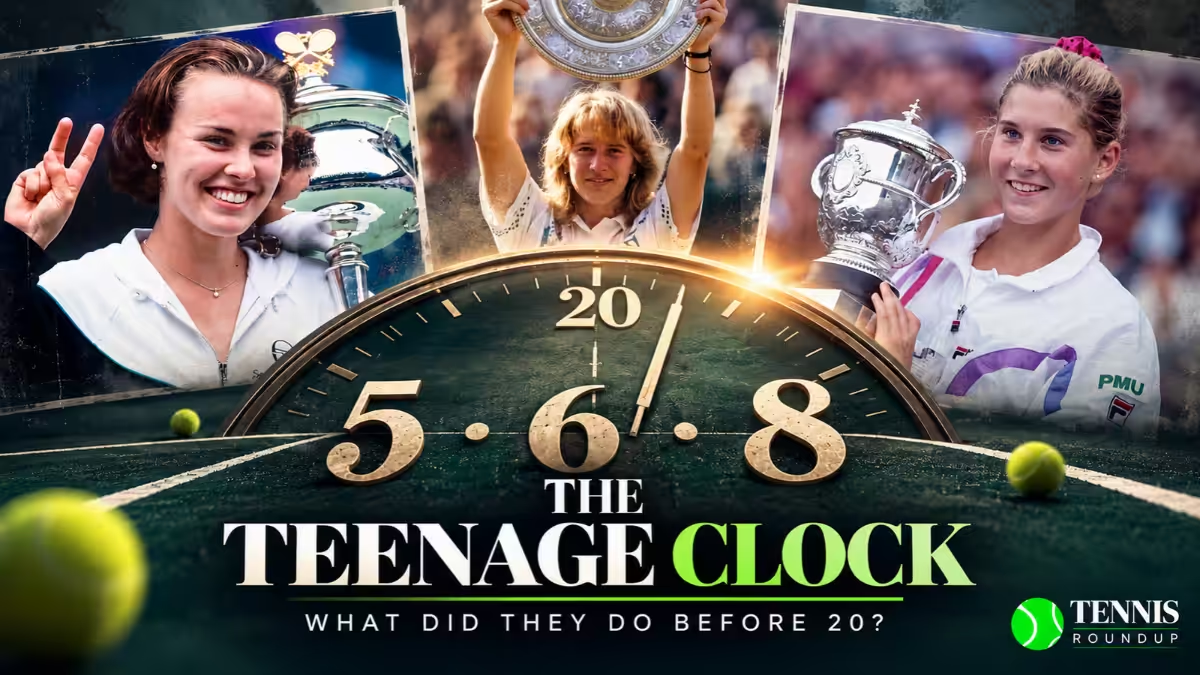
THE TEENAGE CLOCK | What Did the Greats Actually Do Before 20?
It started with frustration.
At Tennis Roundup, we had been following the progress of another young player. And as happens so often around teenage prospects, every result seemed capable of becoming a verdict.
Win, and the future suddenly looked enormous.
Lose, and questions followed.
At some point, we stopped looking at the latest result and started wondering about something much bigger:
What did the greats actually accomplish while they were still teenagers?
Not what they eventually became.
Not how many Grand Slam titles appeared beside their names when their careers were over.
What had they actually done before their 20th birthday?
So we started the clock.
One Simple Rule
The experiment needed a boundary.
For Tennis Roundup’s Teenage Clock, we begin with the Open Era in 1968 and count a Grand Slam singles championship only when the player was 19 or younger when the completed final was played. That’s the methodology we’ve established for this project.
Then we started counting.
That’s when things got strange.
Monica Seles – 8
The WTA records it plainly: eight Grand Slam singles championships as a teenager.
Her first came at Roland Garros in 1990 when she was only 16. By the time her teenage clock expired, Seles had accumulated eight majors. She would finish her career with nine.
Think about that for a moment.
Eight before 20.
That number alone would have been enough to send us deeper into the archives.
But then came another.
Steffi Graf – 6
Graf won Roland Garros in 1987 while still 17. Then came 1988: Australian Open, Roland Garros, Wimbledon and the US Open—the calendar-year Grand Slam—all while she was still a teenager. She added the 1989 Australian Open before turning 20.
Six majors before 20.
Our working research therefore had:
Seles — 8
Graf — 6
Surely this was simply how the greatest players emerged.
Then we reached Martina Hingis.
Martina Hingis – 5
At 16 years, 3 months and 26 days, Hingis won the 1997 Australian Open. She followed it with Wimbledon and the US Open that year and became the youngest World No. 1 in Women’s Tennis Association history.
Eventually, her teenage Grand Slam singles count reached five.
Now the board read:
8 — Seles
6 — Graf
5 — Hingis
And that’s where our little historical investigation stopped behaving the way we expected.
Because after 5…
we couldn’t find 4.
We couldn’t find 3.
Our current working ledger drops all the way to 2.
That is the part we’re still scrutinizing against the complete Open Era champions record before declaring it definitive. Our newsroom tracker currently has Evonne Goolagong, Chris Evert, Hana Mandlikova and Tracy Austin at two teenage majors each.
If that full-ledger verification holds, Seles, Graf and Hingis didn’t merely lead the teenage list.
They broke the scale.
And Then Our Frustration Came Back to Bite Us
Because there was another name we couldn’t ignore.
Martina Navratilova.
Eighteen Grand Slam singles championships.
One of the greatest careers tennis has ever seen.
Teenage Clock:
0.
That’s already our control case in this project.
And suddenly the question that started this investigation looked different.
Maybe asking what a young player has accomplished before 20 can tell us something fascinating about early arrival.
But it cannot tell us how great that player will ultimately become.
The clock measures what happened before midnight.
It doesn’t tell us what happens the morning after.
So We’re Keeping the Clock Running
This wasn’t supposed to become a series.
We were frustrated.
We asked a question.
Then Monica Seles gave us 8.
Steffi Graf gave us 6.
Martina Hingis gave us 5.
And Martina Navratilova gave us 0.
Those four numbers were enough to make the original question much more interesting than we expected.
So now we’re going back.
Seles.
Graf.
Hingis.
The champions who reached two.
The champions who reached one.
And the legends who reached none before 20 and became extraordinary afterward.
Because perhaps the most interesting thing about the Teenage Clock isn’t discovering who was ahead when it stopped.
It’s discovering just how little that clock can tell us about everything that comes next.