
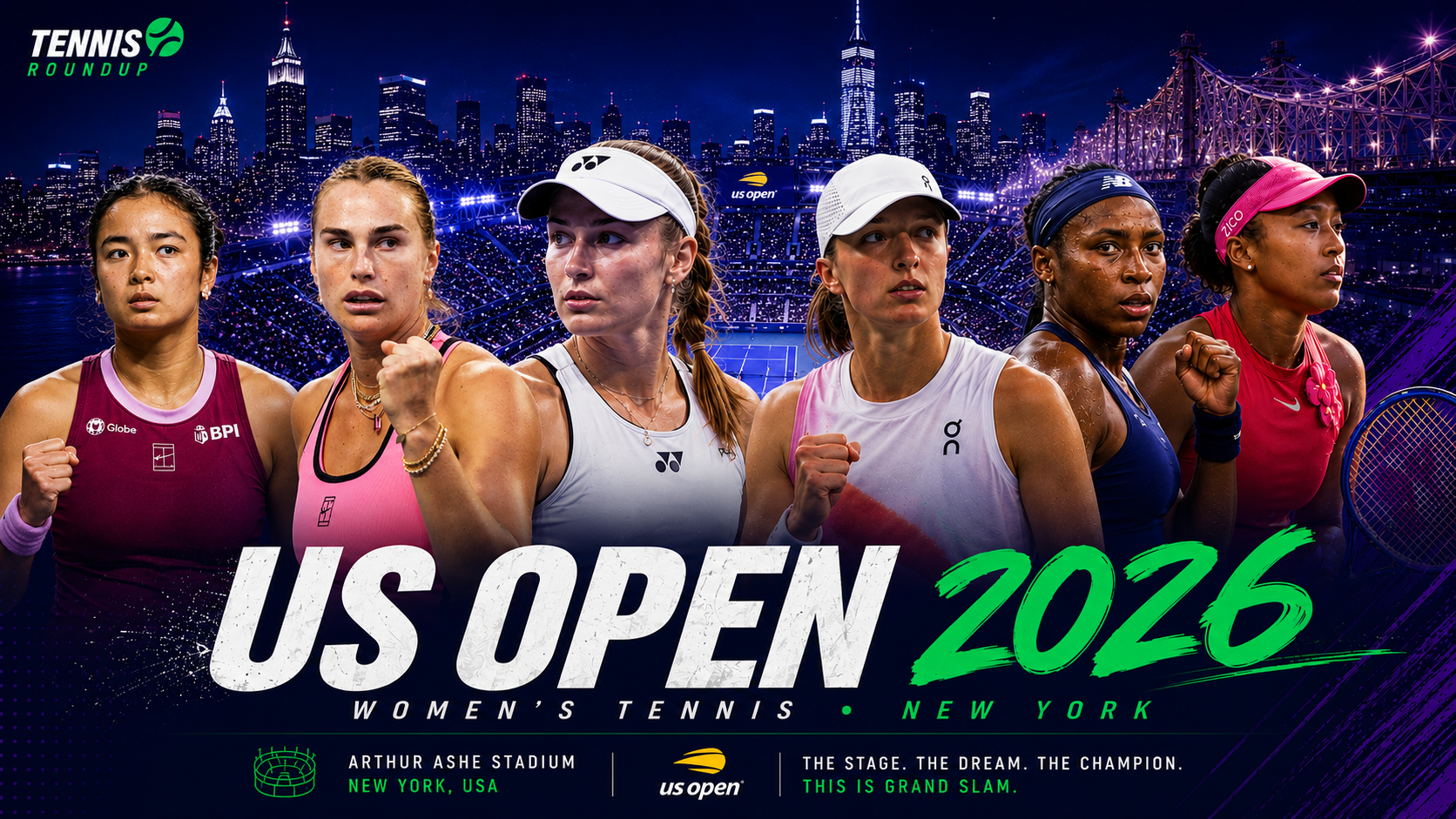
Sabalenka and Rybakina Set Up Battle for the Crown | US Open 2026 Day 12 Roundup
The US Open 2026 Day 12 roundup delivered the championship match the tournament’s larger storylines appeared to be building toward: outgoing world No. 1 Aryna Sabalenka against incoming No. 1 Elena Rybakina.
Sabalenka defeated Jessica Pegula in straight sets to move within one victory of a historic third consecutive US Open title. Rybakina then recovered from a set down against Coco Gauff, reaching her first New York final only one day after securing the top ranking.
US Open 2026 Day 12 Roundup: Sabalenka Overpowers Pegula
Aryna Sabalenka defeated Jessica Pegula 7–5, 6–2, reaching the US Open final for the fourth consecutive year.
The opening set was much closer than the final scoreline suggests.
Pegula protected her serve impressively through the first ten games, repeatedly preventing Sabalenka from applying sustained pressure. The American’s compact strokes and early ball-striking allowed her to match the defending champion during the fast baseline exchanges.
Sabalenka occasionally showed frustration. She double-faulted during the ninth game and struck her racket against the court as the match remained level.
That frustration did not last.
At 5–5, Sabalenka raised her aggression and held comfortably. She then attacked Pegula’s second serve in the following game, winning the first set with the match’s opening break.
The second set revealed the difference between competing with Sabalenka and stopping her.
Once the defending champion established control, Pegula could not sufficiently disrupt her rhythm. Sabalenka struck the ball with greater freedom, repeatedly found the lines and completed the victory in approximately 80 minutes.
Her final numbers demonstrated the authority of the performance:
- 29 winners
- Seven aces
- Only two sets required
- Fourth consecutive US Open final
- Eighth consecutive hard-court Grand Slam final
Pegula later described Sabalenka’s level as “insane” and acknowledged that there was little more she could have done. Reuters match report
Sabalenka Moves One Victory From History
Sabalenka has now won 19 consecutive US Open matches.
Victory in Saturday’s final would make her the first woman since Serena Williams, from 2012 through 2014, to win three consecutive US Open singles titles.
Only Chris Evert and Williams have accomplished that feat during the Open Era.
Sabalenka’s achievement would carry an unusual twist. She will surrender the world No. 1 ranking to Rybakina when the updated rankings are released, regardless of the final result.
That does not diminish what Sabalenka has produced in New York.
Her route to the championship match included a difficult quarterfinal against Linda Nosková, when she recovered from a break down in the deciding set. Against Pegula, she displayed the opposite skill: turning a close match into a controlled victory before her opponent could create genuine danger.
The final therefore gives Sabalenka an opportunity to exchange one crown for another. She may leave New York without the No. 1 ranking—but with a third consecutive US Open trophy.
Watch: Sabalenka vs Pegula highlights
Rybakina Recovers to Eliminate Gauff
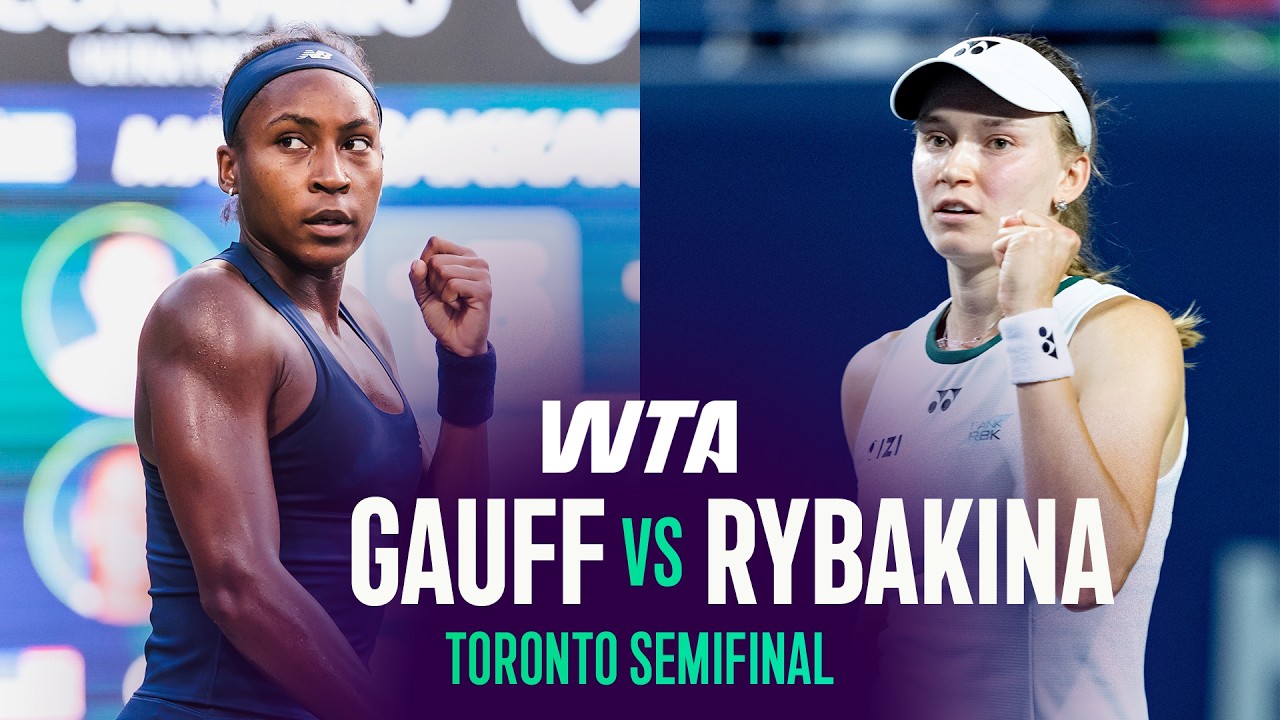
Elena Rybakina defeated Coco Gauff 3–6, 6–4, 6–4, completing a composed comeback under intense pressure from the Arthur Ashe Stadium crowd.
Gauff controlled the opening set with her movement and defensive coverage.
She repeatedly forced Rybakina to play an additional shot, drawing errors from the incoming world No. 1. Gauff secured the decisive break during the sixth game and maintained the advantage to take the set.
Rybakina did not panic.
She improved her serving, reduced the number of rushed attacks and began targeting Gauff’s forehand more consistently. The adjustment gradually shortened the rallies and denied Gauff the time she had used so effectively during the opening set.
One break decided the second.
Rybakina then increased the pressure in the final set and broke for a 5–3 lead. Gauff responded immediately, recovering the break and raising hopes of another dramatic escape after saving two match points against Mirra Andreeva in the quarterfinals.
This time, there was no escape.
Gauff could not hold serve at 4–5. Rybakina attacked the opportunity and broke again to secure her first US Open final.
The result also continued Rybakina’s remarkable transition from injury concern to championship contender. She retired during the Cincinnati tournament and entered New York with questions surrounding her physical condition.
She will now leave the tournament as the new world No. 1—and potentially as the US Open champion.
Watch: Gauff vs Rybakina highlights:
Gauff’s Fighting Run Ends One Match Short
Gauff’s campaign contained some of the tournament’s most dramatic moments.
She entered the semifinal carrying a ten-match winning streak and the confidence gained from saving two match points against Andreeva.
Against Rybakina, however, the weaknesses she had survived in the quarterfinal became more costly.
Gauff’s movement and defence kept her competitive, but her forehand became increasingly vulnerable once Rybakina established control of the baseline. The American finished with 34 unforced errors and could not consistently protect the second serve.
Her late break in the deciding set showed familiar resistance. Losing serve immediately afterward showed the difficulty of repeatedly depending on recovery.
Gauff leaves New York with a semifinal appearance and another example of her competitive strength. The tournament also provided a clear technical reminder: resilience can rescue difficult matches, but it cannot permanently compensate for an unstable serve and forehand against the most powerful players.
Her defeat, combined with Pegula’s earlier loss, means no American woman will contest a Grand Slam singles final in 2026—the first season that has happened since 2006.
Pegula Meets the Sabalenka Barrier Again
Pegula reached her third consecutive US Open semifinal but once again encountered the opponent who has repeatedly blocked her path in New York.
Sabalenka defeated Pegula in:
- The 2024 US Open final
- The 2025 US Open semifinal
- The 2026 US Open semifinal
Pegula did defeat Sabalenka during the Berlin grass-court season, winning the deciding set 6–0. That result offered encouragement before their latest meeting, but hard court—particularly Arthur Ashe Stadium—produced a familiar outcome.
The defeat does not erase Pegula’s consistency.
She recorded her 50th victory of the season during the quarterfinals and remains one of the tour’s most reliable performers. The unresolved question is whether consistency alone can carry her through the final stages of a Grand Slam when the draw presents a player with Sabalenka’s peak power.
For a third consecutive year, the answer in New York was no.
Sabalenka vs. Rybakina: The Final the Season Deserves
The US Open championship will be decided by the two players who have defined the women’s hard-court season.
Sabalenka and Rybakina have already met three times in 2026:
- Australian Open final: Rybakina won
- Indian Wells final: Sabalenka won
- Miami semifinal: Sabalenka won
Their US Open meeting will also be their third Grand Slam final against each other.
Sabalenka won their first at the 2023 Australian Open. Rybakina reversed the outcome in Melbourne earlier this year.
Now they meet in New York with several overlapping stories:
- Sabalenka is pursuing a historic US Open three-peat.
- Rybakina is attempting to celebrate reaching No. 1 with the title.
- Sabalenka wants to demonstrate that losing the ranking has not removed her from the top of the sport.
- Rybakina can end Sabalenka’s 19-match New York winning streak.
- The winner will claim the final Grand Slam title of 2026.
Sabalenka leads their overall rivalry 10–7, but the margins between them have frequently been narrow. Their contrasting versions of first-strike tennis make the matchup particularly compelling: Sabalenka applies greater emotional and physical intensity, while Rybakina’s power arrives with quieter, more economical execution.
The No. 1 ranking has already been decided.
The identity of the sport’s dominant hard-court champion has not.
What Day 12 Told Us
Sabalenka and Rybakina reached the same destination through contrasting performances.
Sabalenka absorbed Pegula’s strong opening set and then overwhelmed her. Rybakina lost the opening set to Gauff, adjusted patiently and controlled the most important stages of the next two.
Both demonstrated why they are the appropriate finalists.
Pegula and Gauff were not defeated by lack of effort. They encountered opponents whose strongest weapons proved more reliable when the semifinal pressure increased.
The final now provides a fitting resolution to the tournament’s most important ranking story.
Rybakina has taken the No. 1 position.
Sabalenka still owns the US Open crown.
On Saturday, the new No. 1 must attempt to take that from her too.
Related Articles
- US Open 2026 Day 5 roundup
- US Open 2026 Day 4 roundup
- US Open 2026 Day 3 roundup
- US Open 2026 Day 2 roundup
- US Open 2026 Day 1 roundup
- US Open Women’s Tennis Roundup hub
- US Open 2026 women’s seedings
News Sources
- Sabalenka beats Pegula and moves closer to US Open three-peat — Reuters
- Pegula praises Sabalenka after semifinal defeat — Reuters
- Rybakina beats Gauff to book US Open final against Sabalenka — Reuters
- Sabalenka moves to the brink of a US Open three-peat — The Guardian
- Rybakina defeats Gauff to set up Sabalenka final — The Guardian
- Sabalenka defeats Pegula 7–5, 6–2 — NBC Sports