
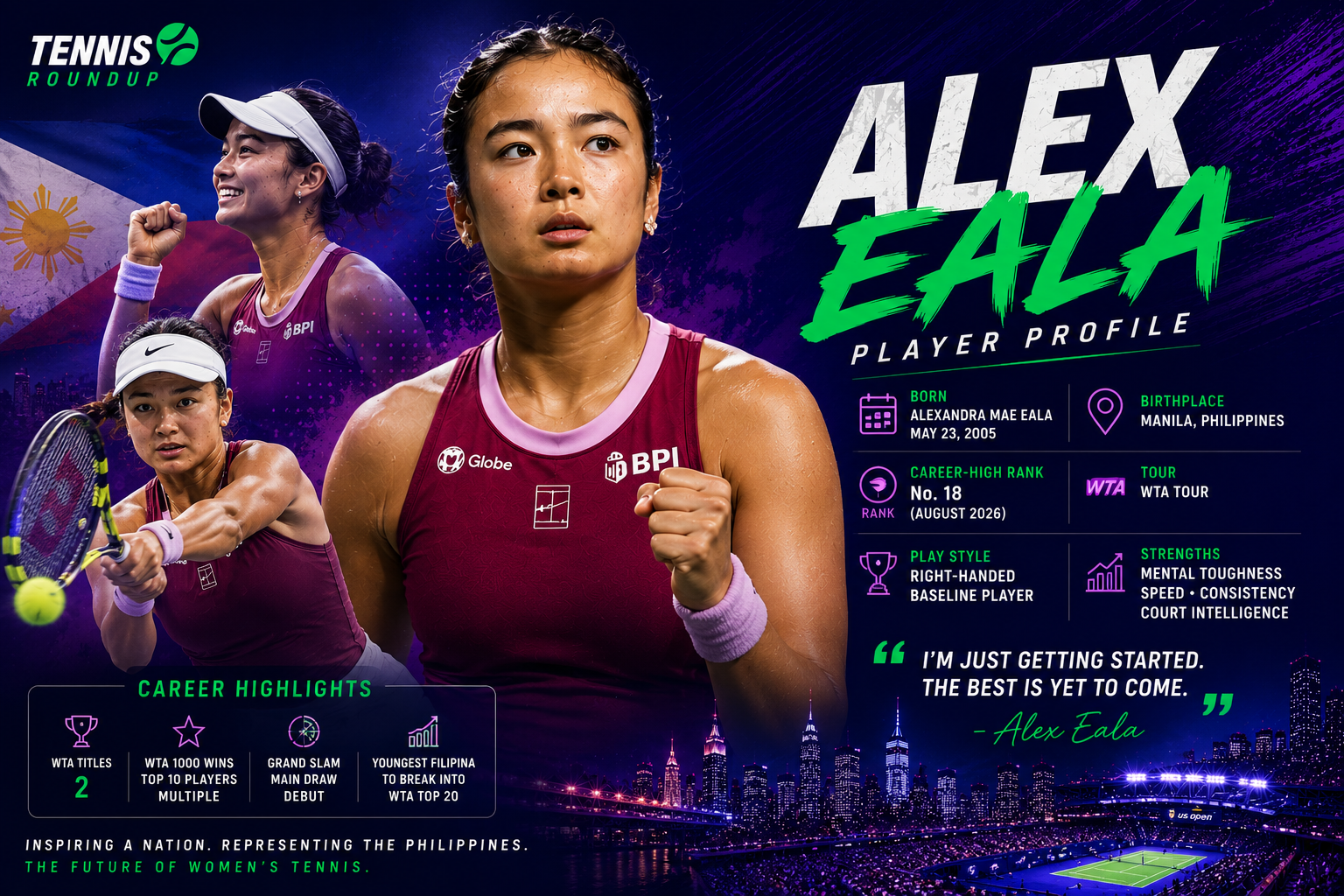
Why Early Exits Do Not Define Alex Eala—or Any Tennis Player
Alexandra Eala’s rise has brought unprecedented attention to Philippine tennis.
It has also brought something that frequently follows sporting success: unrealistic expectations.
When Eala wins, she is celebrated as a national hero. When she loses early, some social media commenters quickly dismiss her as an “Exit Queen.”
The nickname may generate reactions, but it reveals a poor understanding of professional tennis.
In every singles tournament, only one player leaves as champion. Everyone else eventually exits.
A loss is not an exception in tennis. It is part of the sport.
Every Tennis Player Eventually Exits
Consider a standard singles draw.
Half of the players lose in the opening round. Half of those who remain lose in the next. The process continues until only one champion is left.
Even the greatest players in tennis history have lost far more tournaments than they have won.
A player can therefore have an excellent season without regularly lifting trophies. Reaching later rounds, defeating higher-ranked opponents, improving on different surfaces and consistently qualifying for major events can all represent meaningful progress.
Unlike a team league, where a club can lose several games and still finish as champion, most tennis tournaments use direct elimination.
One difficult matchup, poor performance, physical problem or bad day can end a player’s tournament immediately.
That does not erase the work required to reach the event in the first place.
Winning Every Tournament Is Not a Realistic Expectation
Fans sometimes begin treating victories as an entitlement after a player produces a breakthrough result.
A major upset creates excitement. A deep tournament run raises expectations. Once a player reaches a new level, every subsequent defeat can suddenly appear like regression.
But athletic development is rarely linear.
As a player’s ranking improves, she gains entry into larger tournaments. Those events also bring stronger fields, more experienced opponents and fewer forgiving matchups.
Opponents begin studying her tendencies. They examine her serve patterns, preferred rally positions and responses under pressure. The player must continue changing because the rest of the Tour is also adjusting.
Media attention, public expectations and a demanding schedule add further pressure.
Reaching a higher level does not make winning easier. It often makes every match more difficult.
What It Takes to Raise a Tennis Player
Professional tennis is an individual sport, but no player develops alone.
Behind the athlete is usually a network of parents, coaches, trainers, medical professionals, academies and sponsors. Long before meaningful prize money arrives, someone must finance the player’s development.
The investment can include:
- Coaching and court time
- Rackets, strings, shoes and other equipment
- Physical training and physiotherapy
- Tournament participation
- International travel and accommodation
- Visas, transportation and meals
- Education arranged around competition
- Travel expenses for coaches or family members
- Medical treatment and injury recovery
There is no professional club automatically paying these expenses.
A tennis player is effectively an independent sporting business responsible for assembling and financing her own team. For young players, much of that burden initially falls on their families.
The family makes the investment without any certainty that the child will eventually reach the professional Tour.
The Sacrifices Behind Alex Eala
Eala’s journey began years before she became internationally known.
She started playing tennis as a young child, with her maternal grandfather becoming one of her earliest coaches. Her family supported her training and participation in tournaments in the Philippines and abroad.
After Eala won the prestigious Les Petits As junior tournament in France, the Rafa Nadal Academy offered her an opportunity to continue her development in Spain.
Moving abroad as a young teenager required more than financial support.
Eala had to live away from home, adapt to a different culture and combine formal education with the demands of elite training. Her family had to accept the separation and uncertainty accompanying that decision.
The academy scholarship provided an important foundation, but building an international career still required continued support from her family, coaches and private sponsors.
During a public controversy in 2020, Eala’s family disputed a Philippine Sports Commission announcement suggesting that government assistance had already been received.
The PSC later corrected its statement. Eala’s uncle, Noli Eala, explained at the time that she was training through an academy scholarship while her travel was being supported by her family and private sponsors. GMA News
The episode illustrated a challenge faced by athletes from countries without extensive tennis-development systems: government or federation support may be limited, delayed or difficult to access.
Families and private supporters often carry players through the years when expenses are high and earnings remain uncertain.
Prize Money Is Not the Same as Profit
Published prize-money totals can create a misleading impression of how much a tennis player actually earns.
Those figures represent gross tournament income—not the amount remaining after professional expenses and taxes.
Players may have to pay for:
- Coaches
- Fitness trainers
- Physiotherapists
- Agents and managers
- International flights
- Hotels and local transportation
- Training facilities
- Equipment and racket servicing
- Insurance and medical care
Tournament winnings may also be taxed in different countries throughout the season.
A first-round appearance can generate prize money, but reaching that tournament may already have required considerable spending.
This financial reality is particularly difficult for players outside the highest rankings. Many travel without a full professional team, share accommodation or depend on family, federations and private sponsors to continue competing.
Professional tennis may appear glamorous from the stands. Behind the scenes, it can be a financially uncertain career.
Why Sponsors and Endorsements Matter
Prize money is only one part of a professional player’s financial support system.
Established and marketable athletes may also earn or receive assistance through:
- Clothing and equipment partnerships
- Corporate endorsements
- Travel sponsorships
- Advertising campaigns
- Appearance agreements
- Commercial licensing
- Social media partnerships
- National and local business support
These relationships can provide greater financial stability than tournament results alone.
Prize money depends on how far a player advances during a particular week. A sponsor, however, may support an athlete throughout an entire season or over several years.
That continuity can help cover training, international travel, equipment and the professional team required to compete consistently.
Sponsors are not interested only in trophies.
They also consider an athlete’s visibility, reputation, personality, audience connection and commercial potential. Rankings and tournament results remain important, but they are not the only measures of value.
This is particularly relevant to Eala.
Her appeal extends beyond individual match results. She represents the Philippines internationally, has developed a passionate following and attracts Filipino supporters wherever she competes.
That visibility creates value for businesses seeking an association with her achievements, identity and audience.
An early tournament exit may reduce that week’s prize money, but it does not automatically erase her commercial value.
Sponsorship Is Also Earned
Sponsors do not replace performance.
Continued results help a player preserve visibility and commercial interest. Rankings, appearances in major tournaments and victories over prominent opponents all contribute to an athlete’s marketability.
But sponsorship should not be treated as an undeserved reward.
Companies invest because the athlete has created something valuable through achievement, reputation, reach and public connection.
A player who attracts attention can help a sponsor reach a particular audience. A respected athlete can strengthen a brand’s credibility. A compelling personal story can create a connection that lasts beyond one tournament.
For Eala, sponsorship is not separate from the career she has built.
It is one of the results of that career.
Support Should Not Become Ownership
Filipino fans have every right to celebrate Eala’s victories and feel disappointed after her defeats.
Support, however, does not give anyone ownership over an athlete’s results.
Eala carries the Philippine flag, but she does not owe the public a championship every week. She competes against other professionals who have also trained for years, made sacrifices and arrived determined to win.
Criticism of tactics, shot selection, scheduling or performance is part of serious sports discussion.
Mockery is different.
Reducing a player to an insulting nickname after a defeat contributes nothing to understanding the match or the athlete’s development. It overlooks the difficulty of competing at the level she has already reached.
Supporting an athlete does not mean pretending every performance was good. It means evaluating the performance fairly and understanding it within the wider direction of the player’s career.
A Loss Can Still Move a Career Forward
Not every defeat represents progress, and athletes should not be protected from honest analysis.
Some performances are disappointing. Some tactical decisions deserve examination. Players and coaches must identify weaknesses and address them.
But one defeat does not define a career.
The better questions are:
- Is the player competing regularly at a higher level?
- Is she becoming more competitive against stronger opponents?
- Is her game developing across different surfaces?
- Is she improving the weaker areas of her game?
- Is she physically capable of managing a demanding season?
- Is she responding constructively after setbacks?
- Is her ranking moving in the right direction over time?
These questions reveal development more accurately than the result of one match.
Ranking progress is built across an entire season. It reflects accumulated performances, not the emotional reaction following a single defeat.
There Is Only One Champion
Every tennis tournament produces one champion and a long list of players who exited somewhere along the way.
Some lose in the opening round. Others lose in the final. Both have technically been eliminated, but nobody would seriously argue that their achievements were identical.
Context matters.
Alex Eala should be evaluated through the direction of her career—not through a nickname attached to individual defeats.
Her family helped build the foundation. Coaches and academies helped develop her game. Sponsors helped make the journey sustainable. Filipino supporters gave her a powerful community behind her.
But once a match begins, Eala stands alone on her side of the net.
Sometimes she will win.
Sometimes she will lose.
That is not evidence that she does not belong.
That is professional tennis.