
Ice Conquers Fire as Rybakina Wins New York | US Open 2026 Day 13 Final Roundup
US Open 2026 Day 13 Final Roundup
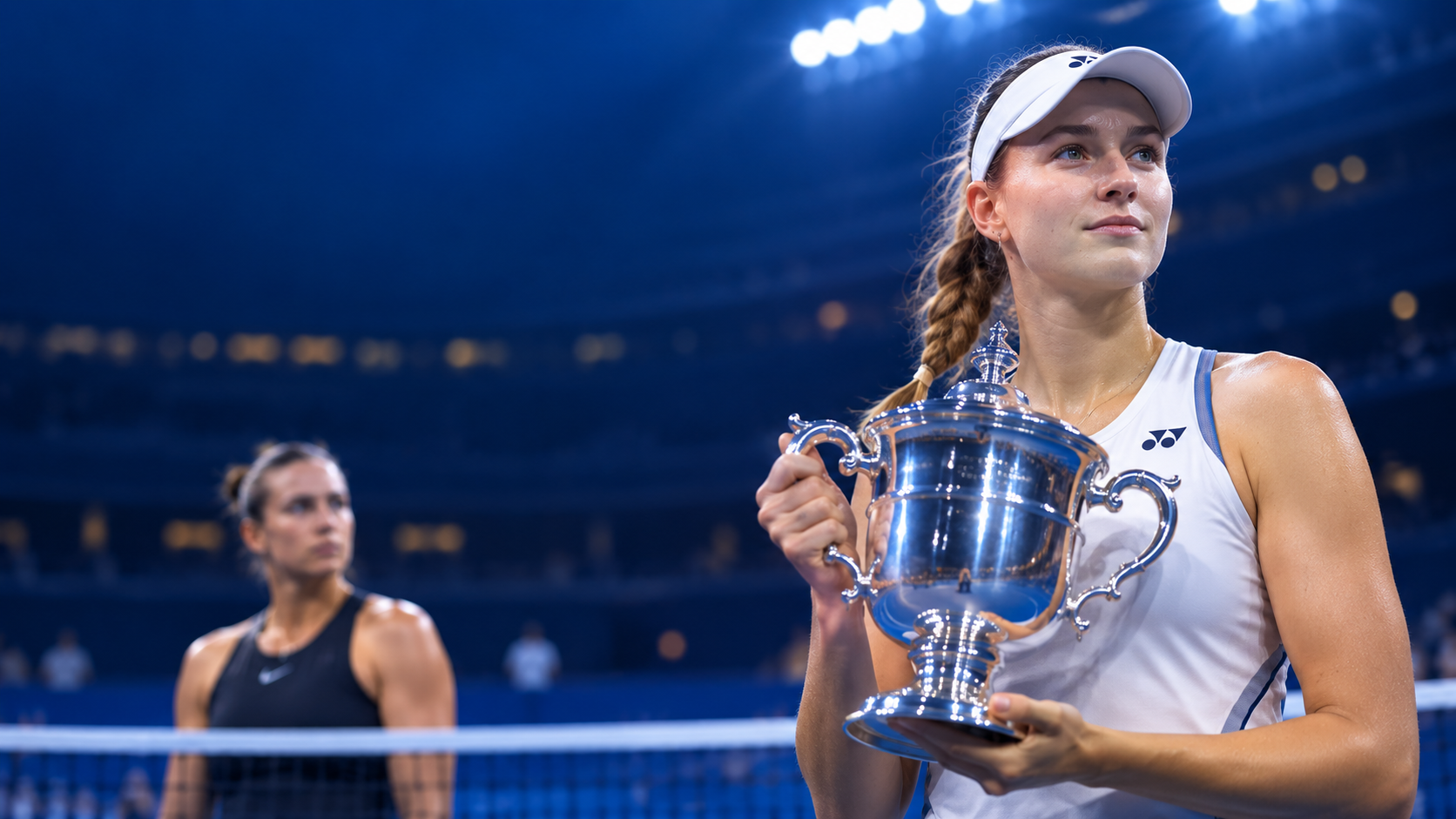
The US Open 2026 Day 13 Final roundup closes with Elena Rybakina defeating Aryna Sabalenka 6–4, 5–7, 6–2 to win her first US Open title.
The final completed Rybakina’s extraordinary New York transformation. She arrived with injury concerns, secured the world No. 1 ranking during the quarterfinals and then defeated the woman whose position she was taking. Rybakina leaves with both crowns: world No. 1 and US Open champion.
US Open 2026 Day 13 Final Roundup: Ice Takes the Crown
The commentator’s description of this rivalry as “Ice and Fire” proved especially appropriate.
Sabalenka brought the emotion, physical intensity and explosive power. Rybakina answered with a controlled expression, economical movement and power delivered with almost no visible effort.
Ice prevailed.
Rybakina completed the victory with an ace—an appropriate conclusion to a match in which her serve repeatedly provided the security Sabalenka could not find.
The victory gives Rybakina:
- Her first US Open title
- Her third Grand Slam singles championship
- Her second major title of 2026
- The world No. 1 ranking for the first time
- A second Grand Slam final victory over Sabalenka this season
- A record $5.5 million winner’s prize
She previously won Wimbledon in 2022 and defeated Sabalenka in the 2026 Australian Open final.
Rybakina Controls the Opening Set
Rybakina established the match’s tactical pattern almost immediately.
She absorbed Sabalenka’s pace without appearing rushed and repeatedly attacked the outgoing world No. 1’s second serve. Her flat backhand was particularly damaging, taking time away from Sabalenka and preventing her from controlling the baseline.
The most surprising first-set statistic was Rybakina’s first-serve percentage: only 28%.
That number would normally indicate serious trouble. Instead, she won 88% of the points when her first serve landed and continued protecting her service games behind an effective second delivery.
Sabalenka struggled to make an impression on the return.
Rybakina also won approximately 64% of the points played behind Sabalenka’s second serve, turning the defending champion’s service games into physical and emotional battles.
At 5–4, Rybakina produced another forceful service game. Sabalenka saved the first set point with an inside-in forehand but eventually struck long on the second.
Rybakina took the opening set 6–4, barely celebrating as she returned to her chair.
Sabalenka Forces the Final Into a Decider
Sabalenka was frequently second-best during the opening two sets, but champions do not always need to control a match to extend it.
She stayed close enough to create an opportunity.
Rybakina continued moving comfortably through her service games, while Sabalenka repeatedly required more effort to protect hers. The pressure almost produced another break when Rybakina earned two opportunities during the third game of the second set.
Sabalenka saved both.
That hold prevented Rybakina from creating early separation, and the set remained level despite the incoming No. 1 appearing to possess the greater control.
At 5–4, Sabalenka finally earned her first break points—and two set points—on Rybakina’s serve. Rybakina saved both and escaped the game.
The danger returned at 6–5.
A nervous forehand from Rybakina presented Sabalenka with another set point. This time, Sabalenka attacked a backhand return down the line and converted.
After spending much of the match trying to contain Rybakina, Sabalenka had somehow taken the second set 7–5.
The final was level.
Rybakina Delivers a Decisive Final Set
The championship match became the 11th of Sabalenka and Rybakina’s 18 meetings to require a deciding set.
Momentum appeared to favour Sabalenka after her late second-set escape. Rybakina responded as though the missed opportunity had never occurred.
She immediately returned to her controlled service rhythm and resumed attacking Sabalenka’s delivery.
With Sabalenka serving at 1–1, Rybakina defended through a longer exchange and earned two break points. Sabalenka saved the first but sent the ball beyond the baseline on the second.
Rybakina had the decisive break.
She then held comfortably, refusing to give Sabalenka any route back into the match. By the time Rybakina led 4–2, she had lost only one point on serve during the deciding set.
Sabalenka’s frustration became increasingly visible. Rybakina’s expression barely changed.
Another double fault placed Sabalenka under pressure at 2–4. Rybakina eventually broke again, leaving herself to serve for the championship at 5–2.
The final game briefly tightened when Rybakina double-faulted at 30–0. Sabalenka closed to 40–30, but Rybakina still held championship point.
She finished with an ace.
No extended rally. No uncertainty. One final serve to complete the tournament.
Rybakina Wins Both Crowns
Rybakina had already done enough to become world No. 1 by defeating Qinwen Zheng in the quarterfinals.
Winning the ranking without winning the tournament would still have represented an exceptional achievement. Winning the US Open transformed the story.
Rybakina did not merely accumulate enough points to pass Sabalenka. She defeated the outgoing No. 1 directly in the championship match and took the title Sabalenka had held for two years.
The No. 1 Chase storyline therefore receives the strongest possible resolution:
Rybakina chased the ranking, secured it—and then defeated the woman she replaced to claim the US Open trophy.
Her route through New York included both commanding performances and significant tests:
- Rebecca Šramková: 6–2, 6–2
- Jessica Bouzas Maneiro: 6–2, 6–4
- Yuliia Starodubtseva: 6–3, 6–2
- Naomi Osaka: 6–3, 6–4
- Qinwen Zheng: 3–6, 6–1, 6–4
- Coco Gauff: 3–6, 6–4, 6–4
- Aryna Sabalenka: 6–4, 5–7, 6–2
Rybakina defeated three consecutive elite opponents from the quarterfinals onward. She recovered from a set down against Zheng and Gauff, then resisted Sabalenka after failing to close the final in straight sets.
The calm exterior should not be confused with an easy passage. Rybakina repeatedly faced pressure and simply declined to advertise it.
US Open, US Open 2026, WTA, Elena Rybakina, Aryna Sabalenka, Women’s Tennis, Grand Slam Tennis, World No. 1, Tennis Rivalries
Rybakina Collects a Record $5.5 Million Prize
Along with the trophy and world No. 1 ranking, Elena Rybakina earned $5.5 million in prize money as the 2026 US Open women’s singles champion.
It is the largest winner’s payment in US Open history. The tournament offered a record $108 million in total player compensation, an increase of 20% from the previous year.
The figure gives Rybakina’s victory another significant dimension. She did not simply leave New York with the ranking and title—she also collected the largest single championship payout the tournament has awarded.
Sabalenka’s Three-Peat Ends One Victory Short
Sabalenka entered the final pursuing a third consecutive US Open title and a place beside Chris Evert and Serena Williams in the tournament’s Open Era history.
Rybakina denied her.
The defeat ended Sabalenka’s 19-match US Open winning streak and means she finishes the 2026 Grand Slam season without a major title for the first time since 2022.
That statistic is striking, but it should not erase her hard-court consistency.
Sabalenka reached her fourth consecutive US Open final and her eighth consecutive hard-court Grand Slam championship match. She also recovered from difficult positions against Linda Nosková in the quarterfinals and Rybakina during the final.
Her inability to complete the comeback was not a failure of effort. Rybakina simply provided too little weakness during the deciding set.
Sabalenka showed frustration after the final point and struck her racket against the court. The reaction reflected the importance of what had escaped her: the title, the three-peat and the opportunity to soften the loss of her No. 1 ranking.
Ice and Fire Becomes the Rivalry of the Moment
The result reduces Sabalenka’s advantage in their rivalry to 10–8.
More importantly, Rybakina now leads their 2026 Grand Slam finals 2–0:
- Australian Open: Rybakina won 6–4, 4–6, 6–4
- US Open: Rybakina won 6–4, 5–7, 6–2
Sabalenka defeated Rybakina at Indian Wells and Miami, but Rybakina won the two meetings carrying the greatest weight.
Their matches work because their similarities disguise important differences.
Both are elite first-strike players. Both possess powerful serves and attempt to control points early. But their emotional rhythms could hardly be more different.
Sabalenka plays like fire: expressive, forceful and constantly attempting to impose herself on the contest.
Rybakina plays like ice: restrained, precise and difficult to read.
The labels simplify two complex athletes, but they provide an effective editorial identity for a rivalry increasingly capable of defining the women’s tour.
This US Open final should not be treated as the end of that story. It is the strongest chapter so far.
What the Final Told Us
Rybakina is no longer merely one of several players capable of defeating the best.
She is now the player the rest of the tour must chase.
Winning the Australian Open and US Open in the same season already establishes her as the dominant women’s hard-court player of 2026. Adding the No. 1 ranking makes the conclusion difficult to dispute.
The title was also won through more than serving.
Rybakina defended effectively, absorbed Sabalenka’s power and remained tactically clear after losing the second set. Her final-set response showed that the calmness associated with her personality is not passivity. It is competitive control.
Sabalenka remains the sport’s most consistent hard-court Grand Slam performer, but the balance of power has shifted.
She entered New York holding two crowns.
Rybakina leaves with both.
YouTube Highlights
The complete official US Open final highlights had not yet been published when this roundup was completed.
The official channel currently has these supporting videos:
- Aryna Sabalenka vs. Elena Rybakina Walk-Out | 2026 US Open Final
- Elena Rybakina Wins Opening Set in Final | 2026 US Open
Wait for the official video titled approximately:
Aryna Sabalenka vs. Elena Rybakina Highlights | 2026 US Open Final
Use that as the article’s primary embed once it appears on the verified US Open Tennis Championships channel. Avoid similarly titled livestreams, reactions and Australian Open highlights already appearing in the results.
Sources
- Aryna Sabalenka vs. Elena Rybakina: US Open women’s final — The Guardian
- Rybakina defeats Gauff to book the US Open final — Reuters
- Sabalenka defeats Pegula and moves closer to three-peat — Reuters
- Pegula reflects on Sabalenka’s semifinal performance — Reuters
- US Open singles champions receive record $5.5 million — ESPN
- 2026 US Open winners take home record $5.5 million — CBS Sports
- 2026 US Open offers $108 million in player compensation — Official US Open
Further Reading
- Elena Rybakina’s journey to world No. 1
- US Open 2026 Day 12 roundup
- US Open 2026 Day 5 roundup
- US Open 2026 Day 4 roundup
- US Open 2026 Day 3 roundup
- US Open 2026 Day 2 roundup
- US Open 2026 Day 1 roundup
- Rybakina–Sabalenka rivalry: Ice and Fire
- US Open 2026 women’s tournament hub
- Qinwen Zheng’s comeback story