
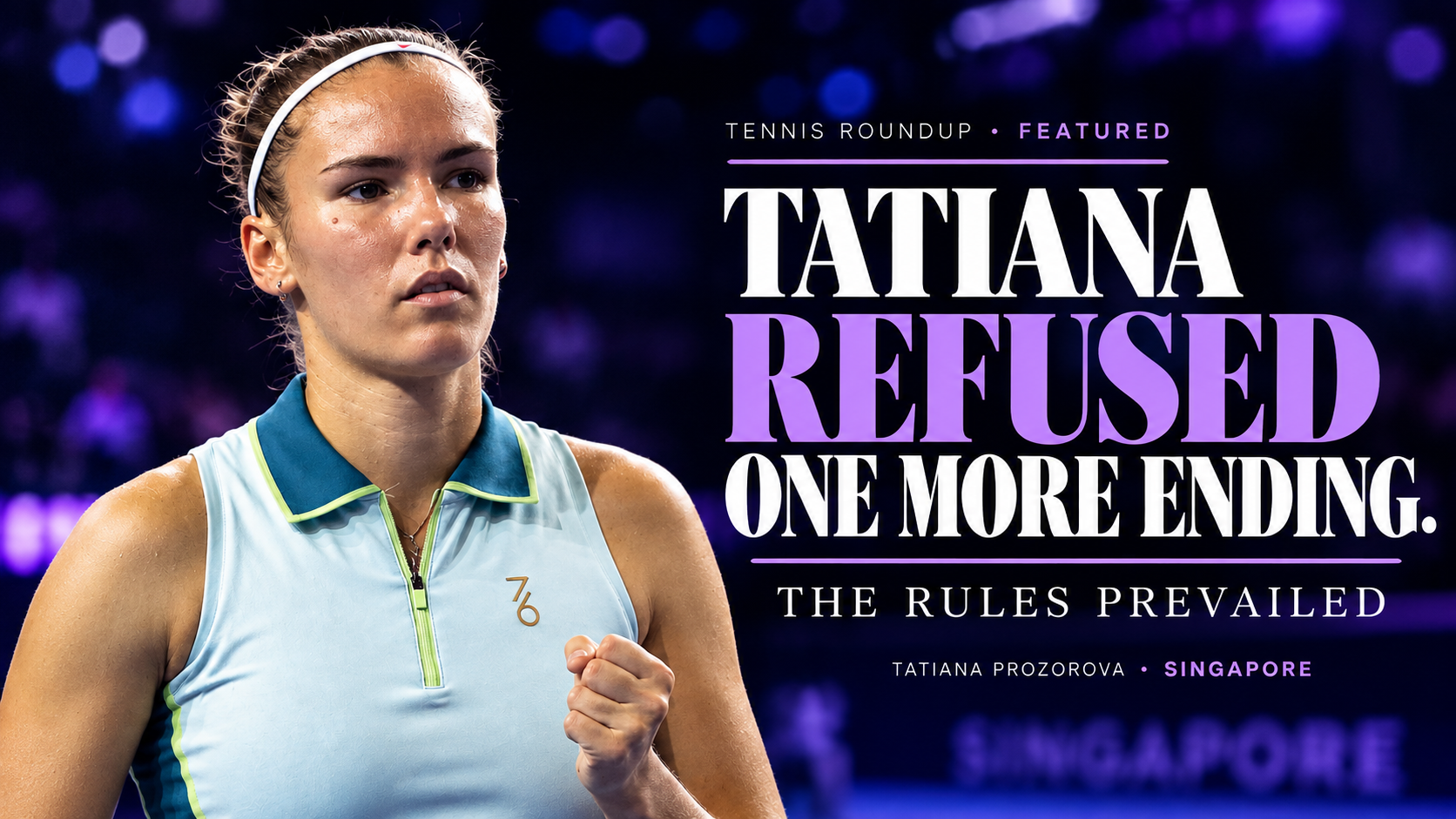
Tatiana Prozorova Refused the Ending — But the WTA Ended Her Singapore Run
Tatiana Prozorova spent the Singapore Tennis Open refusing to let matches end.
Three times she lost the opening set.
Three times she came back to win.
Then, with a place in the Singapore final at stake, Prozorova never got the chance to attempt a fourth escape.
The WTA ruled her physically unable to compete in her semifinal against Talia Gibson after Prozorova was diagnosed with concussion following an incident during her doubles quarterfinal.
Prozorova disputes aspects of the assessment and has said she felt capable of playing.
The result was an unusual ending to one of Singapore’s most compelling runs: Prozorova didn’t lose her semifinal. She never got to play it.
What Happened to Tatiana Prozorova in Singapore?
Hours after defeating Wang Xinyu 3–6, 7–5, 6–4 in the singles quarterfinals, Prozorova returned to court alongside Sofya Lansere for doubles.
They faced Miyu Kato and Ellen Perez.
During the match, an overhead from Kato struck Prozorova. Prozorova and Lansere subsequently retired with Kato and Perez leading 7–5, 5–2 after 1 hour and 33 minutes.
According to the WTA statement reported in LOVE’s research, Prozorova was then assessed by the WTA medical team and tournament physician.
She was diagnosed with concussion.
Under the WTA concussion protocol, she was ruled physically unable to compete in the singles semifinal.
That sent Gibson through to the first Tour-level singles final of her career without the semifinal being played.
Prozorova Disputes the Assessment
That isn’t, however, where the story ends.
Prozorova has disputed aspects of what happened following the doubles match.
According to her account, the ball grazed her cheek and struck her shoulder. She has said she later felt well and has questioned elements of the assessment process that resulted in her being withdrawn from the semifinal.
That distinction matters.
The WTA’s position is that Prozorova was clinically assessed, diagnosed with concussion and ruled unable to compete under its concussion protocol.
Prozorova’s position is that she felt capable of playing and disputes aspects of the assessment that kept her off court.
Independent clinical findings were not available at our research cutoff.
Tennis Roundup therefore cannot independently determine whether Prozorova was medically fit to play.
What can be established is that the WTA’s concussion protocol prevented her from contesting the semifinal—and that Prozorova disagreed with aspects of the decision-making process.
The Player Who Refused the Ending
There is an extraordinary coincidence in how Prozorova’s Singapore tournament ended.
Before her quarterfinal against Wang, Tennis Roundup published a Featured story about the pattern emerging in her career:
Tatiana Prozorova: The Player Who Refuses the Ending.
It wasn’t written after the Wang match.
It was written before it.
Against Sofia Costoulas, Prozorova had been a set and 4–2 down before winning 5–7, 7–6(2), 6–2.
Against No. 3 seed Alexandra Eala, she was again a set and 4–2 down. Eala even had a point for a 5–2 double-break lead.
Prozorova came back again, winning 4–6, 7–5, 6–3.
Then she played Wang.
And did it again.
3–6, 7–5, 6–4.
Three Singapore singles matches.
Three opening sets lost.
Three victories.
By the end of the Wang quarterfinal, Prozorova had spent exactly 9 hours and 1 minute playing singles in Singapore.
But that workload should not be confused with the stated reason for her semifinal withdrawal.
The WTA cited the concussion diagnosis and its protocol—not accumulated fatigue.
Singapore Didn’t Create the Prozorova Story
Her Singapore comebacks weren’t entirely without precedent.
At the 2023 US Open qualifying tournament, Prozorova survived eight first-set set points and a match point before defeating Tamara Zidansek 7–6(11), 3–6, 7–6[8] in 3 hours and 29 minutes.
Her career since has included gradual progress through ITF events and WTA 125 competition before Singapore delivered another breakthrough: her first victory over a Top-20 opponent and her first WTA quarterfinal.
That was why we wrote the original story.
Singapore didn’t create the player who kept escaping.
It revealed her to a much larger audience.
Talia Gibson Advances to the Singapore Final
There is another player’s achievement that shouldn’t disappear underneath the circumstances of the walkover.
Gibson earned her semifinal place.
The 22-year-old Australian moved into the main draw following withdrawals and then defeated Fiona Ferro 6–3, 6–3, Viktoria Morvayova 7–6(2), 7–6(1), and No. 7 seed Maria Sakkari 6–1, 4–6, 6–2.
The semifinal itself was not played.
The walkover sent Gibson into her first Tour-level singles final, where she will face Leylah Fernandez.
An Ending Prozorova Didn’t Choose
It would be easy to turn what happened into a neat ending to the story we had already written.
It isn’t one.
We cannot determine from the available evidence whether Prozorova should have been cleared to compete, and a disagreement over a concussion assessment is more important than preserving a clever narrative.
The WTA says its medical process determined she could not play.
Prozorova disputes aspects of that process and says she felt capable of continuing.
Both facts belong in the record.
But one thing is certain.
After surviving Costoulas, Eala and Wang, Tatiana Prozorova’s Singapore run did not end with another player beating her across the net.
The player who had spent all week refusing the ending finally encountered one she wasn’t permitted to contest.
Related Reading:
- Singapore Tennis Open 2026
- Tennis Roundup Singapore Open Page
- Singapore Tennis Open 2026 Seedings
- Singapore Tennis Open 2026 Day 1
- Singapore Tennis Open 2026 Day 2
- Singapore Tennis Open 2026 Day 3
- Singapore Tennis Open 2026 Day 4
- Singapore Tennis Open 2026 Quarterfinals
- Singapore Tennis Open 2026 Semifinals
- Singapore Tennis Open 2026 Finals