
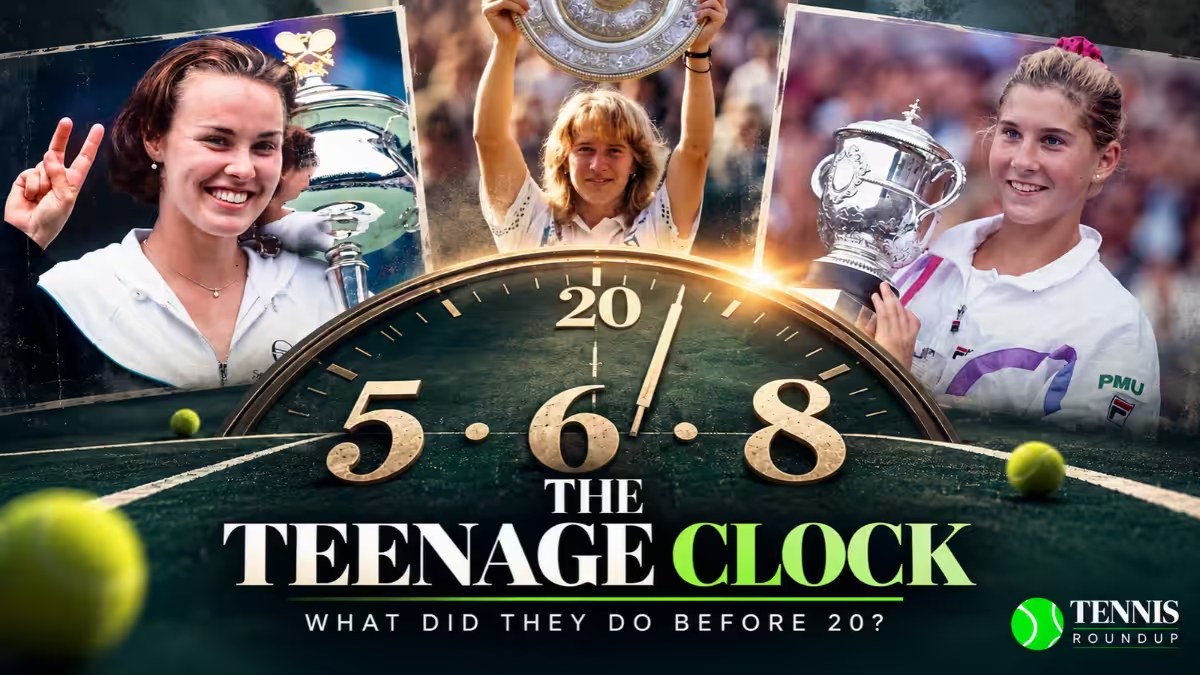
Before Graf, Two Was the Teenage Ceiling
For the first three years of the Open Era, the number was zero.
No woman had won a Grand Slam singles title as a teenager.
Then Evonne Goolagong arrived.
On June 5, 1971, the 19-year-old Australian defeated Helen Gourlay 6–3, 7–5 to win Roland Garros.
The Teenage Clock had its first number.
One.
It lasted 27 days.
At Wimbledon, Goolagong defeated Margaret Court 6–4, 6–1.
She was still 19.
And now the number was:
Two.
Nobody knew it yet, but women’s tennis had just found a teenage Grand Slam ceiling that would survive for almost 17 years.
Goolagong Created the Ceiling
Goolagong did two different things during those remarkable 27 days in 1971.
At Roland Garros, she became the first teenage woman to win a Grand Slam singles championship in the Open Era.
At Wimbledon, she became the first to win two before turning 20.
They were separate milestones, accomplished by the same player less than a month apart.
And there would be no opportunity for a third.
Goolagong turned 20 on July 31, less than a month after winning Wimbledon.
Her teenage Grand Slam clock stopped at two.
The question was whether somebody else could push it farther.
Chris Evert Reached Two — And Had a Chance at Three
Three years later, Chris Evert arrived at the same number.
She won Roland Garros in 1974 at 19.
Then she won Wimbledon.
Two.
For the first time, somebody had matched Goolagong’s teenage record.
But Evert still had time.
She entered the 1974 US Open with two Grand Slam singles championships already won that year and with an opportunity to become the first woman of the Open Era to win three before turning 20.
She reached the semifinals.
Waiting there was Goolagong.
And the woman who had created the record three years earlier helped keep it intact.
Evert lost.
Her Teenage Clock stopped at two.
Tracy Austin Started Earlier Than Everyone
Then came a very different teenage champion.
Tracy Austin was only 16 years, 8 months and 28 days old when she defeated Evert to win the 1979 US Open.
Goolagong and Evert had won their first teenage majors at 19.
Austin had put her first on the board at 16.
That gave her something they hadn’t possessed:
Time.
But a second Grand Slam didn’t come immediately.
At the 1980 US Open, Austin’s title defense ended in the semifinals.
Another year passed.
Then, at the 1981 US Open, the 18-year-old Austin defeated Martina Navratilova in a three-set final.
At last:
Two.
Austin had joined the ceiling.
But by the time she got there, someone else had already beaten her to it.
Hana Mandlíková Came Within One Match of Three
Hana Mandlíková won the 1980 Australian Open at 18.
Then she won Roland Garros in June 1981 at 19.
Two.
Goolagong.
Evert.
Mandlíková.
And, three months later, Austin.
Four teenage champions from different moments in the Open Era.
Every one of them stopped at the same number.
But Mandlíková came agonizingly close to changing it.
Only weeks after winning her second major at Roland Garros, she reached the 1981 Wimbledon final.
She was still 19.
For the first time since Goolagong had established the record a decade earlier, a teenager with two Grand Slam singles titles stood just one match away from three.
Across the net was Evert.
Evert won 6–2, 6–2.
The ceiling survived.
LOVE’s audit identifies Mandlíková’s Wimbledon run as the closest pre-Graf challenge to three: she actually reached a Grand Slam final while already holding two teenage majors.
Something Strange Had Happened
By now, the pattern was becoming difficult to ignore.
Goolagong won two.
Evert won two.
Mandlíková won two.
Austin won two.
And here’s the strange part.
In the complete Open Era period from 1968 through the eventual breaking of the record in 1988, there wasn’t a single teenage women’s Grand Slam champion who finished with exactly one teenage major.
Every woman who won one during that period managed to win another before turning 20.
One wasn’t the ceiling.
Apparently, two was.
For years, nobody moved it.
Then a teenager from West Germany won Roland Garros.
Steffi Graf Put One on the Clock
On June 6, 1987, Steffi Graf defeated Martina Navratilova 6–4, 4–6, 8–6 in the Roland Garros final.
Graf was 17.
Her first Grand Slam singles championship put her on the same road traveled by Goolagong, Evert, Austin and Mandlíková.
The number beside her name was:
One.
Seven months later, Graf reached the 1988 Australian Open final.
Across the net was Evert—the first woman who had once tried to break Goolagong’s ceiling herself.
Graf won 6–1, 7–6.
And now she had:
Two.
Still, nothing had changed.
Graf hadn’t broken the teenage record.
She had joined it.
Goolagong.
Evert.
Mandlíková.
Austin.
Graf.
Five women had reached two.
Nobody had reached three.
6,182 Days
The ceiling had been created when Goolagong won Wimbledon on July 2, 1971.
Graf equaled it at the Australian Open on January 23, 1988.
And when she arrived at Roland Garros a few months later, the old record was still standing.
Graf made the final.
Her opponent was Natasha Zvereva.
There was now only one match between Graf and a number no teenage woman in the Open Era had ever reached.
The final began.
And almost immediately, it was over.
Graf won:
6–0, 6–0.
On June 4, 1988, at 18 years, 11 months and 21 days old, Steffi Graf won her third Grand Slam singles championship.
The record Goolagong had created lasted 6,182 days.
Sixteen years.
Eleven months.
Two days.
Goolagong had reached two.
Evert had reached two.
Mandlíková had reached two.
Austin had reached two.
Graf had reached two.
And then, finally, somebody went one step farther.
Three.
The teenage ceiling was gone.
And Steffi Graf wasn’t finished.
Related Reading
The Teenage Clock: What Did the Greats Actually Do Before 20?
Before the Teenage Clock: Three Champions, Three Different Roads