
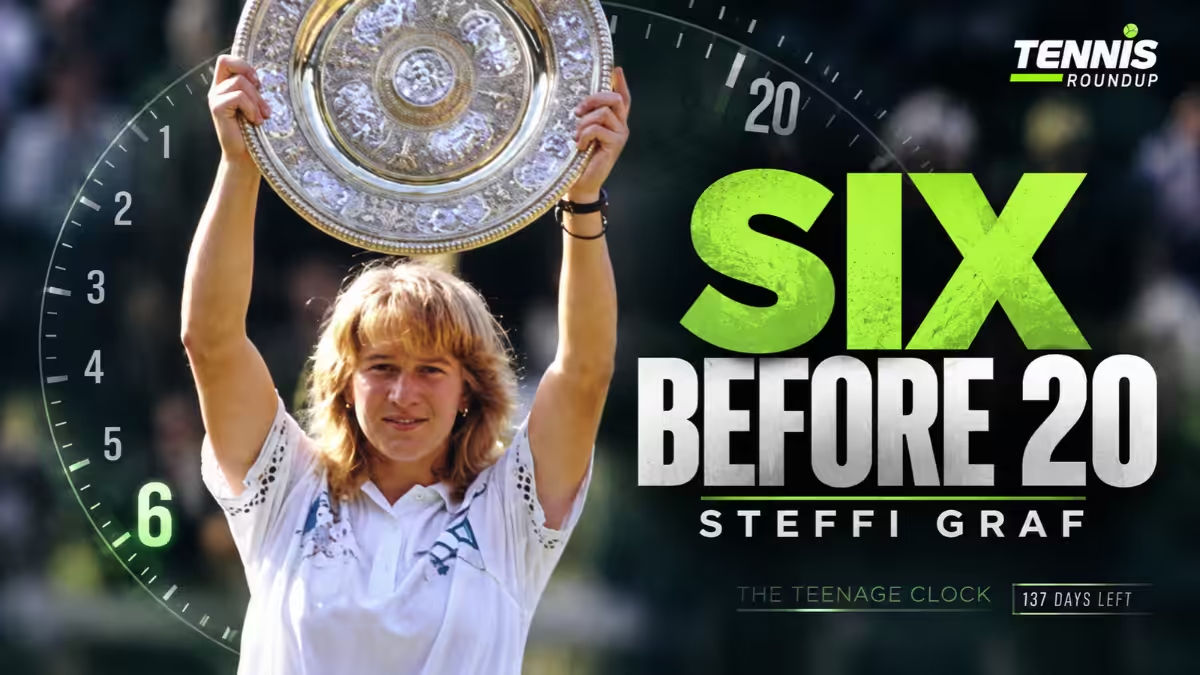
Steffi Graf: How She Broke the Teenage Ceiling—and Kept Going
On January 28, 1989, Steffi Graf defeated Helena Suková 6–4, 6–4 in the Australian Open final.
It was her sixth Grand Slam singles title.
Graf was 19 years, seven months and 14 days old.
And the Teenage Clock still had 137 days left.
Six already sounds extraordinary. But the number alone hides the better story.
Because Graf’s journey from one to six was not an uninterrupted procession of trophies. Her first Grand Slam triumph was followed by two defeats on tennis’s biggest stages. She had to overcome the champion who still stood between her and Wimbledon. She broke a teenage record that had survived almost 17 years, then doubled it. Along the way, she completed the calendar Grand Slam and added Olympic gold.
And with four days remaining before her 20th birthday, she came remarkably close to making six become seven.
Six Before 20 Breaking The Two Ceiling
For almost 17 years, no woman in the Open Era had won more than two Grand Slam singles titles before turning 20.
Evonne Goolagong first established that mark at Wimbledon in 1971. Chris Evert, Hana Mandlíková and Tracy Austin later reached two as teenagers.
Nobody reached three.
Then came Graf.
Her rise would eventually make two look like a modest number. But when she won her first major, even Graf had not yet taken control of women’s tennis.
Martina Navratilova made sure of that.
No. 1 — Paris, 1987
Graf arrived at the 1987 Roland-Garros final as the rising World No. 2.
Across the net was World No. 1 Martina Navratilova.
Graf was still 17.
She had already beaten Navratilova earlier that season at Key Biscayne and entered the French Open final undefeated for the year. But this was her first Grand Slam singles final—and Navratilova was the established champion.
Graf won the opening set 6–4. Navratilova answered by taking the second by the same score.
The deciding set went to 8–6.
Graf had her first Grand Slam championship at 17 years, 11 months and 23 days.
It would have been easy, looking backward, to treat that afternoon in Paris as the moment one era simply gave way to another.
What happened next tells us why history should not be written that way.
Navratilova Answers—Twice
Less than a month later, Graf reached the Wimbledon final.
Navratilova beat her 7–5, 6–3.
Graf reached another Grand Slam final at the US Open.
Navratilova beat her again, 7–6(4), 6–1.
Graf had now reached three consecutive major finals.
She had won one.
Navratilova had won the other two.
Graf’s first major had announced her arrival. It had not settled the hierarchy.
That distinction matters because what followed in 1988 can otherwise look inevitable.
It wasn’t.
No. 2 — Melbourne, 1988
By the time Graf arrived at the Australian Open in January 1988, she was World No. 1.
Her opponent in the final represented another generation entirely.
Chris Evert was 33 and appearing in her 34th and final Grand Slam singles final. Graf was 18.
Graf won 6–1, 7–6(3), completing the tournament without losing a set.
It was Grand Slam title No. 2.
And that number mattered.
Graf had now joined Goolagong, Evert, Mandlíková and Austin at the Open Era teenage ceiling.
She had tied the record.
She had not broken it.
Nobody yet knew that Melbourne was also the first step toward something much larger.
No. 3 — 32 Minutes That Broke a 17-Year Ceiling
On June 4, 1988, Graf returned to the Roland-Garros final.
This time the opponent was Natasha Zvereva, who had eliminated Navratilova earlier in the tournament.
The final barely had time to become a contest.
Graf won 6–0, 6–0.
The widely cited match time is 32 minutes of actual play; records showing 34 minutes include a brief rain interruption. Zvereva won only 13 points. It was the first 6–0, 6–0 women’s Grand Slam final of the Open Era.
Graf was 18 years, 11 months and 21 days old.
More importantly for the Teenage Clock, she now had three Grand Slam singles titles.
The ceiling had finally moved.
Goolagong had established the previous record of two at Wimbledon on July 2, 1971.
Graf broke it 6,182 days later.
Sixteen years, 11 months and two days.
And once Graf finally broke the ceiling, she didn’t merely move it by one.
She started running.
No. 4 — The Wimbledon Champion She Still Had to Beat
If Roland-Garros broke the numerical record, Wimbledon provided something different.
There was still a champion Graf had not displaced on Centre Court.
Navratilova entered the 1988 final as the six-time defending Wimbledon champion, an eight-time champion overall and winner of 47 consecutive matches at the tournament.
She had also beaten Graf in the previous year’s Wimbledon and US Open finals.
And for a while, it appeared she might do it again.
Navratilova won the first set 7–5.
Then she went ahead 2–0 in the second.
Graf responded by winning 12 of the final 13 games.
Final score:
5–7, 6–2, 6–1.
Contemporary reporting described Graf as having “deposed” Navratilova, while Time used the imagery of a torch Graf had been tugging at. Navratilova herself offered a simpler observation after losing to the 19-year-old:
“Bodies warm up easier at 19 than they do at 31.”
This wasn’t merely teenage major No. 4.
Graf had beaten the woman who had stopped her in the previous two major finals—and ended Navratilova’s six-title Wimbledon reign.
Three legs of the 1988 Grand Slam were now hers.
New York was next.
No. 5 — One Match for the Grand Slam
By the time Graf reached the 1988 US Open, the question was no longer merely how many majors a teenager could win.
She had won the Australian Open.
She had won Roland-Garros.
She had won Wimbledon.
One tournament remained.
Waiting in the final was Gabriela Sabatini—and Sabatini was hardly ceremonial opposition. She was the only player who had beaten Graf that year, having already done so twice.
Graf took the opening set 6–3.
Sabatini answered 6–3.
One set remained between Graf and the calendar Grand Slam.
Graf won it 6–1.
At 19 years, two months and 27 days, Steffi Graf had become the third woman to complete a calendar-year singles Grand Slam, following Maureen Connolly in 1953 and Margaret Court in 1970.
Graf was not the youngest. Connolly had been 18.
But Graf had something neither predecessor had been able to pursue in her Grand Slam year.
The Olympics were waiting.
The Gold That Doesn’t Count Toward Six
The Teenage Clock counts senior Grand Slam singles championships.
Olympic gold is not one of them.
So when Graf went to Seoul, her number remained five.
But what happened there made the story contained inside those five considerably larger.
Tennis had returned as a full Olympic medal sport in 1988 after last appearing on the medal program in 1924.
Graf reached the singles final.
Once again, Gabriela Sabatini stood across the net.
Graf won 6–3, 6–3.
Four Grand Slam championships plus Olympic singles gold, all in the same calendar year.
The achievement became known as the Golden Slam.
Graf remains, as of this writing, the only able-bodied singles player to accomplish a calendar-year Golden Slam. Wheelchair singles players Diede de Groot and Dylan Alcott achieved corresponding calendar Golden Slams in 2021, which is why the broader claim that Graf is the “only singles player ever” needs qualification.
The distinction matters.
The US Open completed Graf’s calendar Grand Slam.
Seoul completed the Golden Slam.
And neither changed the Teenage Clock after New York.
It still read:
5.
No. 6 — And 137 Days Still Remained
Graf returned to Melbourne in January 1989 carrying four Grand Slam titles from the previous season and Olympic gold.
She reached the Australian Open final having surrendered only 16 games in six matches.
Helena Suková briefly moved ahead 4–3 in the first set.
Graf responded by winning the next seven games.
She closed the match 6–4, 6–4.
Grand Slam title No. 6.
It was also Graf’s fifth consecutive major championship—not her sixth consecutive, an important distinction because the first of her six had preceded those two 1987 defeats to Navratilova.
From Graf’s first major at Roland-Garros in 1987 to her sixth in Melbourne, only 602 days had passed.
The teenage record had gone from two to six.
And Graf wasn’t 20 yet.
There were still 137 days on the clock.
More importantly, there was still another Grand Slam to play.
Four Days Before 20
Graf returned to Roland-Garros in 1989 with a 45–1 record for the season.
She reached the semifinal and encountered another teenager whose name would eventually become inseparable from this story.
Monica Seles, 15 years old.
Graf survived 6–3, 3–6, 6–3.
In the final stood another teenager: 17-year-old Arantxa Sánchez Vicario.
Graf was seeking a sixth consecutive major victory.
And teenage Grand Slam title No. 7.
Sánchez Vicario won the first set 7–6(6).
Graf answered 6–3.
Then, in the deciding set, Graf moved ahead 5–3.
She served for the championship.
Two games separated her from seven before 20.
She never won another game.
Sánchez Vicario took four straight to win 7–6(6), 3–6, 7–5.
The date was June 10, 1989.
Four days later, Steffi Graf turned 20.
The Teenage Clock stopped.
Six Before 20
Graf’s final teenage number was six.
But now the number tells us more than it did at the beginning.
Six came across nine consecutive Grand Slam finals.
It contained a first championship at 17, followed immediately by two defeats to Navratilova.
Then came five consecutive major titles.
It contained hard courts, clay and grass.
It contained the destruction of a record that had stood at two for almost 17 years.
It contained the end of Navratilova’s six-year Wimbledon championship run.
It contained a calendar Grand Slam.
And outside the count—but forever attached to the same extraordinary period—it contained Olympic gold and the Golden Slam.
Yet perhaps the best way to understand Graf’s six is through the championship she didn’t win.
Four days before turning 20, the most dominant player in women’s tennis stood at 5–3 in the final set of a Grand Slam final, serving for No. 7.
And another teenager stopped her.
So the clock froze at:
6
For a while, that looked almost impossible to catch.
Then came Monica Seles.