
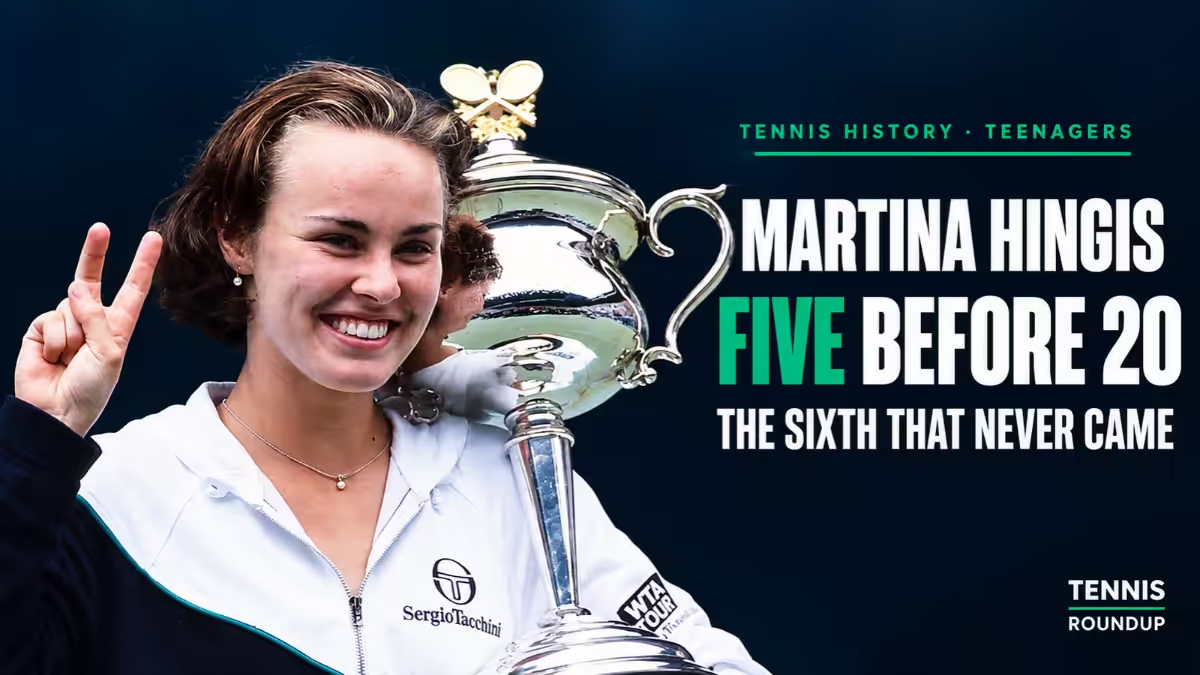
Martina Hingis: Five Grand Slams Before 20 — The Sixth That Never Came
Five Grand Slams Before 20
She conquered three of tennis’s four biggest stages before turning 19. In Paris, Martina Hingis came within one service game of adding the missing trophy — and a sixth teenage Grand Slam title.
One Service Game From Six
Paris, June 5, 1999.
Martina Hingis was serving for the Roland-Garros championship.
At 18, the Swiss star already owned five Grand Slam singles titles. She had won the Australian Open three consecutive times, conquered Wimbledon and lifted the US Open trophy.
Only Roland-Garros was missing.
Against Steffi Graf, Hingis had taken the opening set 6–4 and reached 5–4 in the second. One successful service game would complete her collection of all four major championships.
It would also give her a sixth Grand Slam singles title before her 20th birthday.
But Graf broke back.
The German champion took the second set 7–5 and the deciding set 6–2, winning her sixth French Open singles title.
Hingis had served for the championship, but she had not reached a documented championship point.
The sixth Grand Slam title never arrived.
That Paris afternoon became one of the defining moments of a remarkable teenage career — not because five titles were insufficient, but because Hingis had made a sixth seem so close.
To understand the significance of that missed opportunity, we must return to the extraordinary rise that brought her there.
Martina Hingis: Five Grand Slams Before 20
Born on September 30, 1980, in Košice, then part of Czechoslovakia, Martina Hingis represented Switzerland and became one of the youngest champions in modern tennis history.
Her development was exceptional even before she entered the senior Grand Slam stage.
In 1993, aged 12, she won the Roland-Garros junior singles championship. She successfully defended that title in 1994 and added the Wimbledon junior singles crown the same year.
Three junior Grand Slam singles titles before her 14th birthday had already established her as an extraordinary prospect.
But junior success does not guarantee senior championships.
Hingis still had to make the transition.
She began competing professionally in 1994, made her senior Grand Slam debut at the 1995 Australian Open and claimed her first WTA singles title at Filderstadt in October 1996.
By the beginning of 1997, the teenage prodigy was ready to challenge the established champions.
What followed was one of the most remarkable seasons ever produced by a 16-year-old.
1997: The Year a Teenager Took Over
At the Australian Open in January 1997, Hingis defeated Mary Pierce 6–2, 6–2 to claim her first senior Grand Slam singles title.
She was just 16 years and 117 elapsed days old, making her the youngest women’s singles Grand Slam champion of the Open Era.
The achievement was historic.
But it was only the beginning.
On March 31, Hingis became the youngest WTA singles world No. 1, at 16 years and 182 days.
She had reached the top of the rankings before winning Wimbledon or the US Open.
Her next major destination was Paris.
There, she advanced to the Roland-Garros final against Iva Majoli, with the possibility of winning the first two Grand Slam singles tournaments of the season.
Majoli had other ideas.
The Croatian defeated Hingis 6–4, 6–2, denying the teenager the French Open championship.
That result would become increasingly significant as the season unfolded.
At Wimbledon, Hingis recovered from losing the opening set to defeat Jana Novotná 2–6, 6–3, 6–3.
At the US Open, she defeated another emerging teenager, Venus Williams, 6–0, 6–4.
Three Grand Slam singles titles in one season.
Four Grand Slam finals reached.
And she was still only 16.
Had Hingis won the Roland-Garros final, she would have completed a calendar-year Grand Slam in singles.
Instead, Majoli’s victory remained the decisive interruption to an otherwise extraordinary campaign.
Hingis finished 1997 as world No. 1, having established herself at the center of women’s tennis.
The teenager was no longer chasing the champions.
She was the champion everyone else had to challenge.
From Three to Five: The Australian Open Dynasty
Hingis returned to Melbourne in January 1998 and successfully defended her Australian Open singles title.
This time, Conchita Martínez was her final opponent.
Hingis won 6–3, 6–3.
Four Grand Slam singles titles before turning 18.
She remained a contender throughout the season, reaching the semifinals at Roland-Garros and Wimbledon and the final of the US Open.
But Monica Seles stopped her in Paris, Jana Novotná defeated her at Wimbledon, and Lindsay Davenport beat her in the US Open final.
The fifth title would have to wait.
It arrived in January 1999.
Facing Amélie Mauresmo in the Australian Open final, Hingis won 6–2, 6–3 to capture her third consecutive Melbourne singles championship.
She was 18 years and 122 days old.
Five Grand Slam singles titles before 20.
The sequence was extraordinary:
- Australian Open 1997 Mary Pierce6–2, 6–2
- Wimbledon 1997 Jana Novotná 2–6, 6–3, 6–3
- US Open 1997 Venus Williams 6–0, 6–4
- Australian Open 1998 Conchita Martínez 6–3, 6–3
- Australian Open 1999 Amélie Mauresmo 6–2, 6–3
Her fifth title came more than 600 days before her 20th birthday.
There was still time to add another.
And in Paris, only a few months later, she nearly did.
The Sixth That Never Came
The 1999 Roland-Garros final against Graf was the closest Hingis came to adding a sixth teenage Grand Slam singles title.
She had reached the final in 1997, losing to Majoli.
She had fallen to Seles in the 1998 semifinals.
Now she was serving for the 1999 championship against Graf.
The opportunity was real.
But so was the resistance.
Graf’s comeback turned that afternoon into one of the most memorable French Open finals of the period.
The match also represented a striking meeting between two generations of teenage Grand Slam history.
Graf had won six singles majors before turning 20.
Hingis was attempting to join her at six.
Yet this was a historical parallel, not evidence that Hingis consciously set out to equal Graf’s teenage record.
Graf won the match.
Hingis remained at five.
And the opportunity to complete her collection of all four major singles trophies had slipped away.
Roland-Garros would remain the only Grand Slam singles championship Hingis never won.
Seven More Chances, No Sixth Title
The defeat in Paris did not end Hingis’s opportunities.
She competed in every remaining Grand Slam tournament before her 20th birthday.
There were seven chances after her fifth
title, including the 1999 French Open final.
And the opposition was formidable.
Opponent who ended her run
- Roland-Garros 1999 Final Steffi Graf
- Wimbledon 1999 First round Jelena Dokić
- US Open 1999 Final Serena Williams
- Australian Open 2000 Final Lindsay Davenport
- Roland-Garros 2000 Semifinal Mary Pierce
- Wimbledon 2000 Quarterfinal Venus Williams
- US Open 2000SemifinalVenus Williams
Three finals.
Two semifinals.
One quarterfinal.
And one first-round defeat.
The results reveal something important.
Hingis did not simply disappear from contention after winning her fifth title.
She continued reaching the final stages of the biggest tournaments.
At the 1999 US Open, Serena Williams defeated her 6–3, 7–6(4) to win her first Grand Slam singles championship.
At the 2000 Australian Open, Davenport defeated her 6–1, 7–5.
Venus Williams then ended her runs at both Wimbledon and the US Open in 2000.
The names tell part of the story of a changing competitive landscape.
Graf, Serena, Davenport, Venus, Pierce and Dokić all presented different challenges.
It would be too simple to argue that one playing style alone stopped Hingis.
The record shows something more complex: a young champion who remained competitive at the highest level while a succession of formidable opponents prevented another Grand Slam victory.
Her final teenage major ended in the semifinals of the 2000 US Open.
Less than a month later, she turned 20.
The teenage Grand Slam clock had stopped at five.
Three Champions, Three Different Teenage Clocks
Hingis’s five titles place her alongside two other extraordinary teenage champions in the Open Era.
Monica Seles won eight Grand Slam singles titles before turning 20.
Steffi Graf won six.
Martina Hingis won five.
Their records form a remarkable historical sequence, but the circumstances behind them were different.
Seles captured her eighth teenage major at the 1993 Australian Open. Her remaining scheduled teenage Grand Slam opportunities were lost after the April 1993 attack.
Graf won her sixth teenage major at the 1989 Australian Open and had one more Grand Slam tournament before turning 20.
Hingis won her fifth at the 1999 Australian Open and played seven more majors before her 20th birthday.
Three champions.
Three different journeys.
Three records that cannot be fully understood by comparing the numbers alone.
For Hingis, five titles were not the result of a career that ended before her teenage opportunities ran out.
They were the achievement of a player who rose extraordinarily early, remained among the game’s leading contenders and encountered repeated resistance while pursuing another championship.
Five Was Already Extraordinary
The missing sixth title is an intriguing historical question.
But it should never obscure what Hingis accomplished.
She became the youngest women’s singles Grand Slam champion of the Open Era.
She became the youngest WTA singles world No. 1.
She reached all four Grand Slam singles finals in 1997 at just 16.
She won five major singles championships across three different tournaments before turning 19.
And she remained a Grand Slam contender throughout the rest of her teenage years.
Her intelligence, anticipation, court positioning and ability to construct points helped define a style that made her one of the outstanding players of her generation.
The numbers alone do not capture the full achievement.
Neither does the championship she missed.
The Teenage Clock Stops at Five
New York, September 2000.
Hingis reached the US Open semifinals, where Venus Williams defeated her 4–6, 6–3, 7–5.
It was her final Grand Slam singles appearance before turning 20.
The teenager who had won her first major at 16 finished that chapter with five Grand Slam singles championships.
She would continue her professional career, but she would never win another major singles title.
That makes the 1999 Roland-Garros final an enduring turning point.
For one service game, the sixth seemed within reach.
Graf prevented it.
Seven post-fifth opportunities passed without another championship.
Yet Hingis’s five-title teenage record remains one of the great achievements in women’s Open Era tennis.
Monica Seles reached eight. Steffi Graf reached six. Martina Hingis reached five.
The teenage clock stopped there.
But five Grand Slam singles titles before 20 had already made Martina Hingis a champion for the ages.
Related Reading
- Before the Teenage Clock: Three Champions, Three Different Roads
- Before Graf, Two Was the Teenage Ceiling
- Monica Seles: Eight Grand Slams Before 20
Research: Tennis Roundup, based on WTA tournament records, Australian Open archives, Roland-Garros historical reporting and LOVE’s October 7, 2026 research dossier.