
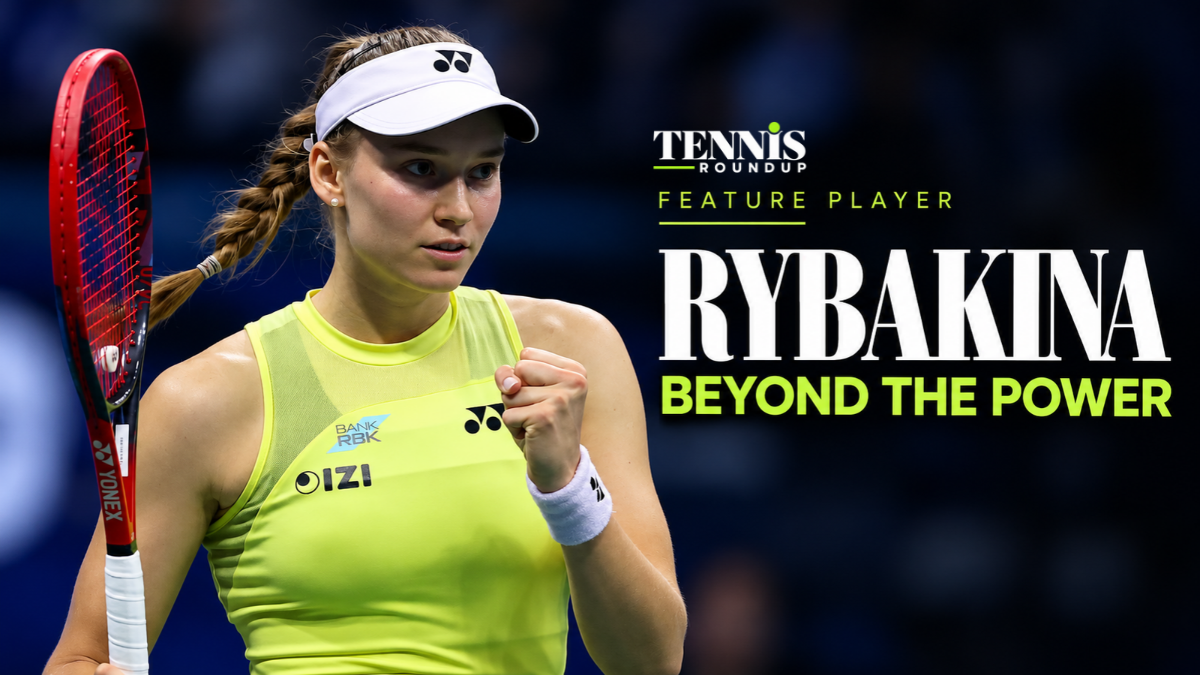
Elena Rybakina: The Game Behind the Grand Slam Champion
Before Elena Rybakina became a Wimbledon champion, an Australian Open champion and one of the most formidable players in women’s tennis, she faced a decision that had little to do with winning a Grand Slam final.
Should she continue her education or pursue professional tennis?
There were opportunities to study at universities in the United States. Her father worried about the financial demands of professional tennis and the uncertainty of a career that could be interrupted by injury.
Rybakina wanted to keep playing.
The decision became easier when Kazakhstan offered the support she needed to pursue tennis professionally.
Years later, that choice would help shape a career that carried her from junior tournaments in Moscow to the biggest stages in the sport.
By September 2026, Rybakina had won two Grand Slam singles championships, the WTA Finals and 13 tour-level singles titles.
But her career was never simply a story of overwhelming opponents with a powerful serve.
It was also a story of development, difficult decisions, changing circumstances and learning how to win when power alone was not enough.
Elena Rybakina Before the Breakthrough
Born on June 17, 1999, in Moscow, Elena Rybakina began playing tennis as a young child.
Before tennis, she had tried gymnastics and ice skating alongside her sister.
Her father introduced her to the sport, initially as another activity to enjoy rather than the beginning of a professional career.
In a January 2020 interview with the WTA, Rybakina recalled being brought to a tennis court at six years old.
Her official player biography lists five as her starting age, but both accounts establish that tennis entered her life early.
Her development was not immediately spectacular.
Rybakina remembered watching other players in her training group advance further in junior tournaments while she regularly lost in the opening rounds.
Progress came gradually.
As she began competing in higher-level junior events, her results improved, and so did her confidence.
In 2017, she reached the girls’ singles semifinals at both the Australian Open and Roland Garros.
She also won the prestigious Trofeo Bonfiglio junior tournament, defeating Iga Swiatek in the final.
Rybakina eventually reached No. 3 in the ITF junior rankings.
Those achievements suggested a professional future.
But talent and results were only part of the equation.
The Decision That Changed Her Career
Professional tennis requires more than the ability to win matches.
Players need coaching, travel, training opportunities and the financial resources to compete internationally.
For Rybakina and her family, those practical considerations mattered.
She completed school while continuing to train and compete. Her father saw education as a more secure option, particularly because a professional tennis career offered no guarantees.
Rybakina had opportunities to attend universities in the United States.
Yet she wanted to continue playing.
In 2018, she began representing Kazakhstan, accepting support from the country’s tennis federation.
The decision gave her greater opportunities to develop her professional career.
It is important to distinguish her background from her sporting representation: Rybakina was born in Russia and represents Kazakhstan in international tennis.
Her decision to represent Kazakhstan also came years before the controversy surrounding Russian and Belarusian participation at Wimbledon in 2022.
For Rybakina, the immediate significance was practical.
She could pursue the career she had chosen with greater support.
Building a Professional Career
Rybakina’s early professional development combined junior competition, ITF events and appearances on the WTA Tour.
She made her WTA main-draw debut as a qualifier in Moscow in 2017.
The following year, she recorded an important breakthrough at St. Petersburg, defeating Caroline Garcia for her first victory over a Top 10 opponent.
In 2019, her progress accelerated.
She began working with coach Stefano Vukov in February, gaining access to a traveling coaching arrangement that allowed her to train and make adjustments throughout the season.
That summer, Rybakina won her first WTA singles title in Bucharest, defeating Patricia Maria Tig in the final.
She also reached the final in Nanchang.
Her ranking reflected the improvement.
Rybakina entered the Top 100 in July 2019 and finished the season at World No. 37.
By January 2020, she had added another title in Hobart.
She also reached finals in Shenzhen, St. Petersburg, Dubai and Strasbourg during the 2020 season.
These results demonstrated something that would become increasingly important throughout her career.
Rybakina could compete successfully on different surfaces, not only on courts that rewarded her serve.
Elena Rybakina: A Serve That Creates the First Advantage
At 1.84 metres tall, Rybakina possesses one of the most recognizable weapons in women’s tennis: a powerful serve.
It can produce aces, create short returns and place opponents under pressure before a rally has properly developed.
Her game is built around taking advantage of that first opportunity.
She strikes the ball aggressively from the baseline, using a strong forehand and two-handed backhand to control exchanges.
When her serve and first groundstroke work together, opponents can find themselves defending almost immediately.
But reducing Rybakina’s tennis to serving power overlooks other important qualities.
More Than Aces
Rybakina’s ability to compete on grass, hard courts and clay reflects a game that requires more than one weapon.
She can move forward to finish points, respond to short balls and adjust when opponents change the rhythm of a rally.
Her 2022 Wimbledon final demonstrated that variety.
Facing Ons Jabeur, a player known for her changes of pace, drop shots and tactical creativity, Rybakina needed to do more than hit through her opponent.
She had to respond to different patterns of play and find ways to take control after losing the opening set.
Her results also show that an imposing serve does not eliminate vulnerability.
First-serve percentages fluctuate. Opponents can attack second serves. Long rallies can test movement, consistency and shot selection.
The most important question is often what Rybakina does when her preferred first-strike pattern is disrupted.
Her greatest victories have required both power and adjustment.
Wimbledon 2022: The First Grand Slam Championship
Rybakina arrived at Wimbledon in 2022 ranked World No. 23 and seeded 17th.
She was 23 years old.
Although she had already established herself as a dangerous opponent, she had never reached a Grand Slam singles final.
That changed over two weeks at the All England Club.
She defeated Bianca Andreescu, Zheng Qinwen, Petra Martic and Ajla Tomljanovic before facing former Wimbledon champion Simona Halep in the semifinals.
Rybakina defeated Halep 6–3, 6–3.
The victory sent her into the final against Ons Jabeur.
A Final That Demanded a Different Answer
Jabeur won the opening set 6–3.
For Rybakina, the championship was suddenly about responding to a match that had begun on her opponent’s terms.
She improved her consistency, took greater control of rallies and gradually shifted the pressure.
Rybakina won the second set 6–2.
Then she won the third by the same score.
Elena Rybakina defeated Ons Jabeur 3–6, 6–2, 6–2 to win Wimbledon 2022.
She became the first player representing Kazakhstan to win a senior Grand Slam singles title.
It was a defining achievement for both the player and the country she represented.
Yet the championship also came with an unusual ranking consequence.
The Wimbledon Championship Worth Zero Ranking Points
Wimbledon awarded no ranking points in 2022 following a dispute over the tournament’s exclusion of Russian and Belarusian players.
Under the normal ranking system, a Grand Slam singles championship was worth 2,000 points.
Rybakina received none.
The policy applied to the tournament as a whole, not specifically to her.
Her Wimbledon title remained a full Grand Slam championship, but it did not produce the ranking benefit normally associated with such an achievement.
She remained World No. 23 immediately afterward.
The distinction became an important part of her career story.
Rybakina had won one of tennis’s biggest titles without receiving the ranking points normally attached to it.
But the missing points do not, by themselves, explain every subsequent change in her ranking.
Her career would continue to be shaped by results, interruptions and new opportunities.
Building Results Across Surfaces
Winning Wimbledon did not guarantee a smooth progression toward the top of the rankings.
In 2023, Rybakina reached the Australian Open final, losing to Aryna Sabalenka in three sets.
She also captured her first two WTA 1000 singles titles.
At Indian Wells, she defeated Sabalenka in the final.
At Rome, she defeated Anhelina Kalinina, who retired during the second set.
Those championships mattered because they demonstrated her ability to win major tournaments under different conditions.
Indian Wells tested her on outdoor hard courts.
Rome brought success on clay.
Rybakina also reached the Miami final and finished 2023 ranked World No. 4.
The Progress Was Not Always Linear
In 2024, Rybakina won titles in Brisbane, Abu Dhabi and Stuttgart.
She also reached the finals in Doha and Miami and advanced to the Wimbledon semifinals.
It was a productive season.
But her career also included interruptions, coaching changes and periods when results did not match the expectations created by her biggest victories.
Before the 2024 US Open, her original coaching partnership with Stefano Vukov ended.
Goran Ivanisevic subsequently joined her team, with that arrangement concluding in January 2025.
Vukov later became eligible to return to WTA events after a restriction on his credentials was lifted in August 2025.
By September 2026, he was again listed as Rybakina’s coach.
The coaching chronology is part of her career, but it should not be reduced to a simple explanation for every victory or defeat.
Tennis results depend on many factors, and the available evidence does not establish a single cause for every change in her performance.
The Work Behind the Restrained Reaction
Elena Rybakina is often recognized for her restrained reactions on court.
Even after important victories, her celebrations can appear understated compared with those of other players.
It is an easily recognizable part of her public image.
But appearance does not necessarily explain experience.
Rybakina has spoken openly about nerves and pressure.
After winning Wimbledon in 2022, she acknowledged how nervous she had been.
She has also described the importance of enjoying tennis and spending time with family and friends.
In her 2020 WTA interview, she explained that tennis had always felt like a game she enjoyed rather than simply a job.
That perspective offers a more useful understanding of the player than describing her as emotionless.
A restrained celebration is not evidence that a victory matters less.
Her career includes moments of visible pressure, difficult decisions and matches that required her to recover from setbacks.
Those experiences are more revealing than assumptions drawn from her expression.
The Resurgence of 2025
By the middle of 2025, Rybakina had experienced another period of uneven results.
Her ranking had fallen outside the Top 10.
But the second half of the season brought an important recovery.
She won the Strasbourg title and later captured the Ningbo championship.
Her run to the Tokyo semifinals secured the final available place at the 2025 WTA Finals.
Then came one of the most significant tournaments of her career.
Rybakina completed the WTA Finals undefeated.
In the championship match, she defeated Aryna Sabalenka 6–3, 7–6(0).
The title represented more than a successful end to the season.
It demonstrated that Rybakina could return to winning the sport’s biggest matches after a period when her trajectory had become less certain.
She finished 2025 as the WTA Finals champion and World No. 5.
That achievement provided a foundation for what followed.
Australian Open 2026: The Second Grand Slam Title
Three years after losing the Australian Open final to Aryna Sabalenka, Rybakina returned to the championship match in Melbourne.
Once again, Sabalenka stood across the net.
This time, Rybakina found a different ending.
She won the opening set 6–4, but Sabalenka responded by taking the second 6–4.
In the deciding set, Rybakina fell behind 0–3.
The match was moving away from her.
Yet she recovered, winning six of the final seven games to complete a 6–4, 4–6, 6–4 victory.
Elena Rybakina was the Australian Open 2026 champion.
It was her second Grand Slam singles title, following Wimbledon 2022.
The victory also offered another example of a defining characteristic of her career.
She could win when her first plan was no longer working.
Her season continued with a title in Stuttgart, where she defeated Karolina Muchova 7–5, 6–1 in April.
That was her 13th tour-level singles championship.
But the months that followed were not uninterrupted success.
She exited Roland Garros in the second round and Wimbledon in the third.
She also lost the Toronto final to Iga Swiatek.
By the time the US Open arrived, Rybakina had already experienced both the highest achievement of a Grand Slam championship and the frustrations that can follow it.
New York 2026: An Unfinished Assignment
At the 2026 US Open, Rybakina entered another important chapter of her career.
She arrived in New York with concerns about her left ankle and uncertainty surrounding her preparation.
But as the tournament progressed, she continued advancing.
On September 9, she faced Zheng Qinwen in the quarterfinals.
Zheng won the opening set 6–3.
Rybakina responded by taking the second 6–1.
In the deciding set, she trailed 3–4 and faced a break point before recovering to win the final three games.
Rybakina defeated Zheng 3–6, 6–1, 6–4.
The victory sent her into her first US Open semifinal.
It also secured a milestone that had remained beyond her reach throughout her career.
Elena Rybakina Secures the World No. 1 Ranking
Following the quarterfinal result, the WTA announced that Rybakina had mathematically secured the next World No. 1 singles ranking.
She was scheduled to become the 30th woman in WTA history to reach the top position when the updated rankings were released on September 14.
She would also become the first player representing Kazakhstan to achieve the No. 1 singles ranking.
At that moment, however, the official ranking had not yet changed.
On September 10, Rybakina was still officially World No. 2, with No. 1 secured for the next ranking release.
The distinction matters.
Her achievement was confirmed, but its official effective date was still ahead.
For a closer look at the unusual path from her Wimbledon championship to the ranking milestone, read our related feature:
Elena Rybakina’s Road to World No. 1: The Wimbledon Champion Who Received Zero Points
One More Comeback Against Coco Gauff
On the evening of September 10, Rybakina faced Coco Gauff in the US Open semifinals.
Gauff won the first set 6–3.
Rybakina recovered to take the second 6–4.
In the deciding set, she broke serve and moved ahead 5–3, but Gauff broke back when Rybakina served for the match.
The pressure returned.
Rybakina responded by breaking Gauff again.
Elena Rybakina defeated Coco Gauff 3–6, 6–4, 6–4 to reach her first US Open final.
Another important victory had required her to recover after losing the opening set.
The result also meant that Rybakina had reached both the Australian Open and US Open finals in the same season.
Her next opponent would be Aryna Sabalenka.
The final had yet to be played.
Elena Rybakina: More Than the Power
By September 10, 2026, Elena Rybakina had built a career that included:
- Two Grand Slam singles titles: Wimbledon 2022 and Australian Open 2026.
- 13 completed WTA Tour singles titles, including the 2025 WTA Finals.
- Two WTA 1000 championships: Indian Wells and Rome in 2023.
- A first US Open final, reached in September 2026.
- A secured World No. 1 ranking, scheduled to become official on September 14.
The achievements were substantial.
But the story behind them is more interesting than the numbers alone.
There was the young player who did not immediately stand out among her training partners.
The family decision between university and professional tennis.
The support that made a more ambitious career possible.
The Wimbledon champion who received no ranking points.
The seasons that brought trophies alongside setbacks.
And the player whose restrained reactions sometimes concealed the intensity of the matches she was fighting to win.
Rybakina’s serve may be the first thing opponents notice.
It is not the only thing that defines her.
Her career has been built on learning, adapting and finding another answer when the first one was not enough.
As she prepared for the US Open final in September 2026, one question remained unanswered.
Could she turn another opportunity on a Grand Slam stage into a third major championship?
Whatever happened next, the journey that brought her there had already established Elena Rybakina as one of the defining players of her generation.
Related Stories
Elena Rybakina’s Road to World No. 1
How her Wimbledon championship, missing ranking points and subsequent achievements led to the top of women’s tennis.
US Open 2026 — Day 11 Roundup
The quarterfinal action that included Rybakina’s victory over Zheng Qinwen.
US Open 2026 — Tournament Coverage
Follow Tennis Roundup’s coverage of the women’s singles tournament in New York.