
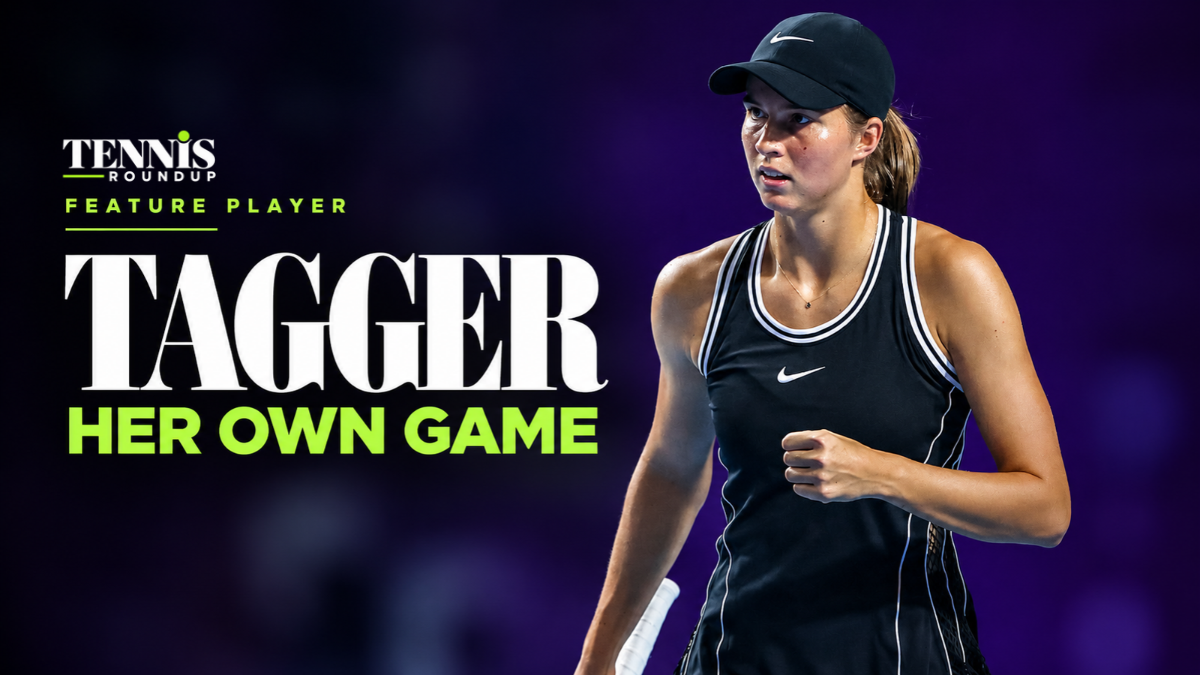
Lilli Tagger: The Game She Chose to Build
Lilli Tagger made reaching another WTA final look remarkably straightforward.
On October 31, 2026, the 18-year-old Austrian defeated Kaitlin Quevedo 6–2, 6–0 in the Guangzhou Open semifinals.
The score suggested a commanding performance. But it revealed little about the years of preparation behind it.
Tagger had already won a junior Grand Slam title, reached two WTA Tour finals and claimed her first Tour championship.
She had also developed one of the most recognizable strokes in women’s tennis: a one-handed backhand.
It was not a stroke she had always played.
She chose it.
And that decision, made when she was just 12, offers a window into the young player she has become.
Because Lilli Tagger’s story is not simply about an uncommon backhand.
It is about building a game, making choices and learning to compete at increasingly demanding levels.
Why Lilli Tagger Chose a One-Handed Backhand
The one-handed backhand has become an uncommon sight on the women’s professional tour.
Most players use two hands, particularly when returning powerful serves and exchanging groundstrokes from the baseline.
Tagger plays differently.
She is right-handed, but strikes her backhand with one hand.
The choice dates back to childhood.
In a February 2026 WTA interview, Tagger recalled wanting to switch from a two-handed backhand when she was around ten.
Two years later, she made a bet with her coach.
If she won a tournament, she could make the change.
She won.
Then came the difficult part.
Tagger switched to a one-handed backhand at 12 and spent approximately a year adapting to the new stroke.
It was not an instant transformation.
Changing a fundamental shot requires adjustments in timing, positioning and preparation.
Tagger had to develop those skills through practice and competition.
Asked about the decision, she emphasized that it had been her own.
The stroke felt natural to her.
That explanation is important.
Although Roger Federer and Dominic Thiem have been mentioned in accounts of her development, Tagger has specifically cautioned against treating Thiem as the reason she changed.
She wanted to try something different because it suited her.
The one-handed backhand eventually became her signature.
But the decision alone did not make her a professional champion.
The work that followed mattered just as much.
From Lienz to a Training Life in Italy
Lilli Tagger was born on February 17, 2008, in Lienz, Austria.
Tennis was already familiar within her family.
Her parents, Sabine and Stephan, had both competed in Austrian Bundesliga tennis.
Her older siblings, Ben and Emma, also played.
Tagger began experiencing the sport as a young child.
But developing into a professional player required opportunities beyond her hometown.
At approximately 13, she began training in Italy with Massimo Sartori.
The arrangement allowed her to combine tennis development with online schooling.
Italy became an important training base, although Tagger later clarified that she continued living at home in Austria.
That distinction matters.
Training abroad was part of her development—not evidence that she had permanently left her Austrian home behind.
The move exposed her to a different training environment and helped prepare her for international competition.
It also eventually brought her into contact with a former Grand Slam champion.
What Francesca Schiavone Added to Her Development
Francesca Schiavone knows what it means to compete at the highest level with a one-handed backhand.
The Italian won Roland Garros in 2010 and reached World No. 4.
She later became part of Tagger’s coaching development.
According to Tagger’s family, their initial trial together took place in November 2023.
The shared backhand naturally attracted attention.
But Tagger has explained that the connection was coincidental.
She had been searching for an appropriate training environment in Italy.
Schiavone’s influence extended beyond teaching a particular stroke.
Tagger has spoken about learning from the former champion’s tactical knowledge and approach to the mental side of competition.
During her junior Roland Garros campaign in 2025, she described advice about enjoying the moment, remaining calm and concentrating on the objective.
Those lessons would become increasingly relevant as she progressed through bigger tournaments.
The WTA also lists Lorenzo Frigerio among Tagger’s coaches.
Her development has involved multiple people and training environments rather than one individual transforming her career.
And while the one-handed backhand attracts attention, Tagger’s game includes considerably more.
She possesses a powerful forehand and a strong serve.
During her five matches at the Mumbai WTA 125 tournament in February 2026, she recorded 33 aces.
Her junior performances also demonstrated the ability to use touch and approach the net effectively.
The backhand makes her recognizable.
Her developing combination of power, variety and tactical understanding makes her competitive.
Roland Garros 2025: A Junior Grand Slam Champion
By 2025, Tagger had established herself among the leading junior players.
She had already won junior titles and reached important finals.
But Roland Garros offered a different stage.
At 17, she entered the girls’ singles competition in Paris.
She progressed through the draw without dropping a set.
In the final, she faced Britain’s Hannah Klugman.
Tagger won 6–2, 6–0.
The victory made her the first Austrian player to win the Roland Garros junior singles title.
It was a historic achievement for Austrian junior tennis.
For Tagger, it was also confirmation that her development was producing results at the highest junior level.
Yet junior success did not automatically translate into senior championships.
The professional tour presented stronger opponents, more demanding schedules and different competitive pressures.
Tagger would soon experience both the opportunities and difficulties of that transition.
Learning to Win on the Professional Tour
Tagger’s professional development did not begin with a single spectacular breakthrough.
She accumulated experience through ITF events before becoming a regular presence in WTA tournaments.
In March 2025, she won an ITF W35 title in Terrassa, defeating Lois Boisson 7–6(4), 6–3.
Later that year, she won W75 titles in Bucharest and Kursumlijska Banja.
Those victories provided valuable experience against senior opponents.
In January 2026, she added an ITF W100 championship in Fujairah.
Her opponent in the final was Harriet Dart.
Tagger won 6–4, 6–2.
That result would become relevant again nine months later.
But it was important to distinguish these tournaments from the main WTA Tour.
ITF championships represented professional progress.
They were not WTA Tour singles titles.
Jiujiang 2025: A First WTA Tour Final
In October 2025, Tagger made her WTA Tour main-draw debut in Jiujiang, China.
She defeated Chenting Zhu 6–2, 6–1 in the first round.
The tournament became an unexpected milestone.
Tagger advanced all the way to the final.
There, she faced Anna Blinkova.
Blinkova won 6–3, 6–3.
Tagger had not captured the championship.
But at 17, she had reached a WTA Tour final in her debut main-draw appearance.
It was an important indication that she could compete beyond the ITF circuit.
Mumbai 2026: Another Final at a Different Level
In February 2026, Tagger reached the Mumbai WTA 125 final.
She lost to Mananchaya Sawangkaew 4–6, 3–6.
Although the tournament belonged to a different category from the main WTA Tour, it provided another opportunity to compete for a professional title.
The result also showed that progress did not always end with a trophy.
Tagger was gaining experience in finals while continuing to develop her game.
Prague 2026: Lilli Tagger Wins Her First WTA Title
The breakthrough arrived in July 2026.
At the Prague Open, Tagger defeated Gao Xinyu, Mai Hontama and Sara Bejlek to reach the semifinals.
There, she faced Barbora Krejcikova.
The match became one of the most demanding of her tournament.
Krejcikova won the opening set in a tiebreak.
Tagger recovered to take the second.
The deciding set also required a tiebreak.
Tagger defeated Krejcikova 6–7(5), 6–3, 7–6(4) to reach the final.
Her opponent was Daria Snigur.
The championship match brought another challenge.
Tagger fell behind 0–3 in the opening set.
But she recovered.
She won the first set in a tiebreak and controlled the second.
Lilli Tagger defeated Daria Snigur 7–6(3), 6–2 to win her first WTA Tour singles title.
She was 18.
The victory carried an additional reward.
On July 27, 2026, Tagger climbed to World No. 45, entering the WTA Top 50 for the first time.
She had moved beyond the promise of junior success.
She was now a WTA Tour champion.
The Difference Between Junior Success and the Senior Tour
Tagger’s development has also included setbacks.
One year after winning the Roland Garros girls’ singles title, she returned to Paris for her first senior Grand Slam main draw.
In May 2026, she faced Wang Xinyu.
Tagger lost 3–6, 6–3, 4–6.
At Wimbledon, she also exited in the first round, losing to Lanlana Tararudee in three sets.
At the US Open, she reached the second round before losing to Amanda Anisimova.
Those results are an important part of her story.
They demonstrate the difference between excelling in junior competition and establishing consistency against experienced professionals.
Winning a junior Grand Slam title did not remove the challenges of the senior tour.
Nor did winning in Prague mean that every subsequent tournament would be straightforward.
Tagger was still learning.
And that learning process continued in Guangzhou.
Guangzhou 2026: Another Final Awaits
In late October 2026, Tagger returned to China for the Guangzhou Open.
She entered the WTA 250 tournament as the fourth seed.
Her opening opponent was Venus Williams.
Tagger won 6–2, 6–2.
In the second round, she defeated Magda Linette by the same score.
The quarterfinal against Shi Han proved more demanding.
Tagger won the opening set 6–4, but Shi responded by taking the second 6–3.
In the deciding set, Tagger trailed 2–4.
She recovered to win 7–5, completing a victory after two hours and 38 minutes.
It was a reminder that even a successful tournament run can contain difficult moments.
A Commanding Semifinal
Tagger’s semifinal opponent was Kaitlin Quevedo.
This time, the match unfolded very differently.
Tagger won 6–2, 6–0.
The victory sent her into her third WTA Tour singles final.
It was her second final of 2026, following the championship she had won in Prague.
And it brought another familiar opponent into view.
Lilli Tagger and Harriet Dart: A Familiar Final
Harriet Dart reached the Guangzhou final after defeating China’s Sun Xinran in the semifinals.
Sun had won the opening set and held two match points in the second.
But Dart survived.
The British qualifier completed a 5–7, 7–6(1), 6–0 comeback.
The result ended the possibility of an all-teenage Guangzhou final between Tagger and Sun.
Instead, Tagger would face Dart.
The two players had already met in an important match earlier in the season.
In January, Tagger defeated Dart 6–4, 6–2 in the ITF W100 Fujairah final.
Now they were preparing to compete for a WTA Tour championship.
The circumstances were different.
The stakes were different.
And the previous result offered no guarantee of what would happen next.
As of this writing, the November 1 Guangzhou final had not yet been played.
Tagger entered the match with one completed WTA Tour singles title and an opportunity to add another.
Lilli Tagger: The Game She Chose to Build
At 18, Lilli Tagger had already accomplished more than many young players manage during their first years of professional competition.
Her career through October 31, 2026, included:
- 2025 Roland Garros girls’ singles champion, the first Austrian to win that title.
- Four identified ITF World Tennis Tour singles titles.
- 2025 Jiujiang WTA Tour finalist.
- 2026 Prague WTA Tour champion.
- Career-high WTA ranking of No. 45, reached July 27, 2026.
- World No. 53 in the official October 26, 2026 rankings.
- 2026 Guangzhou finalist, awaiting the championship match against Harriet Dart.
Yet the achievements tell only part of her story.
There was the young girl from Lienz who grew up around tennis.
There was the decision to train in Italy.
There was the partnership with Francesca Schiavone and the wider support of her coaching team.
There were junior championships, professional victories and losses that revealed how much work remained.
And there was the decision, at 12, to change one of the most fundamental strokes in her game.
The one-handed backhand may be what first catches the eye.
But it is not the whole story.
Lilli Tagger did not become a champion simply because she chose an uncommon stroke. She became a champion by learning how to build a complete game around the choices she made.
And at 18, that work is still unfolding.
Related Stories
Sun Xinran — Feature Player
Discover the journey of the Chinese teenager whose Guangzhou semifinal against Harriet Dart ended after two missed match points.
Toray Pan Pacific Open 2026 — Day 5
Explore our Tokyo coverage, including Sun Xinran’s developing Guangzhou storyline.
Editor’s note: This profile reflects Lilli Tagger’s career through October 31, 2026. The Guangzhou final against Harriet Dart was scheduled for November 1 and had not yet been played.