
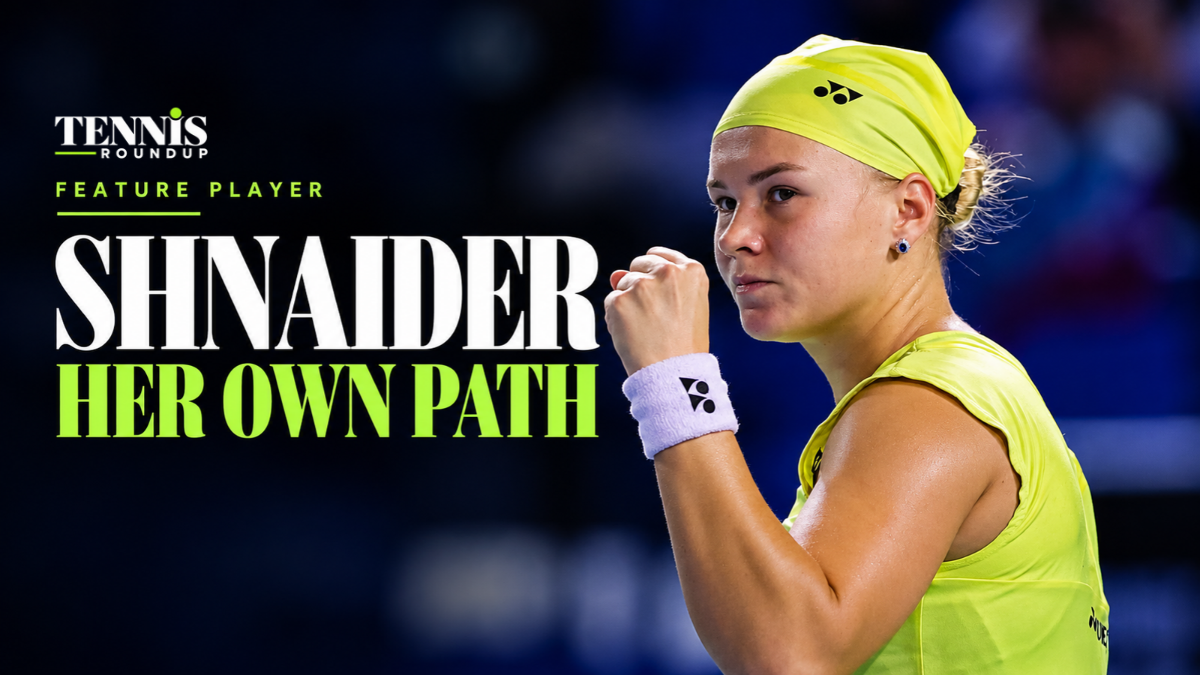
Diana Shnaider: The Path She Built for Herself
Diana Shnaider had already defeated Alexandra Eala twice in two weeks when she stepped onto the court for her Tokyo semifinal.
The Russian left-hander had beaten Eala in straight sets at Ningbo, then survived a much closer encounter at the Toray Pan Pacific Open.
In Tokyo, she had recovered from losing the opening set, fought through a second-set tiebreak and completed a three-set victory.
Now another opportunity awaited.
On October 31, Shnaider defeated 18-year-old Mia Pohankova 6–4, 7–6(7) to reach the Tokyo final.
Her opponent would be Leylah Fernandez.
For Tennis Roundup readers, Shnaider had become a familiar name through her matches against Eala and Fernandez.
But those encounters were only the latest chapter in a career that had already taken an unusual route.
Before winning five WTA Tour singles titles, before reaching a Grand Slam semifinal, and before establishing herself among the world’s leading players, Shnaider had made a decision that seemed to pull her away from professional tennis.
She went to college.
What initially appeared to be a possible detour would become an important part of the career she was building for herself.
Diana Shnaider Before the Professional Tour
Diana Shnaider was born on April 2, 2004, in Zhigulevsk, Russia.
She began developing her tennis game in nearby Tolyatti before moving to Moscow as a child.
Tennis was not the only activity in her early life.
Shnaider also participated in dance, studied piano and played chess.
As a teenager, she took up boxing, a sport familiar to her father, Maxim, who had a boxing background.
Her parents encouraged her to explore different activities.
Those experiences formed part of her childhood, although they cannot independently explain her later success in tennis.
Education was also important in the family.
Her mother worked as an English teacher, while her father had studied law.
For Shnaider, the combination of education and sport would eventually influence one of her most important career decisions.
A Recognizable Style With a Practical Beginning
Even before many tennis fans knew her results, Shnaider had developed a recognizable appearance on court.
She frequently competed wearing a bandana.
The accessory became one of her trademarks.
But its origins were practical.
As a young player, she needed protection from the sun. Wearing a cap interfered with her view of the ball during her service toss.
A scarf offered another solution.
Over time, that practical choice became part of her personal style.
Shnaider later became involved in selecting material for her own scarves.
The detail is small, but it reveals something about her approach.
She was comfortable finding solutions that suited her rather than simply following what other players did.
That independence would become relevant again when she considered her future in tennis.
A Junior Career Already Taking Shape
Before arriving at college, Shnaider had established herself as a successful junior player.
She reached World No. 2 in the ITF junior rankings.
Her junior Grand Slam singles results included semifinals at Roland Garros in 2021 and the US Open in 2022.
She also achieved success in junior doubles.
Those doubles accomplishments were important, but they were separate from her junior singles record.
By the time she began considering college tennis, Shnaider was already competing at a high level.
She had also started playing professional tournaments.
Her senior ITF debut came in late 2020.
In 2021, she won an ITF W15 title in Antalya.
The following year brought further lower-level professional success, including a sequence of three ITF titles.
She was not beginning her tennis career from zero when she arrived in the United States.
She was already a developing professional who had to decide how best to continue.
What One Season at NC State Added
In September 2022, Shnaider arrived at North Carolina State University.
She joined the university’s women’s tennis program, known as the Wolfpack.
For a player with professional ambitions, the decision was not necessarily straightforward.
Shnaider later explained that she had initially viewed college as something that might be incompatible with pursuing a professional career.
Yet the university offered several practical advantages.
There was a training environment, support from coaches and teammates, and an opportunity to continue her education.
It also provided a different kind of competitive experience.
Learning Within a Team
Professional tennis is often an individual pursuit.
College tennis introduced Shnaider to a team environment where results contributed to a shared objective.
During her freshman season, she compiled a 20–3 singles record.
She earned ACC Freshman of the Year honors and All-American recognition.
She also helped NC State win its first ACC tournament championship.
The team subsequently reached its first NCAA championship final.
Those achievements were significant.
But the value of college extended beyond the results.
In a September 2024 WTA interview, Shnaider credited the experience with helping her manage her time and simplify her tactical decisions.
College did not create her talent.
It helped her develop skills that could support her professional career.
A Grand Slam Appearance During College
Shnaider’s professional ambitions had not disappeared.
In January 2023, while still associated with NC State, she qualified for the Australian Open.
She won her first-round match and advanced to face Maria Sakkari.
Shnaider pushed the established Greek player to three sets before losing.
It was an early demonstration that she could compete against experienced opponents on one of tennis’s biggest stages.
After completing her freshman season, she left college to pursue the professional tour.
Her time at NC State had lasted just one season.
But it had given her a different perspective on preparation, competition and the decisions required to succeed.
The college chapter was brief. Its influence extended beyond the classroom and university courts.
From College Tennis to a First WTA Final
Shnaider’s transition to the professional tour was gradual.
She had already won a WTA 125 title in Montevideo in 2022, before completing her college season.
That result belonged to a separate tournament category from the WTA Tour titles she would later win.
In 2023, she reached her first WTA Tour singles final at Ningbo.
Her opponent was Ons Jabeur.
Jabeur won 6–2, 6–1.
For Shnaider, the final represented another important step.
She had moved from junior tournaments and lower-level professional events to competing for titles on the main tour.
The first championship would arrive the following season.
Four Titles, Three Surfaces
The 2024 season became a defining year in Diana Shnaider’s professional career.
She won four WTA Tour singles titles.
Even more significantly, those championships came on different surfaces.
Hua Hin: The First Trophy
In February, Shnaider reached the final in Hua Hin, Thailand.
She faced China’s Zhu Lin.
Shnaider won the opening set 6–3, but Zhu responded by taking the second 6–2.
The championship came down to a deciding set.
Shnaider won it 6–1.
Diana Shnaider defeated Zhu Lin 6–3, 2–6, 6–1 to claim her first WTA Tour singles title.
She was 19 years old.
The victory established her as a Tour champion.
But it was only the beginning of an unusually productive season.
Bad Homburg: A Grass-Court Breakthrough
In June, Shnaider reached the final of the Bad Homburg WTA 500 tournament.
Her opponent was Donna Vekic.
Shnaider won 6–3, 2–6, 6–3.
The victory gave her a second title and her first WTA 500 championship.
The match also provided a useful example of how tennis results are not determined simply by the total number of points won.
Shnaider finished with fewer total points than Vekic but won the points necessary to take two sets.
Her attacking game produced 31 winners and nine aces during the final.
Those were match-specific figures, not a measure of her entire season.
Still, the result demonstrated her ability to win on grass.
Budapest: Success on Clay
Less than a month later, Shnaider reached another final.
This time, the surface was clay.
At Budapest, she defeated Aliaksandra Sasnovich 6–4, 6–4.
It was her third WTA Tour title of 2024.
And it completed a notable achievement.
Shnaider had now won Tour singles titles on hard courts, grass and clay in the same season.
The variety mattered.
Her game was not confined to one type of court.
She could adjust her movement, timing and shot selection to different conditions.
Hong Kong: Four Titles in One Season
In November, Shnaider reached the Hong Kong final against Katie Boulter.
She won 6–1, 6–2.
The result gave her a fourth singles title in 2024.
It was an emphatic conclusion to a season that had transformed her standing on the WTA Tour.
Shnaider finished 2023 ranked World No. 60.
By the latter part of 2024, she had entered the Top 20.
Her success was no longer a matter of potential.
She had accumulated championships across multiple surfaces.
Four titles in one season had established Diana Shnaider as a serious contender on the professional tour.
The Game Behind the Results
Shnaider plays left-handed.
That alone creates different serving and rally patterns from those encountered against right-handed opponents.
But being left-handed is not a guarantee of tactical superiority.
Her success depends on how effectively she uses her strengths.
Shnaider is capable of aggressive baseline tennis, generating pace and taking control when opportunities arise.
Her title record also demonstrates adaptability.
She has won on hard courts, grass and clay.
Yet the surfaces demand different adjustments.
Learning to Adapt
In a September 2024 interview, Shnaider discussed her earlier preference for clay.
As a junior, she enjoyed the ability to slide and the additional time available to construct points.
She later recognized that her game could also work effectively on hard courts.
That development reflects a broader feature of her career.
She has continued learning how to make tactical decisions rather than relying on one fixed playing pattern.
Her October 2026 comments also emphasized shot placement, preparation and the importance of responding appropriately during long games.
The work behind her results involves more than striking the ball hard. It involves choosing when and where to attack.
Building the Right Support Team
Shnaider’s coaching arrangements have changed as her career has developed.
Igor Andreev worked with her during 2024.
Her father helped during part of early 2025.
Former World No. 1 Dinara Safina joined her coaching team in April 2025.
By August 2025, Shnaider had begun working with Sascha Bajin.
In an October 2026 interview, she discussed the importance of finding the right people and building a support structure that could help her compete consistently.
That included coaching, fitness support and hitting partners.
The changes should not be treated as proof that any one coach was solely responsible for her victories.
Professional development is usually more complicated.
For Shnaider, the recurring theme has been the continuing effort to improve.
Monterrey 2025: A Fifth WTA Title
In August 2025, Shnaider reached the Monterrey final.
She faced Ekaterina Alexandrova.
The match required three sets.
Shnaider won the opening set 6–3.
Alexandrova responded by taking the second 6–4.
In the decider, Shnaider recovered control.
She won the third 6–4.
Diana Shnaider defeated Ekaterina Alexandrova 6–3, 4–6, 6–4 to win the Monterrey WTA 500 title.
It was her fifth WTA Tour singles championship.
The result added another significant trophy to a career that had developed rapidly since her college season.
But the following year would bring an achievement of a different kind.
Roland Garros 2026: A First Grand Slam Semifinal
In June 2026, Shnaider reached the Roland Garros quarterfinals.
Her opponent was Aryna Sabalenka.
The challenge was substantial.
Sabalenka won the opening set 6–3.
In the second, Shnaider fell behind 1–4.
The match appeared to be moving decisively toward her opponent.
But Shnaider began recovering.
She won the second set 7–5.
Then she dominated the decider.
Shnaider defeated Sabalenka 3–6, 7–5, 6–0, winning the final ten games of the match.
The victory sent her into her first senior Grand Slam singles semifinal.
It was one of the most important achievements of her career.
The result demonstrated her ability to recover against an elite opponent on one of tennis’s biggest stages.
But the tournament did not end with a championship.
In the semifinals, Shnaider lost to Maja Chwalinska 6–7(4), 4–6.
Her remarkable quarterfinal comeback had not guaranteed the next victory.
Still, reaching a Grand Slam semifinal represented another important step.
Shnaider had already proved she could win Tour titles.
Now she had reached the final four of a major championship.
Diana Shnaider Returns to the Spotlight in Tokyo
By October 2026, Shnaider had continued reaching the latter stages of important tournaments.
She made semifinals in Adelaide, Washington and Ningbo, in addition to her Roland Garros run.
At Ningbo, she defeated Alexandra Eala in the round of 16 and Iva Jovic in the quarterfinals.
Elena Rybakina ended her tournament in the semifinals.
Then came Tokyo.
The Toray Pan Pacific Open provided another opportunity to reach a final.
And once again, familiar opponents appeared along the way.
Two Weeks, Two Victories Against Alexandra Eala
Shnaider defeated Eala 7–5, 6–4 in the Ningbo round of 16 on October 22.
Eight days later, they met again in the Tokyo quarterfinals.
This time, the match was considerably closer.
Eala won the opening set 6–2.
Shnaider recovered to force a second-set tiebreak.
The tiebreak reached 5–5, leaving Eala two points from victory.
But Eala never held an actual match point.
Shnaider won the tiebreak 7–5.
She then completed the comeback by taking the deciding set 6–4.
Diana Shnaider defeated Alexandra Eala 2–6, 7–6(5), 6–4 after two hours and 52 minutes.
The victory sent her into the semifinals.
It was her second win over Eala in consecutive weeks.
But the matches had unfolded differently.
Ningbo had been a straight-sets victory.
Tokyo required a recovery from a set down and a difficult tiebreak.
The contrast offered another example of Shnaider’s ability to find different solutions within a match.
Mia Pohankova and the Road to the Final
Shnaider’s semifinal opponent was Mia Pohankova.
The 18-year-old Slovak had produced an impressive run in Tokyo, reaching her first WTA Tour semifinal.
Shnaider, however, had more experience competing in the latter stages of Tour events.
She won the opening set 6–4.
The second set was closer, eventually reaching a tiebreak.
Shnaider prevailed 9–7 in the tiebreak to complete a 6–4, 7–6(7) victory.
The result sent her into the Tokyo final.
It was her first WTA Tour singles final of 2026 and the seventh of her career.
Her opponent would be Leylah Fernandez.
Diana Shnaider and Leylah Fernandez: Another Meeting
Leylah Fernandez had also advanced through the Tokyo draw.
The Canadian defeated Himeno Sakatsume and Elise Mertens before progressing past Elena Rybakina by walkover.
She then defeated Kamilla Rakhimova 7–5, 6–3 in the semifinals.
That result confirmed a final between Fernandez and Shnaider.
The two players had already met twice during 2026.
In January, Shnaider defeated Fernandez 7–5, 6–3 at Adelaide.
In April, she won again at Charleston, this time 6–3, 6–0.
Those results gave Shnaider a 2–0 record in their verified 2026 meetings before Tokyo.
They did not, by themselves, establish a complete career head-to-head record.
The November 1 final would provide another chapter in their encounters.
For Shnaider, the opportunity was significant.
She had reached several semifinals during 2026 without winning a Tour singles title that season.
Now she was one match away from another championship.
But the final had not yet been played.
As of October 31, 2026, Diana Shnaider was a Tokyo finalist—not yet the Tokyo champion.
Diana Shnaider: The Path She Built for Herself
At 22 years old, Diana Shnaider had already assembled an impressive professional record.
Her achievements through October 31, 2026, included:
- Five WTA Tour singles titles, including two WTA 500 championships.
- Four titles during 2024, won across hard courts, grass and clay.
- A first Grand Slam singles semifinal at Roland Garros 2026.
- A career-high ranking of World No. 11, reached in May 2025.
- A World No. 13 ranking on the official October 26, 2026 list.
- A place in the Tokyo final, with Leylah Fernandez awaiting on November 1.
But the results do not tell the entire story.
Before the trophies, there was a young player developing through junior and ITF competition.
There was a family that valued both sport and education.
There was a decision to attend college, even when professional tennis remained the ambition.
There was one season at NC State that added new experiences and helped her develop skills she would carry onto the Tour.
Then came the championships, the coaching changes, the tactical adjustments and the increasingly demanding opponents.
Her recognizable bandana may make her easy to identify on court.
Her results have given tennis fans reasons to remember her.
But neither the accessory nor any single victory fully explains Diana Shnaider.
Her story is about the decisions, experiences and continuing work behind a career that has become distinctly her own.
And as she prepared to face Leylah Fernandez in Tokyo, another chapter remained unwritten.
Related Stories
Alexandra Eala — Feature Player
Explore the career of the Filipina player Shnaider defeated in consecutive weeks at Ningbo and Tokyo.
Leylah Fernandez — Feature Player
Discover the journey of Shnaider’s opponent in the Tokyo final.
Toray Pan Pacific Open 2026 — Day 5
Revisit the quarterfinal action, including Shnaider’s comeback victory over Eala.
Toray Pan Pacific Open 2026 — Day 3
Follow the earlier matches that set up the Eala–Shnaider rematch.
Toray Pan Pacific Open 2026 — Tournament Hub
Explore the tournament coverage from Tokyo.
Editor’s note: This Feature Player profile reflects Diana Shnaider’s career through the research snapshot of October 31, 2026, at 16:35 Japan Standard Time. The Tokyo final against Leylah Fernandez had not yet been played.