
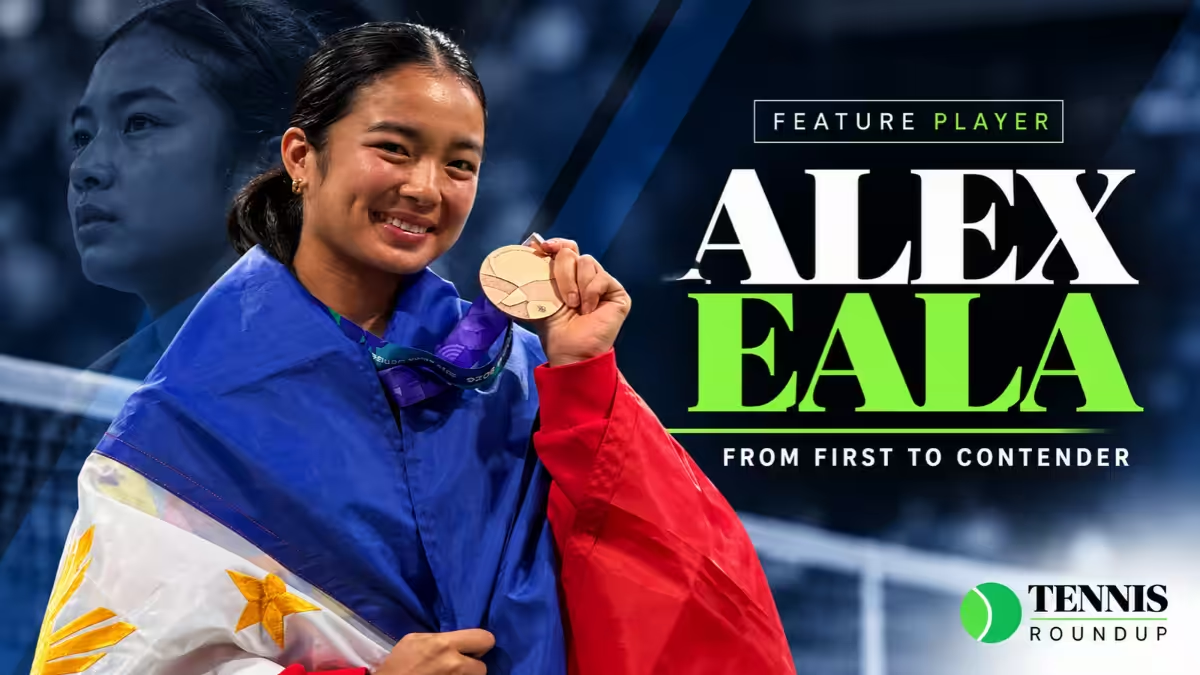
Alex Eala: From Philippine First to WTA Contender
Jessica Pegula had the first set.
Then came the rain.
Alex Eala walked off the court in Washington one set away from another final ending without a trophy.
She had been here before. At Eastbourne in 2025, Eala reached her first WTA Tour singles final. She came within four championship points of winning it.
She didn’t.
Now, across the net in Washington, stood a Grand Slam finalist and one of the best players in the world.
When play resumed, something changed.
Eala won nine straight games.
The match turned.
The title was hers.
And for the first time, a Filipina was a WTA Tour singles champion.
For years, Alex Eala’s story had been about becoming the first.
Washington changed the question.
The Firsts Are Now Facts
There was a time when almost every step Eala took opened another door for Philippine tennis.
Junior Grand Slam champion.
Miami semifinalist.
WTA Tour finalist.
Top 20.
WTA champion.
The milestones kept accumulating until something subtle happened.
They stopped feeling impossible.
Eala won the US Open girls’ singles title in 2022, becoming the first Filipino junior Grand Slam singles champion.
Her senior breakthrough accelerated in Miami in 2025, where a run that included a victory over Iga Swiatek carried her into a WTA 1000 semifinal.
Eastbourne brought her first WTA Tour singles final.
Guadalajara and Birmingham brought WTA 125 titles.
Then Washington brought the one that had been missing.
But Washington mattered for another reason.
Look at who stood between Eala and the trophy.
Zheng Qinwen.
Leylah Fernandez.
Elina Svitolina.
Naomi Osaka.
Jessica Pegula.
Every opponent was either a former Grand Slam finalist or a current Top-10 player.
Eala didn’t find a shortcut through the draw.
She went through it.
Eastbourne had shown that she could reach the door.
Washington showed she could walk through it.
Before the Crowds, There Was a Four-Year-Old With a Racket
The player now followed by huge Filipino crowds started playing tennis at four.
Alexandra Maniego Eala was born on May 23, 2005, and eventually continued her development at the Rafa Nadal Academy in Mallorca.
But there was no straight line from talented child to Top-20 professional.
Eala made her WTA qualifying debut in Miami in 2021.
Then came years of building.
Ranking points.
Matches.
Physical resilience.
Losses.
More matches.
The junior champion had to become a professional tennis player before she could become a successful one.
Her sporting roots weren’t confined to tennis. Her mother, Rizza, competed in swimming for the Philippines at the Southeast Asian Games.
Years later, representing the same country would force Eala into one of the most consequential choices of her own career.
We’ll get there.
First, the tennis.
What Makes Alex Eala Difficult to Play?
The left hand is the first clue.
But it isn’t the whole answer.
Eala is an aggressive baseliner who likes to take time away from opponents. She can strike early, redirect from the backhand side and use her forehand to create angles that open the court.
Being left-handed changes the geometry.
Returns arrive differently.
Rally patterns feel different.
Familiar situations become slightly less familiar.
And when Eala catches momentum, matches can change quickly.
Washington supplied the obvious example.
Nine games. Unanswered.
But the more interesting development may be quieter.
Eala has become more patient in constructing points and better at recovering when momentum shifts. She’s increasingly capable of solving different kinds of opponents within the same tournament rather than depending solely on one aggressive pattern.
That’s what makes Washington more useful than a trophy photograph.
Five opponents.
Five different problems.
One title.
But There Are Cracks Opponents Can Attack
The rise hasn’t made Eala complete.
Nor should a Feature Player profile pretend otherwise.
Her second serve can become vulnerable.
Service consistency can fluctuate under pressure.
Physical load matters.
And the same ability to catch fire and change a match quickly has another side:
volatility.
Perhaps the most interesting weakness, though, isn’t technical.
It’s expectation.
Because Alex Eala is no longer walking onto court as the player with nothing to lose.
The Hunter Became the Hunted
Miami was exhilarating partly because nobody expected it.
The lower-ranked Filipina kept beating players she wasn’t supposed to beat.
Every upset made the next one feel possible.
But eventually, success changes the equation.
At World No. 18, Eala increasingly enters tournaments seeded.
She is studied.
Scouted.
Prepared for.
And when the player across the net is ranked far below her, Eala is supposed to win.
Singapore offered a harsh demonstration.
A high seed doesn’t protect anyone from an opening-round loss.
A ranking doesn’t play the match.
And a player who built her reputation upsetting favorites eventually has to learn how to be the favorite.
That’s not a contradiction in Eala’s rise.
It’s what comes next because of it.
And Then There Is the Philippines
You can sometimes hear Eala’s significance before the first ball is struck.
The crowds arrive.
Filipino flags appear.
Fans gather around practice courts.
A professional tennis career that developed thousands of kilometers from the Philippines somehow carries the atmosphere of home from tournament to tournament.
That support brings extraordinary visibility.
It brings pressure too.
And in 2026, the relationship between player, country and tour became more than symbolism.
Eala had a choice to make.
Beijing or the Philippines?
The China Open was mandatory.
The Asian Games meant representing the Philippines.
The calendars collided.
Eala chose Nagoya.
That decision meant accepting the possibility of a WTA ranking penalty and fine while Philippine tennis authorities sought an exemption.
It also meant chasing something bigger than an Asian Games medal.
There was an Olympic opportunity attached.
Eala arrived as the No. 1 seed.
She reached the semifinals.
And against Wang Xiyu, she won the first set.
For a moment, the road remained open.
Then Wang turned the match around.
3-6, 6-3, 6-2.
Eala’s gold-medal run was over.
Wang went on to win the tournament. Eala left with bronze—and without the immediate Asian continental qualification place for Los Angeles 2028.
But there is an important distinction.
She missed an Olympic shortcut.
She did not miss the Olympic road.
Her principal route remains qualification through the June 2028 WTA ranking.
And that’s another story we’re going to follow.
NEXT → Alex Eala’s Road to the 2028 Los Angeles Olympics
Success Created Something Else: Noise
History creates attention.
Attention creates expectation.
And expectation creates opinions.
Eala’s enormous following means victories can produce celebration far beyond the tournament where they’re played.
Losses can produce something equally loud.
Too much hype.
Overrated.
Not ready.
Sometimes criticism identifies something real.
The serve can be analyzed.
So can stamina.
Scheduling.
Shot selection.
Tactics.
Consistency.
Those are tennis questions.
But there’s another way to evaluate a player.
Look at the record.
Junior Grand Slam singles champion.
Miami semifinalist.
Eastbourne finalist.
Two WTA 125 titles.
Washington WTA 500 champion.
World No. 18.
None of those achievements predicts what Alex Eala will become.
They don’t need to.
They tell us what she already is.
History Doesn’t Protect a Ranking
This may be the uncomfortable part of Eala’s next chapter.
Being historically important to Philippine tennis doesn’t guarantee that she remains among the world’s elite.
Washington proved her ceiling.
It didn’t prove permanence.
Now come different tests.
Defending ranking points.
Beating players who have studied her game.
Winning when she is expected to win.
Recovering from poor tournaments.
Managing the physical demands of a full season.
Finding deep runs without needing career-best tennis every week.
Those challenges don’t make the story less exciting.
They make it more interesting.
Because the question is no longer whether Alex Eala can arrive.
She’s here.
Making the Extraordinary Feel Normal
The rain eventually stopped in Washington.
Eala returned to court.
Nine games later, another Philippine tennis first belonged to her.
But eventually there are only so many firsts left to collect.
The next stage isn’t about proving that a Filipina can win at this level.
Eala has already done that.
It’s about doing it again.
And again.
When opponents know her.
When crowds expect her.
When she is the seed.
When she’s the favorite.
When history is no longer enough.
Alex Eala has already changed what is possible for Philippine tennis.
Her next challenge is harder: making the extraordinary feel normal.
FEATURE PLAYER | ALEX EALA
Full name: Alexandra Maniego Eala
Born: May 23, 2005
Country: Philippines
Plays: Left-handed
Height: 1.75 m / 5 ft 9 in
Coach: Joan Bosch
Training base: Rafa Nadal Academy, Mallorca
Preferred surface: Hard court
Singles ranking: No. 18
Career high: No. 18
WTA Tour singles titles: 1 — Washington 2026
Ranking verified October 3, 2026. This Feature Player profile is a living page and will be updated as Eala’s career develops.
Related Stories
Why Is Alex Eala the No. 1 Seed at the Asian Games?
Alex Eala’s Road Through Nagoya: Which Projected Matchups Will Survive?
Alex Eala’s Road to the 2028 Los Angeles Olympics