
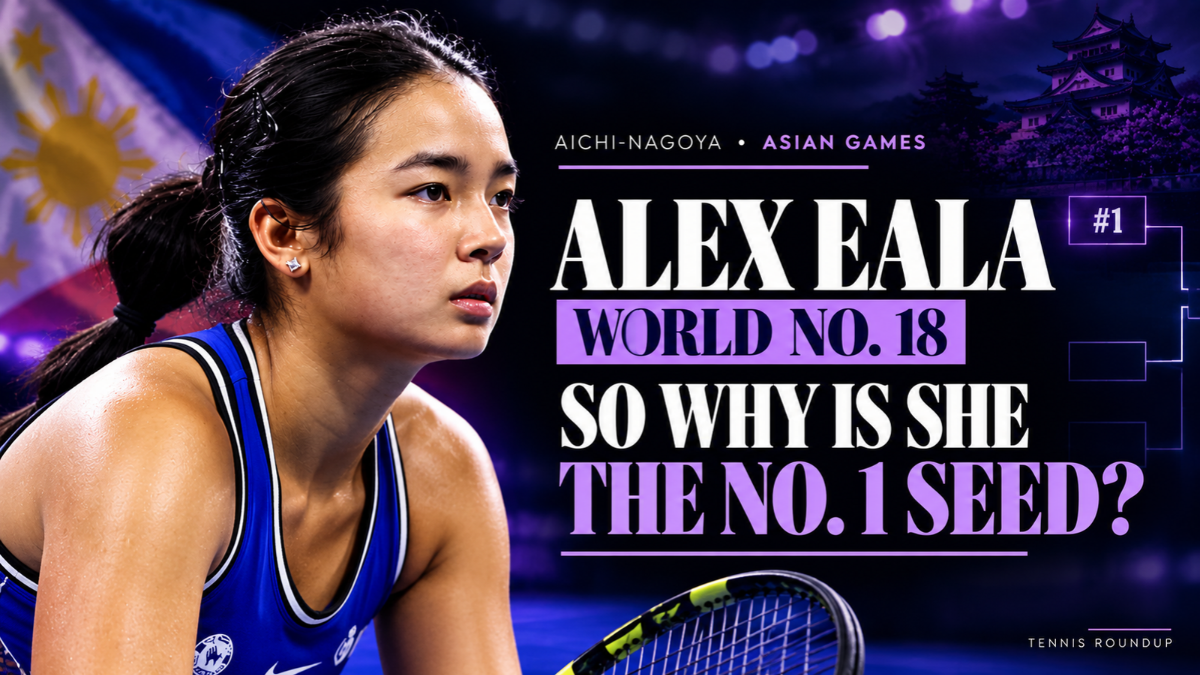
Why Is Alex Eala the No. 1 Seed at the Asian Games?
Alex Eala is the No. 1 seed in women’s singles at the Aichi-Nagoya 2026 Asian Games.
But wait.
Isn’t Kazakhstan’s Elena Rybakina the World No. 1? What about Japan’s Naomi Osaka, China’s Zheng Qinwen and other leading Asian players?
They exist.
They just aren’t in this draw.
The answer to why Eala sits at the top of the Nagoya bracket is actually straightforward:
The Philippines’ World No. 18 is the highest-ranked player who entered the Asian Games women’s singles draw.
But why so many prominent names are missing tells a much more interesting story.
Why Eala Is No. 1: Seedings Follow the Field, Not the Whole Continent
Being the Asian Games No. 1 seed does not mean Eala is the highest-ranked player representing an Asian country on the WTA Tour.
She isn’t.
Rybakina represents Kazakhstan and is World No. 1.
What matters in Nagoya is the field that actually entered.
Eala arrives as World No. 18 and the highest-ranked player in the women’s singles draw. That puts her on the No. 1 line.
That distinction matters because this particular Asian Games landed in a difficult place on the professional tennis calendar.
The China Open Collision That Changed Nagoya
The Asian Games overlap with the China Open, a mandatory WTA 1000 event beginning September 30 in Beijing.
And Beijing attracted an extraordinary field.
The WTA reported that all 14 highest-ranked players and 18 of the Top 20 were on the China Open entry list.
Eala and Canada’s Victoria Mboko were the only Top 20 players missing when that list was published. Mboko was sidelined by a knee injury.
Eala was headed somewhere else.
Nagoya.
The Philippine Tennis Association formally requested an exemption from the WTA because Eala would miss the mandatory tournament.
PHILTA said Eala had made her decision to represent the Philippines at the Asian Games and that it supported her decision.
Philippine Olympic Committee president Abraham Tolentino was even more explicit: regardless of the WTA ruling, Alex would be in Nagoya “for flag and country.”
That calendar collision helped shape the field Eala now leads.
Rybakina and Osaka Are Among the Stars Missing
Two particularly striking names are absent.
Elena Rybakina (Kazakhstan) is World No. 1.
Naomi Osaka (Japan) was listed at No. 13 when the WTA published its Beijing entry story.
Neither is playing women’s singles in Nagoya.
The Olympic Council of Asia reports that both are skipping the Asian Games to play the mandatory China Open. At the time of this writing, no separate player statement explaining their Nagoya decisions had been found.
And yes—Kazakhstan belongs in this conversation.
Kazakhstan competes at the Asian Games through an Olympic Council of Asia-recognized National Olympic Committee and has participated in the Games since 1994.
So a theoretical Asian Games field containing Rybakina is entirely legitimate.
It just isn’t the field Nagoya got.
Janice Tjen Shows How Difficult the Calendar Collision Became
Indonesia’s Janice Tjen provides perhaps the clearest example of how the overlapping schedules affected the Asian Games field.
Tjen was expected to compete in Nagoya but withdrew.
According to Reuters, she was unable to secure an exemption from China Open participation.
That distinction is important.
Players skipping Nagoya should not automatically be characterized as choosing money, rankings or tour tennis over their countries.
Mandatory-event obligations, exemption decisions, national-team selection and individual circumstances can all shape who appears in the draw.
The Defending Champion Is Missing Too
China’s Zheng Qinwen, the defending Asian Games women’s singles champion, is also absent.
But here the evidence line stops.
Her absence from the Nagoya draw is confirmed, but at the time of this writing, a sufficiently reliable source establishing the specific reason had not been identified.
So we won’t assign one to her.
The same applies to China’s Wang Xinyu: she is absent, but her reason should not be assumed merely from the surrounding tournament schedule.
Sometimes “we don’t know” is the most accurate answer.
Who Could Have Been in Nagoya?
Here is where the unusual shape of the field becomes easier to see.
| Player | Represents | Ranking/Status | Nagoya |
|---|---|---|---|
| Elena Rybakina | Kazakhstan | World No. 1 | No |
| Naomi Osaka | Japan | Top 20 | No |
| Alex Eala | Philippines | World No. 18 | Yes — No. 1 seed |
| Janice Tjen | Indonesia | Around Top 50 | Withdrew |
| Zheng Qinwen | China | Defending Asian Games champion | No |
| Wang Xinyu | China | Around Top 60 | No |
This is not a list of players who were necessarily selected, available or willing to compete.
It shows prominent players representing Asian Games-eligible nations who could, in principle, have figured in the field.
And it helps explain why World No. 18 Eala sits at the very top of the draw that actually assembled in Nagoya.
From Singapore No. 3 to Nagoya No. 1
Only days ago, Eala entered the Singapore Tennis Open as the No. 3 seed.
Her run ended in her opening match against unseeded Tatiana Prozorova.
Now she arrives in Nagoya in a completely different position.
No. 1 seed.
First-round bye.
Highest-ranked woman in the draw.
Yet Eala herself has played down what that status guarantees.
“I think I have as big a chance as any other person on the draw.”
That was her assessment ahead of the tournament.
Being No. 1 determines where her name appears on the bracket.
It doesn’t determine what happens after the first ball is struck.
She Chose Nagoya. The Draw That Remained Made Her No. 1.
There are bigger Asian tennis names outside this Asian Games draw.
The World No. 1 is one of them.
But Asian Games seedings aren’t a ranking of every eligible player across a continent.
They belong to the players who are there.
The 2026 calendar created a collision between Nagoya and one of the WTA Tour’s mandatory events. Some prominent players went to Beijing. One withdrew after being unable to secure an exemption. Other absences have reasons that remain unconfirmed.
Eala made her decision to represent the Philippines.
And among the women who assembled in Nagoya, nobody arrived with a higher WTA ranking.
That’s why Alex Eala is the No. 1 seed.
She chose Nagoya. The draw that remained put her at No. 1.