
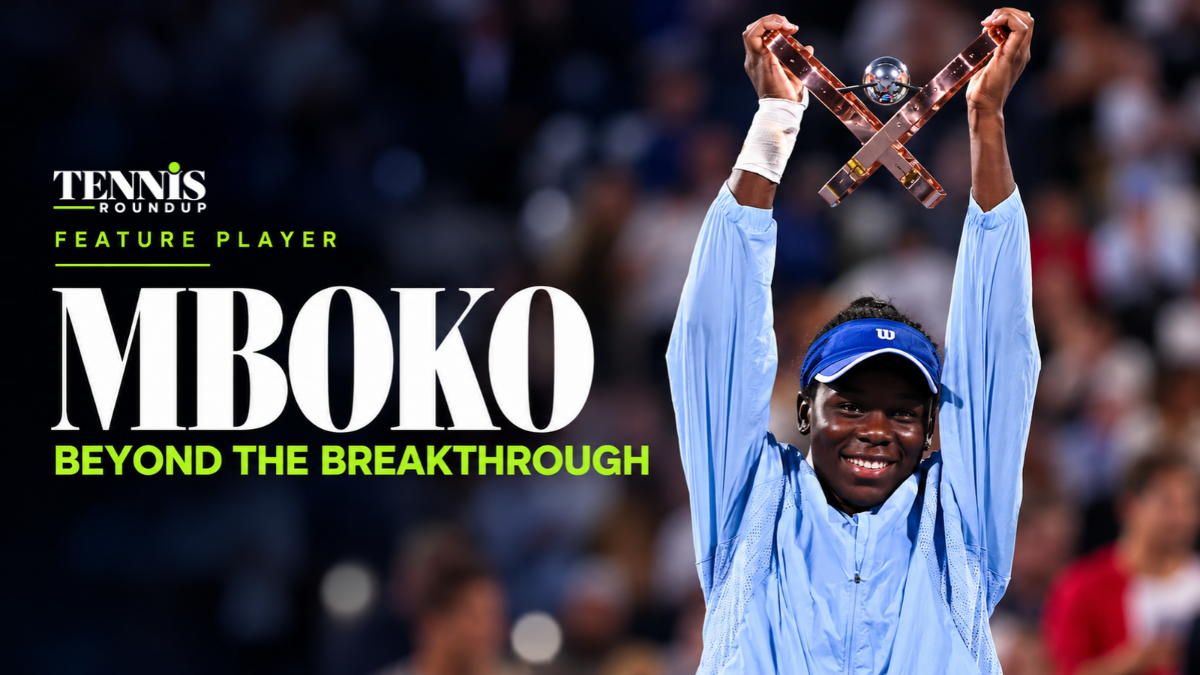
Victoria Mboko: Building Beyond the Breakthrough
Victoria Mboko had already won one of the biggest titles of her young career when she arrived in Hong Kong in November 2025.
Three months earlier, the Canadian had stunned the tennis world by winning the Montreal WTA 1000 championship.
Now she was facing another test.
In the Hong Kong final against Cristina Bucsa, Mboko won the opening set but lost the second in a dramatic tiebreak after having an opportunity to finish the match.
The momentum had shifted.
Mboko needed another answer.
She found one.
The Canadian defeated Bucsa 7–5, 6–7(9), 6–2 to win her second WTA singles title.
Afterward, she explained the importance of regrouping when a match does not unfold as expected.
That response offered a glimpse of the player behind the sudden attention.
Montreal had made Victoria Mboko famous.
What followed would reveal how much more there was to her career than one extraordinary tournament.
Victoria Mboko Before the Breakthrough
Victoria Mboko was born on August 26, 2006, in Charlotte, North Carolina, in the United States.
Her parents, Cyprien Mboko and Godee Kitadi, emigrated from the Democratic Republic of the Congo.
When Victoria was just two months old, her family moved to Toronto, Canada.
She grew up in a family where tennis was already familiar.
The youngest of four siblings, Mboko watched her older brothers and sisters play. Two of them, Gracia and Kevin, would compete in college tennis.
Her family’s sporting environment helped introduce her to the game at an early age.
But her development was not simply a matter of following her siblings.
She had to build her own game.
A Canadian Player With Congolese Roots
Mboko represents Canada internationally, but her family heritage connects her to the Democratic Republic of the Congo.
She has spoken about her Congolese background, including family traditions and the food she grew up enjoying.
Her identity reflects several places: her American birthplace, her family’s Congolese heritage and the Canadian environment in which she developed as a tennis player.
Those connections are part of her story without defining the limits of what she can achieve.
Mboko’s tennis career developed in Canada, supported by a family whose own journey began elsewhere.
Learning the Game
Mboko began using a tennis racquet as a small child.
Her early development included training in Burlington, Ontario, where Pierre Lamarche was among the coaches who worked with her.
She also spent time training at Justine Henin’s academy in Belgium.
As she progressed through junior competition, her results began to attract attention.
In 2022, she reached the girls’ singles semifinals at both Wimbledon and the US Open.
At the US Open, her semifinal opponent was another emerging player who would later become familiar to Tennis Roundup readers: Alexandra Eala.
Mboko eventually reached World No. 6 in the ITF junior rankings.
Those results established her as a promising junior competitor.
But success in junior tennis does not guarantee success on the professional tour.
The next stage required another level of development.
From Junior Tennis to the Professional Tour
Mboko entered her first ITF professional tournament in 2021, competing at a W15 event in Prokuplje, Serbia.
She was just 14.
In 2022, she won her first ITF singles title at a W25 tournament in Saskatoon.
That year also brought her first appearances in WTA Tour qualifying and a main draw.
The progress continued in 2023.
At another Saskatoon tournament, this time a W60 event, Mboko defeated Emina Bektas 6–4, 6–4 in the final.
She completed the tournament without losing a set.
It was her second professional singles title.
The victories mattered, but the larger benefit was experience.
Competing regularly against professional opponents gave Mboko opportunities to develop her game beyond the junior circuit.
The Importance of the ITF Pathway
During 2024 and early 2025, Mboko continued building her career through ITF tournaments.
She won titles in different locations, including Darmstadt, Le Lamentin, Rome in Georgia, and Porto.
The events were less prominent than the tournaments that would later make her famous.
But they provided something essential.
Matches. Repetition. Opportunities to adjust.
Her results gradually translated into ranking progress.
At the beginning of January 2025, Mboko was ranked World No. 333.
By June, she had entered the Top 100.
The improvement was substantial.
Yet the biggest breakthrough was still ahead.
Learning to Build Control
Victoria Mboko plays an aggressive style of tennis.
She likes to strike the ball with power, control rallies and place opponents under pressure.
In a May 2025 WTA interview, she described her preference for taking charge of points.
But she also acknowledged that aggression alone was not enough.
She needed to improve her defense, movement and stamina.
That understanding became important as she faced stronger opponents.
More Than Baseline Power
Mboko’s game is built around aggressive groundstrokes and the ability to take control from the baseline.
When she finds her rhythm, she can dictate exchanges and force opponents into defensive positions.
But experienced players can disrupt that rhythm.
They can vary the pace, change the direction of rallies and make her play additional shots.
To compete consistently at the highest level, Mboko needed more tactical options.
Former Wimbledon finalist Nathalie Tauziat, who worked with Mboko during her development, encouraged her to incorporate more slices and net play.
Those adjustments were part of a broader effort to make her game more adaptable.
The goal was not to abandon power. It was to learn when power needed support from patience, defense and variety.
That process would become visible in some of the most important matches of her career.
Montreal 2025: Seven Matches That Changed Everything
When Victoria Mboko entered the 2025 Canadian Open in Montreal, she was ranked World No. 85.
She was an unseeded wildcard.
Winning the tournament was hardly an expected outcome.
But over seven matches, Mboko produced one of the most remarkable runs of the season.
She began by defeating Kimberly Birrell.
Then came victories over Sofia Kenin and Marie Bouzkova.
In the fourth round, she faced World No. 1 Coco Gauff.
Mboko won 6–1, 6–4.
It was a result that immediately changed the level of attention surrounding her.
She followed it by defeating Jessica Bouzas Maneiro in the quarterfinals.
Then came a semifinal against Elena Rybakina.
Victoria Mboko Against Elena Rybakina
Rybakina was already a Grand Slam champion and one of the most dangerous players on the WTA Tour.
She won the opening set 6–1.
Mboko was suddenly facing the kind of challenge that could end an extraordinary tournament run.
But the Canadian recovered.
She won the second set 7–5, forcing a decider.
The third set became another battle.
Mboko saved a match point and eventually prevailed in a tiebreak.
Victoria Mboko defeated Elena Rybakina 1–6, 7–5, 7–6(4).
The semifinal lasted two hours and 46 minutes.
The victory sent Mboko into her first WTA Tour singles final.
Waiting for her was another Grand Slam champion.
Naomi Osaka.
The Final Against Naomi Osaka
Osaka won the opening set 6–2.
For the second consecutive match, Mboko had lost the first set against a major champion.
Once again, she responded.
Mboko took the second set 6–4 and carried that momentum into the decider.
She won the third 6–1.
Victoria Mboko defeated Naomi Osaka 2–6, 6–4, 6–1 to win the Montreal WTA 1000 title on August 7, 2025.
It was her first WTA Tour singles championship.
Across the tournament, she had defeated four former Grand Slam singles champions: Sofia Kenin, Coco Gauff, Elena Rybakina and Naomi Osaka.
She had also recovered from losing the opening set in three matches.
The victory transformed her ranking.
On August 11, she climbed to World No. 24.
Only seven months earlier, she had been outside the Top 300.
Montreal was an extraordinary breakthrough.
But it was not the beginning of her development.
The championship was the visible result of years spent learning how to compete.
What Came After Montreal
A breakthrough tournament creates new opportunities.
It also creates expectations.
After Montreal, Mboko was no longer simply an emerging player working her way through the professional rankings.
She was a WTA 1000 champion.
Opponents knew her game.
Spectators recognized her.
Every new tournament offered another test of whether she could reproduce her success.
Mboko’s approach was to treat each week as a new opportunity rather than assume that one title guaranteed another.
That perspective became important during the final months of 2025.
Hong Kong: A Second Championship
In November, Mboko reached the Hong Kong final.
Her semifinal opponent was fellow Canadian Leylah Fernandez.
Fernandez won the opening set 6–2.
Mboko recovered to take the next two 6–3, 6–2.
The victory set up a final against Cristina Bucsa.
Mboko won the opening set 7–5, but the second developed into a dramatic contest.
Bucsa eventually won the tiebreak 11–9.
The match had slipped into a deciding set.
Rather than allowing the missed opportunity to determine the outcome, Mboko regrouped.
She won the third set 6–2.
Her Hong Kong championship was her second WTA singles title of 2025.
It also provided an important answer to a question raised after Montreal.
Could she win another tournament after the initial breakthrough?
Yes.
And she had done it through another difficult three-set final.
Mboko finished 2025 ranked World No. 18.
Victoria Mboko Enters the Top 10
The following season brought more opportunities and more demanding opponents.
In January 2026, Mboko reached the Adelaide International final.
She faced Mirra Andreeva, another young player whose rapid development had attracted considerable attention.
Andreeva won 6–3, 6–1.
For Mboko, it was a reminder that reaching a final and winning one are different challenges.
But the result did not stop her progress.
The Doha Final
In February, Mboko reached the final of the Doha WTA 1000 tournament.
Her opponent was Karolina Muchova, a player known for her variety, movement and tactical intelligence.
Muchova won 6–4, 7–5.
Mboko had reached another important final without taking the title.
Yet the ranking points earned during the tournament carried her into the world’s elite.
On February 16, 2026, Victoria Mboko entered the WTA Top 10 for the first time, reaching World No. 10.
One month later, on March 16, she achieved a new career-high ranking of World No. 9.
The milestone confirmed how far she had progressed.
But it did not mean her development was complete.
Learning From Defeat
Mboko continued to produce strong results during the spring.
She reached the quarterfinals at Indian Wells and Miami.
In May, she advanced to the Strasbourg final on clay.
There, she faced Emma Navarro.
Navarro dominated the opening set 6–0.
Mboko responded by using more variety, including drop shots, to change the rhythm of the match.
She won the second set 7–5.
But the recovery was incomplete.
Navarro took the deciding set 6–2.
Mboko finished with 57 unforced errors.
The result illustrated both her progress and the work that remained.
Adding new tactical options could help her change a match, but it did not guarantee victory.
By the end of May 2026, Mboko had reached three WTA singles finals during the season.
She had not won any of them.
Her career was still moving forward, but not in a straight line.
An Interrupted Season
At Roland Garros in 2026, Mboko reached the third round before losing to Madison Keys in three sets.
Her next challenge came on grass.
At Queen’s Club in London, she faced Karolina Pliskova in the round of 16 on June 10.
Pliskova won the opening set 6–2.
Mboko was leading 4–3 in the second set when she fell and could not continue.
She retired from the match.
Two days later, Mboko announced that she had sustained an MCL injury to her left knee.
She withdrew from the remainder of the grass-court season, including Wimbledon.
Her absence subsequently extended beyond the grass season.
In July, she withdrew from the Canadian Open.
The tournament that had brought her international recognition only a year earlier would take place without its defending champion.
The Uncertainty of Recovery
An injury can interrupt a player’s career without erasing the achievements that came before it.
But recovery does not follow an editorial schedule.
As of October 30, 2026, the available official match record did not establish a completed WTA singles return for Mboko after her June retirement.
Nor did it confirm an exact return date.
That uncertainty matters.
It would be easy to turn the injury into the beginning of a triumphant comeback story.
But such a comeback had not yet been documented.
Mboko’s recovery was still an unfinished chapter.
Her team had expressed the intention to return to competition as soon as possible.
For the moment, the next result remained unknown.
Victoria Mboko Beyond the Breakthrough
By October 30, 2026, Victoria Mboko had already achieved more than many players accomplish in an entire career.
At just 20 years old, her record included:
- Two WTA Tour singles titles: Montreal and Hong Kong in 2025.
- Five WTA Tour singles finals, including three runner-up finishes in 2026.
- A career-high ranking of World No. 9, reached in March 2026.
- A fourth-round appearance at the Australian Open, her best Grand Slam singles result to that point.
- A World No. 15 ranking on the official October 26, 2026 list.
But those achievements tell only part of the story.
Before Montreal, Mboko had spent years developing through junior and ITF competition.
After Montreal, she proved that she could win another championship.
During 2026, she learned that reaching the world’s Top 10 did not eliminate defeats, tactical challenges or physical setbacks.
And when injury interrupted her season, the future became uncertain again.
The player who emerged from Montreal was not a finished product.
She was still learning.
Still adjusting.
Still discovering what her game required against different opponents.
That may be the most important distinction in Victoria Mboko’s story.
The breakthrough brought recognition. It did not end the work.
And when she eventually returns to competition, the next chapter will be written through results rather than expectations.
Related Stories
Elena Rybakina: The Game Behind the Grand Slam Champion
Explore the career of the two-time Grand Slam champion Mboko defeated in her remarkable Montreal semifinal.
Leylah Fernandez: The Career Beyond the US Open Breakthrough
Discover the career of the fellow Canadian Mboko defeated on her way to the 2025 Hong Kong title.
Mirra Andreeva — Feature Player
Meet another emerging competitor whose career intersected with Mboko’s during the 2026 Adelaide final.
Editor’s note: This profile reflects Victoria Mboko’s career through October 30, 2026. Rankings, results and injury information are presented as documented at that historical cutoff.