
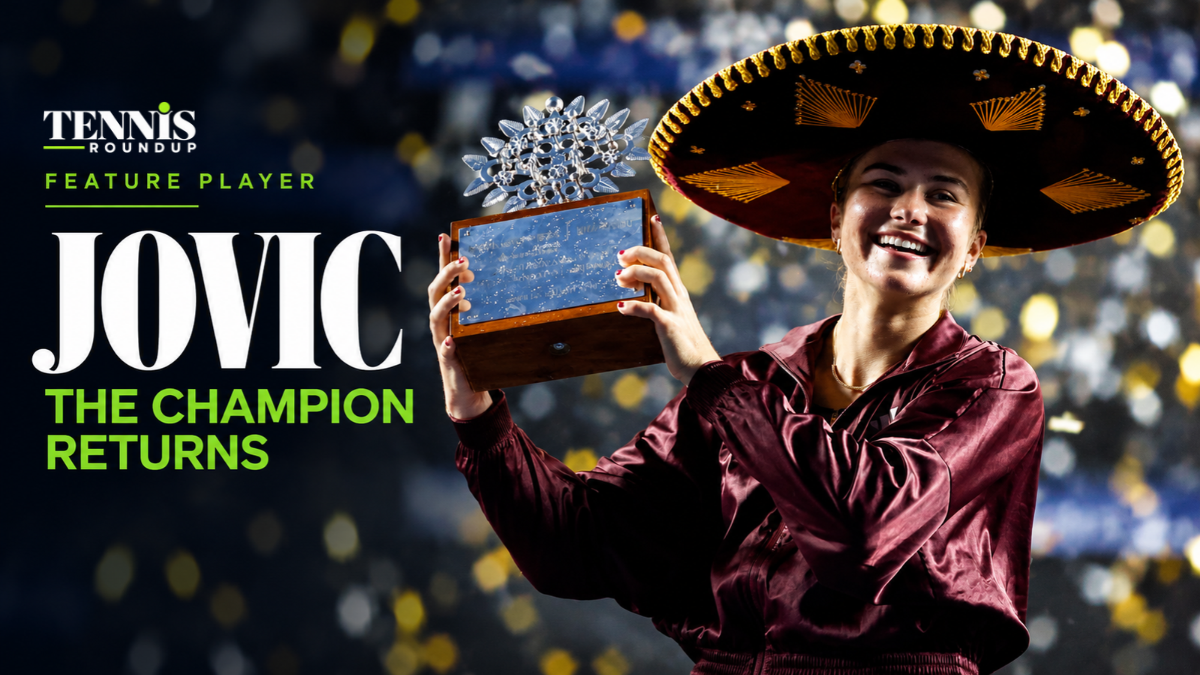
Iva Jovic: From Breakthrough Teenager to Defending Champion
In 2025, Iva Jovic arrived in Guadalajara as an unseeded 17-year-old searching for her first WTA Tour title. One year later, she returned as the defending champion—and won again without dropping a set. Between those two championships, the American teenager was learning what it meant to compete among the world’s best.
Two Championships, Two Different Journeys
When Iva Jovic returned to Guadalajara in September 2026, she was no longer the teenager who had surprised the field a year earlier.
She was the defending champion.
In 2025, Jovic had arrived at the Mexican WTA 500 tournament ranked World No. 73. She was unseeded, still searching for her first WTA Tour singles championship, and had never reached a quarterfinal at that level.
Her path to the title was anything but straightforward.
She needed three sets to win three of her five matches, survived a match point in the quarterfinals, and eventually defeated Emiliana Arango in the final.
A year later, the circumstances had changed.
Jovic returned as the No. 2 seed and World No. 16.
This time, she did not lose a set.
She defeated Zeynep Sonmez, Magdalena Frech, Cristina Bucsa and Peyton Stearns to successfully defend her title.
Four victories. Eight sets won. None lost.
The Guadalajara Open had become the setting for two important stages of her young career.
In 2025, Jovic proved she could become a WTA champion. In 2026, she proved she could defend a championship.
But the journey between those victories had begun much earlier.
Before Guadalajara, Iva Jovic Was Already Building Her Career
Iva Jovic was born on December 6, 2007, in Torrance, California, and represents the United States.
She began playing tennis at five.
Her early tennis experiences included practicing with her sister, Mia, on a rooftop court.
She later developed her game at the Jack Kramer Club in Southern California, where coaches including Peter Smith and Thomas Gutteridge contributed to her development.
Even before her professional breakthrough, Jovic had established herself as a promising American junior.
In 2022, she was part of the United States team that won the Junior Billie Jean King Cup.
Her progress continued through 2024.
At the junior Grand Slams, she reached the Wimbledon and US Open girls’ singles semifinals, as well as the Roland-Garros girls’ singles quarterfinals.
She also enjoyed success in doubles.
Partnering Tyra Caterina Grant, Jovic won the 2024 Australian Open and Wimbledon girls’ doubles championships.
Those were important junior achievements, but her ambitions were already extending toward professional tennis.
And she had begun building a record at that level.
The First Steps Into Professional Tennis
Jovic made her first appearance on the ITF professional circuit in 2022, reaching the final of a W15 tournament in Los Angeles.
In 2023, she won her first ITF singles title at W25 Redding, California.
The following year brought further progress.
She won titles at W35 Berkeley and W75 Rancho Santa Fe, then reached the final of the W100 tournament in Tyler.
But her most significant result of 2024 came at the US Open.
Ranked World No. 389, Jovic entered her first WTA Tour-level main draw.
Her opening opponent was Magda Linette, an established professional ranked inside the world’s Top 50.
Jovic won 6–4, 6–3.
It was her first Top-50 victory and an important introduction to Grand Slam competition.
The result did not immediately establish her among the world’s leading players.
But it showed that the teenager could compete against experienced opponents on one of tennis’s biggest stages.
The following season, she would take another step.
The Week a Match Point Became a Championship
In June 2025, Jovic won the WTA 125 Ilkley title, defeating Rebecca Marino in the final.
It was an important professional achievement, although WTA 125 titles are counted separately from WTA Tour championships.
Three months later, she arrived in Guadalajara.
The tournament would become the setting for her first WTA Tour singles title.
Her opening match against Katarzyna Kawa required three sets.
Jovic won 6–4, 4–6, 6–3.
She then defeated eighth seed Camila Osorio 6–4, 6–2 to reach her first WTA Tour quarterfinal.
That was where her championship run nearly ended.
Facing qualifier Victoria Jimenez Kasintseva, Jovic found herself in a deciding-set tiebreak.
She faced a match point.
Had she lost that point, her tournament would have ended in the quarterfinals.
Instead, she survived.
Jovic won 6–3, 3–6, 7–6(6).
The narrow escape became one of the defining moments of her week.
In the semifinals, she faced Czech wildcard Nikola Bartunkova.
Once again, the match went three sets.
Jovic prevailed 6–3, 6–7(5), 6–3.
The final brought a meeting with Colombia’s Emiliana Arango.
This time, Jovic won in straight sets, 6–4, 6–1, claiming her first WTA Tour singles championship.
At 17 years and 283 days, she became the youngest WTA Tour singles champion of the 2025 season.
She was also the youngest American to win a WTA Tour singles title since Coco Gauff’s victory in Parma in 2021.
The achievement carried her into the world’s Top 40.
But the significance of Guadalajara extended beyond the ranking.
Jovic had arrived without a WTA Tour title. She left as a champion.
And she had learned that winning a tournament sometimes required surviving the moments when defeat appeared closest.
What Iva Jovic Brings to the Court
Jovic’s rise has been built around qualities that do not always depend on overwhelming power.
Her game emphasizes timing, ball control, movement and the ability to take time away from opponents.
Rather than relying entirely on hitting harder, she seeks to make effective contact with the ball and position herself to control exchanges.
One player who influenced her approach was Belinda Bencic.
Jovic has spoken about admiring Bencic’s early ball contact and efficient footwork, particularly her ability to cut angles and take the ball before opponents can recover.
Those qualities help explain the style Jovic has been developing.
But her game remains a work in progress.
In March 2026, coach Thomas Gutteridge discussed the importance of continuing her technical and physical development.
Among the areas receiving attention were serve-plus-one patterns, variation and the development of a more complete all-court game.
The coaching team was also conscious of the demands created by rapid success.
Rather than chasing every available ranking point, they wanted to preserve opportunities for training and improvement.
Gutteridge summarized that approach:
“I don’t want to push her too soon.”
It was an important distinction.
Jovic was already achieving significant results.
But those results did not mean her development was complete.
Winning matches and building a sustainable professional game were two parts of the same process.
The Australian Open: A Different Kind of Breakthrough
The months following her first Guadalajara title brought Jovic into increasingly demanding competition.
She began 2026 by reaching the Auckland semifinals and Hobart final.
Then came the Australian Open.
In Melbourne, Jovic reached her first senior Grand Slam singles quarterfinal.
Her fourth-round victory over Yulia Putintseva was particularly convincing.
Jovic won 6–0, 6–1.
The result earned her a meeting with Aryna Sabalenka, one of the sport’s leading players.
The quarterfinal proved a different challenge.
Sabalenka won 6–3, 6–0, ending Jovic’s run.
The defeat did not erase the achievement of reaching the last eight.
Instead, it illustrated the difference between breaking through at Grand Slam level and consistently competing with the very best players.
Jovic had already demonstrated that she could win a WTA 500 title.
Now she had experienced a Grand Slam quarterfinal.
Her career was advancing, but each new level brought another set of challenges.
Toronto and the Alina Korneeva Connection
Not every important chapter in a young player’s development ends with a victory.
At the 2026 Canadian Open in Toronto, Jovic faced another emerging player whose career had followed a different path.
Alina Korneeva, the former junior World No. 1 and two-time junior Grand Slam singles champion, was rebuilding her professional career after injury interruptions.
Their meeting came in the round of 32 on August 7.
Jovic entered as the No. 13 seed.
Korneeva won 6–3, 6–4.
For Korneeva, the result was an important milestone in her return to higher-level competition.
For Jovic, it was another reminder of the depth of talent emerging across women’s tennis.
The two players had experienced different developmental journeys.
Korneeva’s early junior success had been followed by physical setbacks and a gradual return.
Jovic’s progress had taken her through ITF titles, a WTA championship and a Grand Slam quarterfinal.
Their Toronto encounter connected those stories.
But one meeting does not establish a rivalry.
It was a meaningful match between two developing careers—not a prediction of years of future battles.
Returning to Guadalajara as the Defending Champion
When Jovic returned to Guadalajara in September 2026, the circumstances were very different from those of her first championship.
She was no longer an unseeded teenager trying to establish herself.
She was the No. 2 seed, ranked World No. 16, and the defending champion.
That brought a different kind of expectation.
Her opening match against Zeynep Sonmez was competitive.
Jovic won 7–6(5), 6–4.
From there, her progress became increasingly convincing.
In the quarterfinals, she defeated seventh seed Magdalena Frech 6–2, 6–1.
In the semifinals, she beat sixth seed Cristina Bucsa 6–4, 6–1.
The final brought an all-American meeting with Peyton Stearns.
Jovic won 6–4, 6–2 in one hour and 26 minutes.
She had defended her Guadalajara title without dropping a set.
The victory was her second WTA Tour singles championship.
It also made her the first two-time champion in the Guadalajara Open’s event history, according to the tournament organizers.
During the trophy presentation, Jovic expressed her affection for the tournament:
“The crowd is my favorite thing about coming here.”
The two championship runs offered an interesting contrast.
In 2025, she had survived a match point and three three-set matches.
In 2026, she had won four matches in straight sets.
That contrast suggests a player whose competitive experience had grown.
It does not prove that defending a title had become easy.
Nor does it mean she would never again struggle through a difficult match.
But it does establish something important.
Jovic had returned to the tournament where she first became a champion—and succeeded again under different expectations.
The Work Continues Beyond Guadalajara
Guadalajara was not the end of Jovic’s 2026 season.
In October, she continued competing on the Asian swing.
At the Wuhan Open, she defeated Dayana Yastremska before eventually losing to Maja Chwalinska in the round of 16.
At the Ningbo Open, she defeated Jasmine Paolini before her tournament ended against Diana Shnaider in the quarterfinals.
Those results added further chapters to her season.
They also reinforced an important point about professional tennis.
A player can defend a championship successfully and still face setbacks in the following weeks.
A Grand Slam quarterfinal does not guarantee another.
A strong tournament does not automatically establish consistency across an entire season.
Jovic’s career remains a process of learning how to reproduce her best tennis against different opponents, on different surfaces and under changing expectations.
That is particularly important for a player who is still only 18.
Iva Jovic: A Career Still Being Built
There are several ways to measure Iva Jovic’s progress.
She has won professional titles at ITF and WTA 125 level.
She has captured two WTA Tour singles championships.
She has reached a Grand Slam quarterfinal.
And she has moved from being an unseeded teenager in Guadalajara to successfully defending the same tournament as one of its leading contenders.
Those achievements are already part of her career.
But they do not answer every question about her future.
Her coaching team continues working on technical development, physical preparation and the demands of competing regularly at the highest level.
There will be more difficult opponents.
There will be more matches that do not go her way.
And there will be new expectations created by the success she has already achieved.
In 2025, Guadalajara introduced Jovic as a WTA Tour champion.
In 2026, it welcomed her back—and watched her win again.
The first title showed what she was capable of achieving.
The second showed that the achievement was not confined to one extraordinary week.
What happens next will depend on the work still being done.
And that is what makes Iva Jovic’s developing career worth following.
RELATED STORIES
I recommend starting with these verified Tennis Roundup URLs.
| Related story | Connection |
|---|---|
| Alina Korneeva: The Junior Champion Rebuilding Her Place in Tennis | Their Toronto 2026 meeting |
| Wuhan Open 2026 — Day 3 | Jovic’s victory over Yastremska |
| Ningbo Open 2026 — Day 4 | Jovic’s victory over Paolini |
| Ningbo Open 2026 — Story Seeds | Guadalajara title-defense context |
SOURCES & FURTHER READING
| Source | Research relevance |
|---|---|
| WTA — Iva Jovic Player Profile | Biography, coaching and career record |
| USTA — Jovic Wins First WTA Title in Guadalajara | 2025 championship and ranking breakthrough |
| WTA — Jovic Goes Back-to-Back in Guadalajara | 2026 championship defense |
| WTA — From the Rooftop to the Big Stage | Childhood, development and 2024 US Open |
| ITF — Class of 2024: Iva Jovic | Junior career and professional transition |
| WTA — Jovic’s Quick Ascent Follows a Long-Term Plan | Coaching and development |
| Australian Open — Jovic Reaches First Major Quarterfinal | Australian Open 2026 |
| Guadalajara Open — Jovic Becomes Two-Time Champion | Tournament history and final |
The official draws provide the underlying match-by-match results:
2025 Guadalajara: WTA Official Singles Draw
2026 Guadalajara: WTA Official Singles Draw