
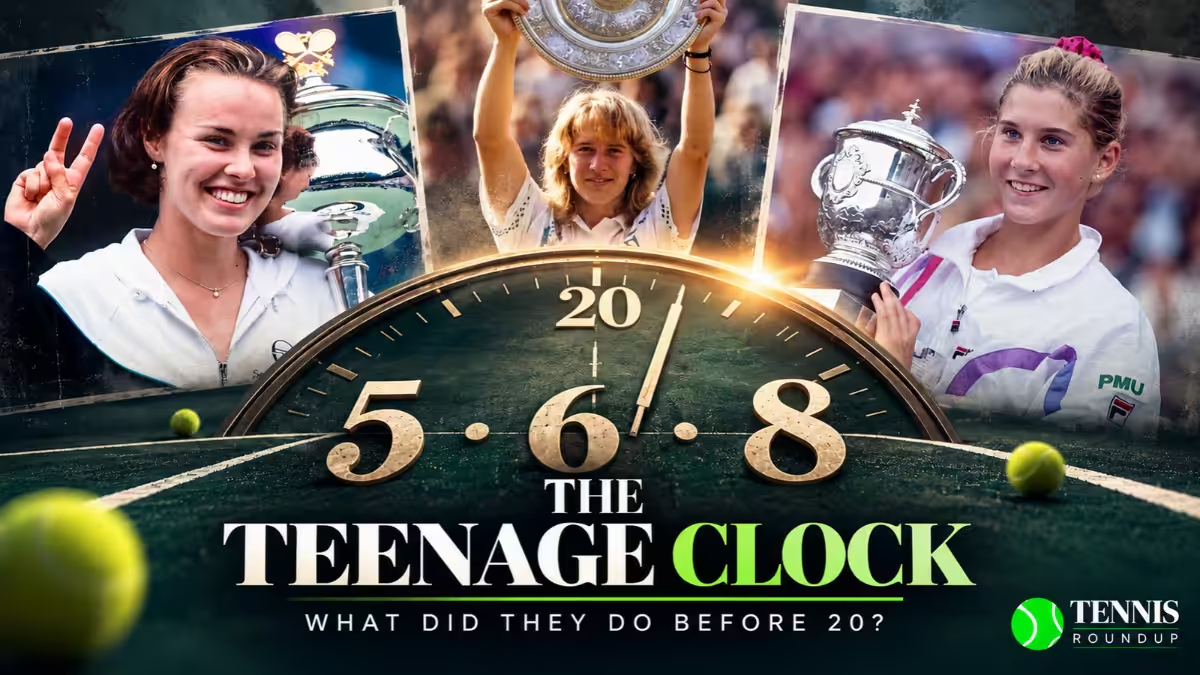
Before the Teenage Clock Started, They Took Different Roads
The numbers came later.
Monica Seles would win eight Grand Slam singles titles before turning 20. Steffi Graf would win six. Martina Hingis would win five.
Those figures are extraordinary—but they do not tell us when the warning signs first appeared.
Before the teenage Grand Slam clock began, Graf, Seles and Hingis were already moving toward the professional game through three very different routes.
Graf: the senior-tour prodigy
Steffi Graf’s early record was defined less by junior Grand Slam success than by how quickly she entered the adult game.
Graf won the Junior Orange Bowl in 1981, turned professional at 13, and became the youngest player to appear in the Roland-Garros main draw. Before turning 16, she had already reached the fourth round at both the Australian Open and Wimbledon.
Her first WTA title came shortly after her 16th birthday, when she defeated Chris Evert in the Family Circle Cup final.
Graf did not need a long junior Grand Slam résumé to announce herself. Her evidence was already visible in the senior draw. At an age when most players were still being measured through junior results, Graf was already surviving multiple rounds against established professionals.
Seles: the fastest conversion
Monica Seles won the Junior Orange Bowl at 11. WTA records that she moved to Florida at 12, played her first professional tournament as a 14-year-old amateur in 1988, and won her first WTA title in Houston in 1989 by defeating Chris Evert.
Seles was only 15 when she reached the Roland-Garros semifinals on her Grand Slam debut. She lost there to world No. 1 Graf—but the result made the direction of her career unmistakable.
By 16, Seles had already achieved something neither of the other two had quite matched at the same age: a WTA title and a Grand Slam semifinal against the world’s leading player.
Her path was not defined by a long list of documented junior Grand Slam titles. It was defined by how quickly she converted elite junior promise into adult-tour danger.
Hingis: the junior champion
Martina Hingis provides the clearest junior prodigy story.
She won the junior Roland-Garros title at 12, retained it at 13, and added the junior Wimbledon title that same year. WTA records her as a three-time junior Grand Slam champion. Contemporary reporting later described her as having effectively outgrown the junior circuit before turning professional at 14.
By the time Hingis reached 16, she had already:
- dominated the junior Grand Slam circuit;
- turned professional at 14;
- begun competing in senior Grand Slam events;
- won the Wimbledon women’s doubles title at 15;
- become a serious senior singles contender.
Hingis’s early path was therefore clear: junior dominance first, adult success immediately afterward.
Three kinds of early evidence
| Player | Early signal |
|---|---|
| Graf | Senior major competitiveness at 13–15 |
| Seles | Rapid conversion into WTA and Grand Slam results |
| Hingis | Junior Grand Slam domination |
That distinction matters.
“Prodigy” is often used as if it describes one fixed route. It does not. A player can defeat adults unusually early, move rapidly from junior success into senior competition, or dominate her age group before crossing over.
Graf was the early senior challenger.
Seles was the accelerated converter.
Hingis was the junior champion.
What had they done by 16?
When each player reached her 16th birthday:
- Graf had already proved that she belonged in senior Grand Slam draws.
- Seles had already won at WTA level and reached a Grand Slam semifinal.
- Hingis had already built the strongest junior résumé and begun her senior transition.
None of those paths guaranteed what came next. But all three had crossed an important threshold before the teenage Grand Slam clock began.
The bridge to the Teenage Clock
The teenage clock did not begin when Graf, Seles or Hingis won her first major.
It began earlier, in different places:
- in the senior Grand Slam draw for Graf;
- on the WTA Tour for Seles;
- on the junior courts for Hingis.
Before they became the extraordinary 6–8–5 teenage champions, they had already shown that something unusual was happening.
But they did not show it in the same language.
That may be the most revealing part of the comparison.
Related Story
THE TEENAGE CLOCK | What Did the Greats Actually Do Before 20?