
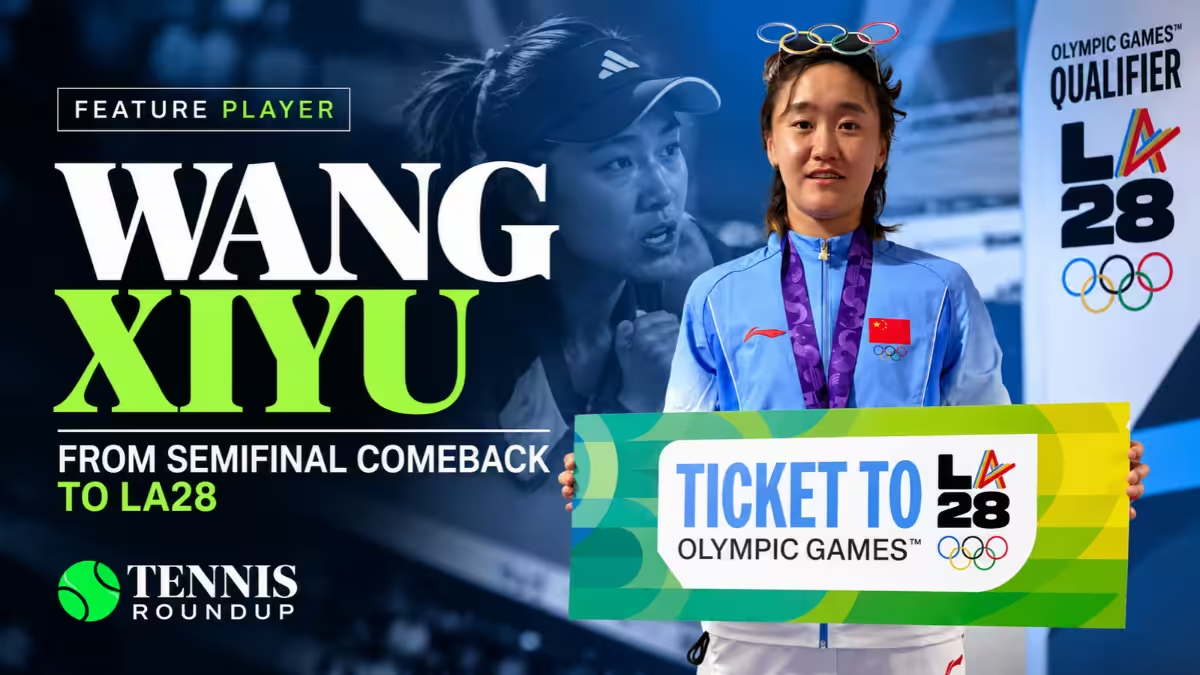
Wang Xiyu: The Player Who Beat Alex Eala — Then Won Asian Games Gold
Alex Eala was one victory away from the Asian Games women’s singles final.
For one set, she appeared to be heading there.
Then Wang Xiyu changed the match—and eventually changed the tournament.
The Chinese left-hander recovered from a set down to defeat top seed Eala 3–6, 6–3, 6–2 in the semifinal of the 2026 Asian Games.
That result ended Eala’s bid for singles gold and introduced Wang to many Tennis Roundup readers following the Filipina’s run in Nagoya.
But stopping Wang’s story there would miss the most important part.
She didn’t just beat Eala.
She went on to win the gold medal.
Wang Xiyu Turned the Semifinal Around
Eala entered the semifinal as the tournament’s top seed and World No. 18. Wang arrived ranked No. 85 and seeded fourth.
Eala took the opening set 6–3.
Wang responded 6–3 in the second.
By the deciding set, the balance of the match had shifted.
The 1.82-meter left-hander established a 4–1 lead, absorbed Eala’s pressure and eventually served out the match to love for a 3–6, 6–3, 6–2 victory.
Power is an obvious part of Wang’s game. Her heavy left-handed forehand and first-strike tennis can take time away from an opponent.
But against Eala, power wasn’t the whole explanation.
Wang became the steadier player as the match developed. Eala herself pointed to Wang’s greater consistency while acknowledging fluctuations in her own level.
For Wang, there was still another match to play.
Beating Eala Wasn’t the Finish Line
Across the net in the gold-medal match was another Chinese player: Zhang Shuai.
This time, Wang didn’t need a comeback.
She defeated Zhang 6–2, 6–1 in 66 minutes to become the 2026 Asian Games women’s singles champion.
The victory delivered more than a gold medal.
It also secured Wang an automatic qualification place for the Los Angeles 2028 Olympic tennis event, subject to the applicable eligibility requirements.
That changed the meaning of her Asian Games run.
Wang had arrived in Nagoya ranked well below her career high.
She left as a continental champion with another Olympic opportunity ahead.
Wang Xiyu Was Never an Unknown
A ranking of No. 85 can hide quite a bit of history.
Wang Xiyu was born on March 28, 2001, in Taixing, Jiangsu Province. She began playing tennis at eight and eventually became the junior World No. 1 in both singles and doubles.
And there is a particularly relevant chapter in her junior career.
At the 2018 US Open, Wang defeated Clara Burel 7–6(4), 6–2 to win the girls’ singles championship.
She became China’s first girls’ singles Grand Slam champion.
Her junior résumé also included a girls’ doubles bronze medal alongside Wang Xinyu at the 2018 Youth Olympics.
The senior tour eventually brought another breakthrough.
A WTA Champion on Home Soil
In 2023, Wang captured her first WTA singles title at home in Guangzhou.
She defeated Magda Linette 6–0, 6–2 in the final, using the combination that has become characteristic of her tennis: a heavy left-handed forehand backed by strong first serving.
That same season she reached the Round of 16 at the WTA 1000 event in Rome, saving a match point against Taylor Townsend before eventually losing to Zheng Qinwen.
Her singles ranking climbed as high as World No. 49 in January 2023.
By the time she arrived at the 2026 Asian Games, however, Wang was back at No. 85.
The gold medal therefore carried another layer.
This wasn’t the arrival of an unknown player.
It was a reminder of what a former Top-50 player was still capable of producing.
Wang Xiyu and Alex Eala: Their First Meeting
One detail is particularly important because two Chinese players with very similar names have crossed Eala’s path.
Wang Xiyu and Wang Xinyu are different players.
Eala defeated Wang Xinyu 6–4, 6–3 in Rome in May 2026.
The Asian Games semifinal was Eala’s first career meeting with Wang Xiyu.
Wang Xiyu won it 3–6, 6–3, 6–2.
So, for now:
Wang Xiyu leads their head-to-head 1–0.
Whether Nagoya becomes the beginning of a recurring matchup between two prominent Asian players is something future draws will decide.
One match is enough to establish a result.
It isn’t enough to manufacture a rivalry.
From Paris to Los Angeles — With One Big Chinese Question
Wang Xiyu already knows what Olympic tennis feels like.
At Paris 2024, she reached the Round of 16 before losing 6–3, 6–4 to World No. 1 Iga Swiatek.
Her Asian Games gold has now put Wang on a very different road toward Los Angeles 2028.
The women’s singles champion from the 2026 Asian Games receives a continental qualification place for LA28 — provided she is ranked inside the Top 500 at the June 12, 2028 cutoff and China’s maximum singles quota has not already been filled through direct acceptance.
That second condition could become particularly interesting.
China has considerable depth in women’s tennis, and Wang was only its fourth-highest-ranked woman when she won the Asian Games title.
If Wang also qualifies through her own ranking, she still uses the Asian Games place. But if four other Chinese players fill China’s singles quota through direct acceptance, Wang would no longer be able to use the continental place.
That could put the Asian Games result back into play.
Under the Olympic qualification system, an unused continental place is reallocated through the results of the corresponding Continental Games.
And suddenly the players Wang defeated in Nagoya could matter again.
Wang beat Zhang Shuai in the gold-medal match.
Alex Eala was one of the losing semifinalists.
None of that guarantees Eala an Olympic place. The rankings, China’s eventual Olympic qualifiers, eligibility requirements and the formal reallocation order still have nearly two years to develop.
But it gives Wang’s gold medal another layer.
Nagoya wasn’t simply the end of an Asian Games tournament. It was the beginning of an Olympic qualification story that may not be resolved until 2028.