
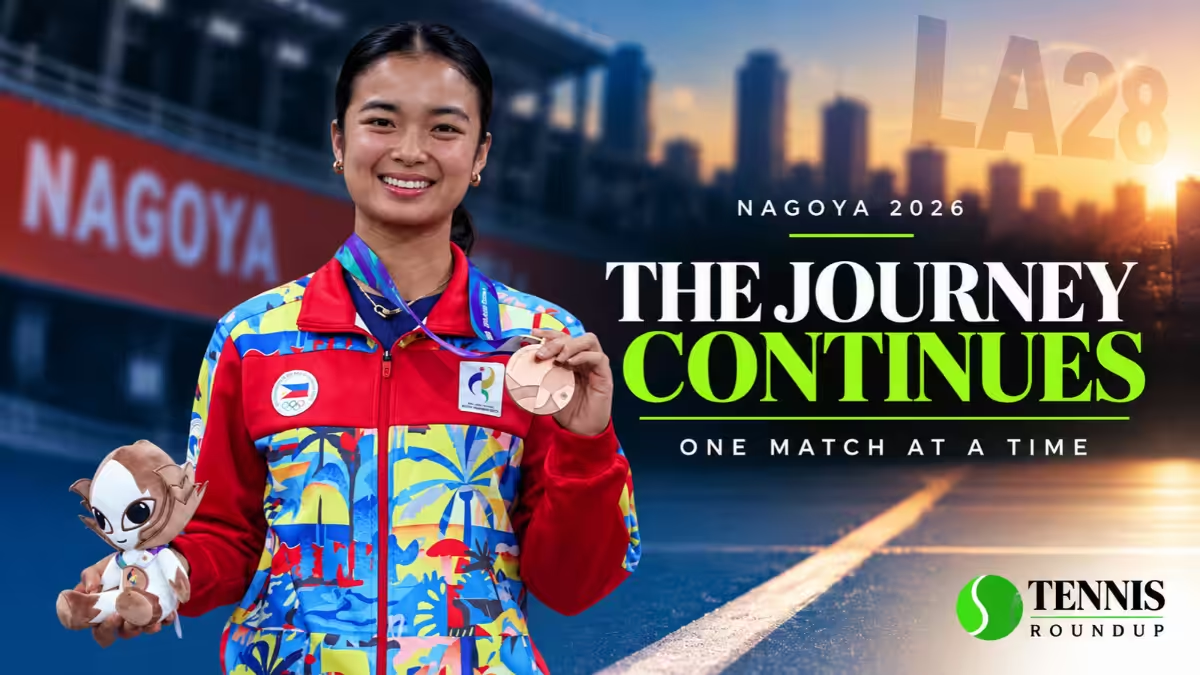
Alex Eala Leaves Nagoya With Bronze — And a Different Road to LA28
Alex Eala came to Nagoya with two things within reach.
A gold medal for the Philippines.
And an early ticket toward Los Angeles 2028.
She left with neither.
But she didn’t leave empty-handed.
There was an Asian Games bronze medal.
There was another week playing for the Philippines.
And there was clarity about what comes next.
Eala’s run ended in the semifinals when Wang Xiyu recovered from a set down to defeat the tournament’s No. 1 seed 3-6, 6-3, 6-2.
Wang went on to win the gold medal.
Eala went home with bronze.
And the shortcut to Los Angeles disappeared.
The journey did not.
Eala Chose Nagoya
Before there was a medal, there was a decision. The China Open was waiting on the WTA calendar. So were the Asian Games.
Eala couldn’t be in both places.
She chose the Philippines.
The decision meant skipping a mandatory WTA 1000 event and accepting the possibility of ranking penalties and a fine while Philippine tennis authorities sought an exemption.
But Nagoya offered something Beijing could not.
The chance to represent her country.
The chance to chase an Asian Games gold medal.
And potentially, a much shorter road to the Olympic Games.
Why Was Alex Eala the No. 1 Seed?
On paper, something about the Asian Games draw initially looked unusual.
There were Asian players ranked above Eala in the WTA standings.
Yet it was the Filipina who stood at the top of the draw.
That No. 1 beside Eala’s name wasn’t a declaration that she was the highest-ranked Asian player in tennis.
It reflected the field that actually entered the Asian Games.
And once the draw was set, the possibilities became fascinating.
Eala wasn’t simply playing for another tournament title.
Every round moved her closer to a medal—and toward a potential Olympic shortcut.
Nagoya suddenly carried consequences stretching all the way to 2028.
The Road Through Nagoya Kept Getting Shorter
Before the tournament began, we mapped Eala’s possible route through the draw.
But projected matchups are only possibilities.
Tennis decides which ones survive.
One match at a time.
Some anticipated opponents disappeared.
Others emerged.
Eala kept moving.
Until only one victory separated her from the Asian Games final.
Across the net stood Wang Xiyu.
Eala Won the First Set
For one set, the path remained open.
Eala took the opener 6-3.
One more set would put her into the gold-medal match.
But Wang didn’t disappear.
She adjusted.
The match changed.
Wang took the second set 6-3.
Then the deciding set 6-2.
3-6, 6-3, 6-2.
Eala’s run for Asian Games gold was over.
There would still be a medal.
Just not the one she came to Nagoya chasing.
Wang Xiyu Finished the Journey
Beating Eala wasn’t Wang’s finish line.
There was still a final to play.
Wang defeated Zhang Shuai to become the Asian Games women’s singles champion.
That result changed the meaning of Eala’s semifinal defeat.
Wang hadn’t merely denied Eala a place in the final.
She had gone on to claim the prize attached to winning the tournament:
the Asian continental qualification place toward LA28, subject to Olympic eligibility requirements.
Eala received bronze.
And one potential route to Los Angeles became considerably longer.
What Alex Eala Missed in Nagoya
This is the part worth getting exactly right.
Eala did not lose her chance to compete at the 2028 Los Angeles Olympics.
She lost the easiest opportunity currently available to secure a place early.
The shortcut.
Winning the Asian Games women’s singles title could have provided an Asian continental qualification route toward LA28, subject to the applicable eligibility requirements.
Wang won it.
Eala didn’t.
That distinction matters because saying Eala “missed the Olympics” would turn one defeat into something it wasn’t.
Her Olympic journey remains alive.
And her strongest route may ultimately be the most straightforward one:
her WTA ranking.
World No. 18 Changes the Picture
Eala left Nagoya without the continental place.
She also left as an established Top-20 player.
At the time this story closes, she stands at World No. 18, also her career high.
That ranking isn’t an Olympic reservation.
There are still nearly two years of tennis between Nagoya and the ranking date that will help determine the LA28 singles field.
Points will be won.
Points will disappear.
Rankings will rise and fall.
Eligibility requirements will still have to be satisfied.
And the Olympic field will eventually have to account for country limits and the other qualification routes.
So there is little value in pretending that World No. 18 in October 2026 guarantees anything in June 2028.
But it tells us something important.
Eala doesn’t need Nagoya to keep the Olympic dream alive.
She can build her way there.
Bronze May Not Be the End of the Asian Games Story Either
There is even one unusual wrinkle worth keeping in the background.
The Asian continental place isn’t necessarily as simple as “Wang won it, therefore the story is permanently closed.”
Olympic allocation rules, eligibility and national limits can affect how continental places are ultimately used.
Because Wang Xiyu and runner-up Zhang Shuai both represent China, the Chinese Olympic singles quota could eventually become relevant.
Under certain circumstances, the allocation pathway can reach the losing semifinalists.
Eala was one of them.
That does not mean she has an Olympic place waiting for her.
It means her bronze-medal finish created a contingency worth tracking.
Nothing more.
For Eala, the sensible plan remains the same:
qualify with her tennis.
Nagoya Changed the Road, Not the Destination
Eala came to the Asian Games as the No. 1 seed.
She chose the Philippines over a mandatory WTA 1000 tournament.
She reached the semifinals.
She won a medal.
She lost to the eventual champion.
And she missed an opportunity to make the road to Los Angeles much shorter.
That’s what happened in Nagoya.
No need to turn bronze into gold.
No need to turn defeat into disaster either.
Because the next part of this story won’t be decided by what happened in one semifinal.
It will be decided by what Alex Eala does after it.
One Match at a Time
The easiest version of Eala’s Olympic story would have ended in Nagoya with a ticket to Los Angeles.
Tennis rarely writes the easiest version.
Instead, she leaves with bronze.
With World No. 18 beside her name.
With weaknesses still to improve.
With ranking points to defend.
With tournaments still to play.
And with an Olympic dream that now has to be earned across something much bigger than one week in Japan.
There will be no single match tomorrow that sends Alex Eala to Los Angeles.
There doesn’t need to be.
The shortcut is gone.
The journey continues.
One tournament.
One round.
One match at a time.
And from here, Tennis Roundup will follow the road all the way to LA28.