
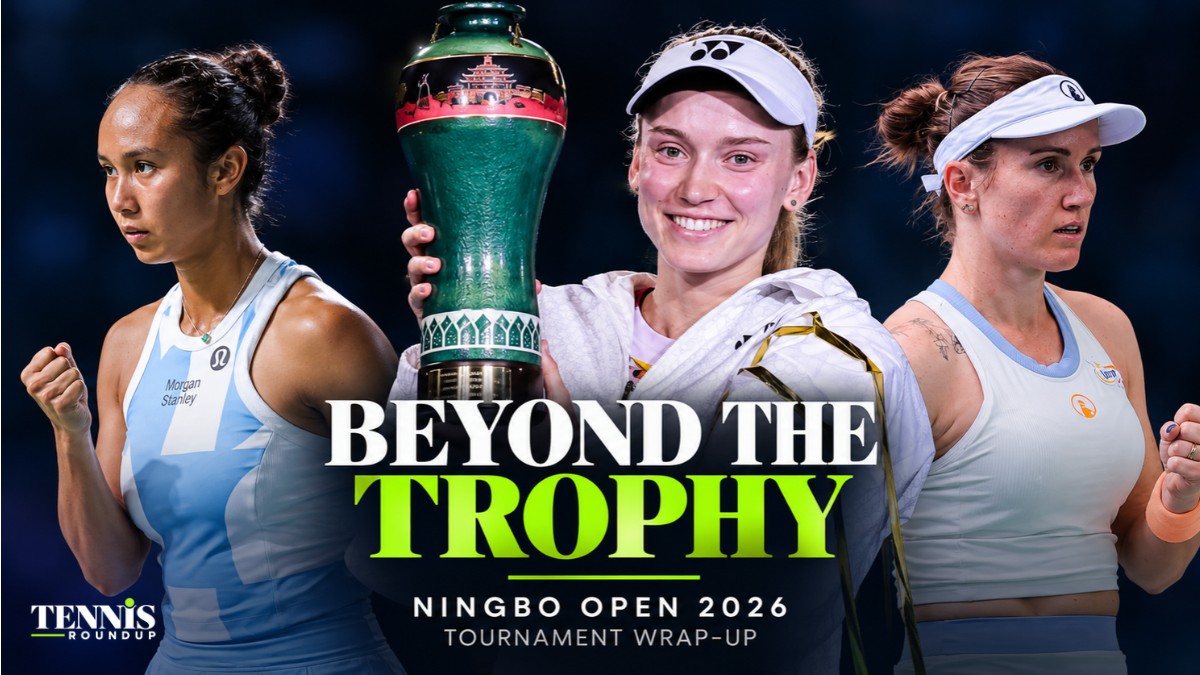
Ningbo Open 2026 Wrap-Up: Rybakina’s Defense, Fernandez’s Fight and Kawa’s Breakthrough
Elena Rybakina retained her championship, Leylah Fernandez fought her way through the draw, and Katarzyna Kawa delivered a breakthrough at 33. Seven days in Ningbo produced more than one story worth remembering.
The trophy belongs to Elena Rybakina.
The defending champion completed her mission on October 25, defeating Leylah Fernandez 6–2, 6–2 to win the Ningbo Open for the second consecutive year.
It was Rybakina’s first successful career title defense, her 15th WTA Tour singles title and her fourth championship of 2026.
That is how the tournament ended.
But it is not everything the tournament gave us.
Fernandez reached the final after surviving three consecutive deciding-set matches. Katarzyna Kawa, a 33-year-old qualifier ranked No. 128, defeated a Top 20 opponent for the first time. Diana Shnaider connected several of the draw’s most closely followed storylines. Marie Bouzková and Sara Bejlek gave the tournament a compelling Czech chapter.
Other stories ended before they could fully develop.
Some players withdrew. Others found their campaigns cut short by opponents who were not part of the original expectations.
When we introduced the tournament, Tennis Roundup identified eight Story Seeds—eight questions waiting for answers.
Seven days later, we have those answers.
This Ningbo Open 2026 wrap-up looks beyond the championship score to revisit the players, turning points and unexpected developments that defined the week.
Ningbo Open 2026 Wrap-Up: A Title Defense Earned in Stages
Elena Rybakina arrived in Ningbo as the defending champion.
A year earlier, she had defeated Ekaterina Alexandrova 3–6, 6–0, 6–2 to win the 2025 title.
Returning with a trophy to defend created an expectation.
It did not guarantee another championship.
Rybakina received a first-round bye, then advanced from her opening match when Polina Kudermetova retired with the top seed leading 5–0.
That shortened encounter offered little evidence of how she would respond to a sustained challenge.
Katarzyna Kawa provided one in the quarterfinals.
After Rybakina won the opening set 6–1, the Polish qualifier fought back to take the second 6–3.
The champion recovered in the decider, winning 6–1.
Diana Shnaider presented a different test in the semifinals.
Rybakina needed 11 set points to secure the opener. In the second set, she was broken while serving for the match at 5–4.
She eventually prevailed 6–3, 7–5.
Then came Fernandez.
The final produced Rybakina’s most controlled service performance of the week.
She held all eight service games, saved all four break points she faced and converted four of her five opportunities on return.
The 6–2, 6–2 victory required just one hour, 16 minutes and 25 seconds.
The final score was decisive.
The journey to it had been less straightforward.
A First Successful Defense
The victory gave Rybakina several milestones.
She became a two-time Ningbo Open champion, extended her tournament record to eight wins without defeat across two appearances, and secured her first title since reaching world No. 1.
Her four championships in 2026 came at the Australian Open, Stuttgart, US Open and Ningbo.
But the most meaningful Ningbo achievement may be the simplest.
She returned as champion.
She left as champion.
Our original Story Seed S02—Rybakina’s Title Defense—was resolved only when the final point was played.
Leylah Fernandez’s Week Cannot Be Reduced to the Final
The championship match lasted 76 minutes.
Leylah Fernandez’s journey to reach it took considerably longer.
She spent more than 11 hours on court across five singles matches, including the tournament’s two longest encounters.
Her opening match against seventh seed Elise Mertens immediately established the pattern.
Fernandez lost the first set and later trailed 3–5 in the deciding set.
She recovered to win 2–6, 6–3, 7–5.
It was an escape that became the foundation of her tournament.
Against qualifier Aliaksandra Sasnovich, Fernandez again needed three sets.
She won the opener, lost the second-set tiebreak and eventually prevailed 7–5, 6–7(3), 6–3.
The match lasted three hours, three minutes and five seconds.
It was the longest singles match of the tournament.
The quarterfinal brought Ekaterina Alexandrova.
Their recent meetings had created an increasingly interesting rivalry, and Fernandez had an opportunity to build on her victory over Alexandrova in Wuhan.
She lost the first set.
Again, she recovered.
Fernandez won 4–6, 6–2, 6–1, recording her second consecutive victory over Alexandrova and leveling their head-to-head at 3–3.
Three matches.
Three deciding sets.
Three victories.
A Different Kind of Semifinal Comeback
The semifinal against Marie Bouzková finally ended in straight sets.
But Fernandez still needed to recover from a difficult position.
Bouzková served for the second set at 5–4.
Fernandez broke to love, held serve and broke again.
She won the final three games to secure a 6–3, 7–5 victory.
The Canadian had reached the championship match.
Her run was particularly notable when viewed against the tournament as a whole.
Of Ningbo’s seven completed three-set main-draw singles matches, Fernandez won three.
She also participated in the two longest: the three-hour contest against Sasnovich and her two-hour, 49-minute opening victory over Mertens.
These numbers reveal how much of the tournament’s competitive drama passed through her matches.
One Final Challenge Too Many
Rybakina ended the run.
In the final, Fernandez created four break-point opportunities but converted none.
The defending champion held serve throughout.
That difference prevented the recoveries that had repeatedly carried Fernandez forward.
Her defeat did not erase her previous four victories.
Ningbo was Fernandez’s second WTA Tour singles final of 2026, following her Singapore championship in September.
It was also the tenth singles final of her career.
She leaves with a runner-up finish and another significant late-season result.
The final belonged to Rybakina. The journey to that final remains one of Fernandez’s achievements.
Katarzyna Kawa’s Breakthrough at 33
Not every important Ningbo story was visible before the tournament began.
Katarzyna Kawa provided the clearest example.
The Polish player arrived ranked No. 128 and entered the main draw through qualifying.
Her two qualifying victories both ended when opponents retired after play had begun.
Then she faced Daria Snigur again.
Snigur had returned to the main draw as a lucky loser, creating an unusual second meeting between the same players at the same tournament.
This time, the match was completed.
Kawa recovered from losing the opening set to win 1–6, 6–2, 6–4.
Her reward was a meeting with fifth seed Belinda Bencic.
A Victory That Changed the Week
On October 22, Kawa defeated Bencic 7–5, 6–2.
It was not simply another upset.
At 33, Kawa had achieved three significant career firsts:
- Her first victory over a Top 20 opponent.
- Her first WTA Tour hard-court quarterfinal.
- Her first WTA 500 quarterfinal.
The result carried particular weight because Kawa was not an inexperienced player making her first appearance at Tour level.
She had already reached WTA Tour finals on clay in Jurmala in 2019 and Bogotá in 2025.
Ningbo represented a different kind of achievement: a new breakthrough on hard courts against higher-ranked opposition.
Her next opponent was Rybakina.
Kawa lost the opening set 6–1 but took the second 6–3 before the eventual champion recovered to win the decider.
Her tournament ended in the quarterfinals.
Her milestone did not.
The Story We Didn’t Predict
Kawa was not one of the individually named protagonists in our original Story Seeds.
That matters.
Our eighth seed, Challengers Beyond the Headlines, deliberately left room for someone unexpected to emerge.
Kawa earned that place through her results.
We did not predict her breakthrough.
We followed it when it happened.
And in retrospect, it became one of Ningbo’s most memorable achievements.
A tournament does not have to end with a trophy for a player to leave with something important.
For Kawa, Ningbo added a new chapter to an established career.
Diana Shnaider: The Player Who Connected the Storylines
If Fernandez provided the tournament’s comeback thread, Diana Shnaider became the player who connected several of its original stories.
Her campaign began with a narrow escape against qualifier Yulia Putintseva.
Shnaider saved five set points across the match before winning 7–5, 7–6(4).
That victory set up a second-round meeting with Alex Eala.
The End of Eala’s Ningbo Journey
Eala had opened her tournament by defeating Diane Parry 6–3, 6–1.
The victory ended a three-match WTA Tour losing sequence and gave her Redemption Road storyline a positive first step.
But Shnaider proved a tougher obstacle.
In their meeting of left-handers, Shnaider defeated Eala 7–5, 6–4, converting her seventh match point.
Eala finished Ningbo with one win and one loss.
Her opening victory was meaningful.
Her second-round defeat prevented a deeper run.
Both belong in an accurate assessment of her tournament.
Shnaider Meets Another Original Protagonist
The quarterfinal brought Iva Jovic.
At 18, Jovic was our principal Teenagers storyline in Ningbo.
After receiving a bye, she defeated Jasmine Paolini 6–4, 6–3 to reach the last eight.
Against Shnaider, Jovic took the second set but could not complete the comeback.
Shnaider won 6–3, 4–6, 6–1.
The result ended Jovic’s Ningbo campaign and carried Shnaider into the semifinals.
There, she pushed Rybakina through a demanding first set and briefly disrupted the defending champion’s attempt to serve out the match.
Rybakina eventually won 6–3, 7–5.
For Shnaider, Ningbo was her fourth semifinal of 2026.
It also continued an established connection with the tournament: she had previously reached the Ningbo final in 2023 and the semifinals in 2025.
The Match That Never Happened
The draw had created the possibility of an Eala–Jovic quarterfinal.
That meeting never took place.
Shnaider defeated both players before they could face one another.
The actual story proved more revealing than the hypothetical matchup.
Shnaider survived her opening test, ended two developing storylines and reached the semifinals herself.
She did not win the championship.
But she helped shape the tournament.
The Czech Thread: More Than a Quarterfinal Meeting
Another storyline developed through Marie Bouzková and Sara Bejlek.
Their paths eventually converged in an all-Czech quarterfinal.
But both had to earn their places there.
Bejlek defeated Alycia Parks in three sets before overcoming eighth seed Sorana Cîrstea.
Against Cîrstea, she saved two set points and won 7–6(3), 6–4.
Bouzková had her own escape against lucky loser Anastasia Zakharova.
She saved four set points before winning 7–5, 6–2.
Their quarterfinal guaranteed a Czech semifinalist.
Bouzková advanced, defeating Bejlek 6–3, 6–4.
She recovered from a 0–3 deficit in the second set and saved eight of nine break points.
Bouzková reached the semifinals without dropping a set.
Her campaign ended against Fernandez, who recovered from Bouzková serving for the second set.
The Czech storyline had developed beyond the draw’s original expectations.
It did not require a championship to become a meaningful part of Ningbo’s week.
And it did not require us to create another numbered Story Seed.
The results supplied the story.
A Tournament Changed by Withdrawals—and Defined by Those Who Played
Ningbo’s draw did not remain unchanged.
Iga Świątek and Maja Chwalińska withdrew before competing.
Other players, including Marta Kostyuk, Jelena Ostapenko and Polina Kudermetova, retired during matches.
These developments affected the tournament’s opportunities and matchups.
But a withdrawal is not an on-court defeat.
And a retirement after play begins is not the same as a walkover.
The distinctions matter when reconstructing a tournament.
They also matter when assessing the players who advanced.
Kawa’s qualifying path included retirement victories, but she subsequently defeated Snigur and Bencic in completed main-draw matches.
Bouzková faced Zakharova after Świątek’s withdrawal changed the draw, but still had to defeat her opponent on court.
By the quarterfinals, the entire bottom half consisted of unseeded players: Fernandez, Alexandrova, Bejlek and Bouzková.
All four were already WTA Tour singles title winners.
Unseeded did not mean inexperienced.
The draw changed.
The players still had to earn their victories.
One More Escape Worth Remembering
Jasmine Paolini also contributed one of the tournament’s most dramatic passages.
Against Anhelina Kalinina, Paolini trailed 0–5 in the second set.
She then won seven consecutive games to complete a 6–2, 7–5 victory.
Paolini lost her next match to Jovic.
But her remarkable second-set recovery remains part of Ningbo’s story.
Not every memorable performance belongs to a semifinalist.
How Our Eight Original Story Seeds Resolved
Before the tournament, Tennis Roundup published eight Story Seeds.
They were not predictions.
They were questions based on the draw, player form and developing storylines.
Now that the tournament has ended, we can revisit them.
| Story Seed | Original storyline | Ningbo outcome |
|---|---|---|
| S01 | Alex Eala’s Redemption Road | Defeated Parry, then lost to Shnaider in the Round of 16. |
| S02 | Elena Rybakina’s Title Defense | Resolved: Champion. Successfully defended the title. |
| S03 | Maja Chwalińska’s Wuhan Momentum | Withdrew before competing. |
| S04 | Iva Jovic / Teenagers | Defeated Paolini, then lost to Shnaider in the quarterfinals. |
| S05 | Świątek and Kostyuk’s Late-Season Positions | Świątek withdrew; Kostyuk retired against Alexandrova. |
| S06 | Guo Hanyu’s Next Challenge | Lost her opening singles match to Alexandrova. |
| S07 | Daria Kasatkina’s Return | Lost her opening match to qualifier Sasnovich. |
| S08 | Challengers Beyond the Headlines | Fernandez reached the final; Shnaider and Bouzková reached the semifinals; Kawa emerged as a breakthrough quarterfinalist. |
Some questions received decisive answers.
Rybakina defended her title.
Fernandez became the last challenger.
Others reached a tournament-specific conclusion without resolving the larger questions surrounding a player’s career.
Eala’s Ningbo campaign ended in the Round of 16, but her broader effort to establish consistency continues.
Jovic reached another quarterfinal, but one tournament cannot determine her long-term development.
Chwalińska did not compete, leaving her post-Wuhan momentum to be assessed elsewhere.
That is the value of treating Story Seeds as questions rather than predictions.
They give us a framework to follow.
The matches provide the answers.
And sometimes, as Kawa demonstrated, the most memorable answer comes from someone we had not initially named.
A Filipino Connection on Championship Sunday
Ningbo’s final day also offered a connection for Filipino tennis followers.
Leylah Fernandez, who represents Canada and has Filipino heritage through her mother, finished runner-up in singles.
American Desirae Krawczyk, who also has Filipino roots through her mother, won the doubles championship alongside Hungary’s Fanny Stollár.
Krawczyk and Stollár defeated Cristina Bucșa and Nicole Melichar-Martinez 7–6(5), 5–7, [10–6].
The two results belonged to different competitions and different national representations.
But they provided a shared cultural connection for fans following championship Sunday.
What Ningbo Leaves for Tokyo
The Ningbo Open is over.
The questions it created do not all end with the tournament.
Several players move directly into the Toray Pan Pacific Open in Tokyo, scheduled for October 26–November 1.
Rybakina enters as the top seed and receives a first-round bye. Her next opponent will be either Yulia Putintseva or Maria Sakkari.
Fernandez begins against Japanese wild card Himeno Sakatsume.
The two Ningbo finalists occupy the same quarter of the Tokyo draw, making another meeting possible if both advance.
Shnaider is seeded third and also receives a first-round bye.
Chwalińska, who withdrew from Ningbo, appears in Tokyo’s draw as the second seed with a bye. Whether she can build on her earlier Wuhan momentum remains a question for the matches ahead.
Rybakina is also already qualified for the WTA Finals at Indian Wells, scheduled for November 8–15.
Beyond the immediate schedule, Ningbo leaves several stories worth following.
Can Kawa build on her breakthrough against Top 20 opposition?
How will Jovic continue her development after another quarterfinal?
Can Fernandez extend her late-season results?
And what will Rybakina’s fourth title of 2026 mean as she approaches the season’s final major event?
Those are questions for another tournament.
Ningbo has already given us its answers.
Ningbo Open 2026 — Selected Results and Milestones
Championship and Final Four
| Finish | Player | Defining result |
|---|---|---|
| Champion | Elena Rybakina [1] | Defeated Fernandez 6–2, 6–2 |
| Runner-up | Leylah Fernandez | Won four matches to reach the final |
| Semifinalist | Diana Shnaider [6] | Lost to Rybakina 3–6, 5–7 |
| Semifinalist | Marie Bouzková | Lost to Fernandez 3–6, 5–7 |
Other Notable Achievements
| Player | Ningbo milestone |
|---|---|
| Katarzyna Kawa | First Top 20 win; first Tour hard-court and WTA 500 quarterfinal |
| Iva Jovic | Quarterfinalist after defeating Jasmine Paolini |
| Sara Bejlek | Quarterfinalist after defeating Sorana Cîrstea |
| Alex Eala | Ended a three-match Tour losing sequence with victory over Diane Parry |
| Jasmine Paolini | Recovered from 0–5 in the second set against Anhelina Kalinina |
The Tournament in Numbers
| Measure | Ningbo Open 2026 |
|---|---|
| Main-draw singles matches | 27 |
| Completed singles matches | 24 |
| Matches ending through retirement | 3 |
| Completed three-set matches | 7 |
| Three-set matches won by Fernandez | 3 |
| Longest match | Fernandez vs. Sasnovich — 3:03:05 |
| Second-longest match | Fernandez vs. Mertens — 2:49:36 |
| Champion’s prize money | $185,500 |
| Runner-up’s prize money | $114,500 |
Tournament-wide counts and match durations are based on Tennis Roundup’s review of official WTA main-draw singles records. Qualifying and doubles matches are excluded.
Related Reading: The Complete Ningbo Open 2026 Story
Before the tournament
Daily coverage
- Ningbo Open 2026 — Day 1
- Ningbo Open 2026 — Day 2
- Ningbo Open 2026 — Day 3
- Ningbo Open 2026 — Day 4
- Ningbo Open 2026 — Day 5: Leylah Fernandez Turns the Rivalry Around
- Ningbo Open 2026 — Day 6: Fernandez’s Fight Meets Rybakina’s Title Defense
- Day 7 — Rybakina Completes Her Title Defense
The Stories That Remain
Elena Rybakina will be remembered as the Ningbo Open 2026 champion.
Her name belongs on the trophy.
But the tournament also belongs to the players who made its seven days worth following.
Fernandez, who repeatedly found another way through.
Kawa, who reached a new milestone at 33.
Shnaider, who connected storylines that had begun separately.
Bouzková and Bejlek, who turned an all-Czech quarterfinal into a meaningful chapter.
Eala and Jovic, whose Ningbo journeys ended earlier than they hoped but still offered evidence of progress and challenges ahead.
Some stories ended with victories.
Others ended with defeats, withdrawals or opportunities that never became matches.
Together, they made the tournament.
The trophy tells us who won Ningbo.
The stories tell us why we followed it.
Tennis Roundup — Women’s Tennis Beyond the Score.