
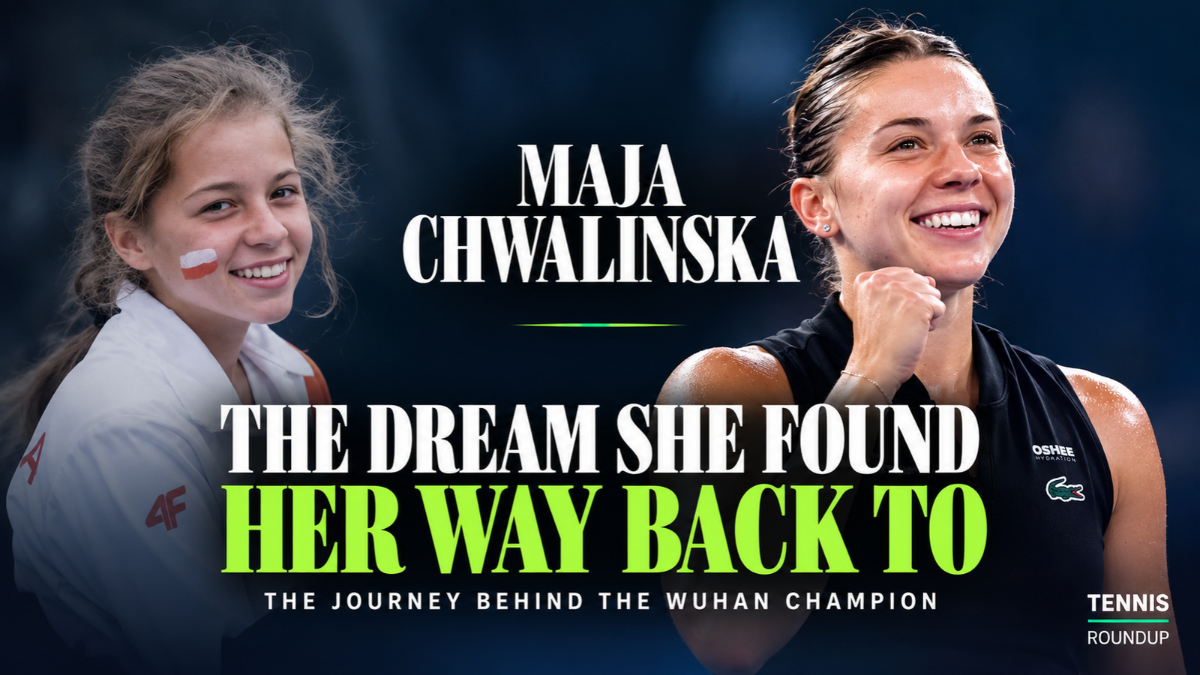
Maja Chwalinska: The Dream She Found Her Way Back To
She once stepped away from tennis without knowing whether she would return. Years later, Maja Chwalinska stood on a championship court in Wuhan, holding a trophy that told only part of her extraordinary story.
In April 2026, Maja Chwalinska had a conversation with her team physiotherapist.
She was 24 years old.
By professional tennis standards, that is hardly old. But Chwalinska had already spent years chasing a career that seemed to advance, stall and begin again.
She felt that time was passing.
That she had not yet fulfilled her potential.
And that perhaps the opportunities she had imagined were slipping away.
Months later, during the Wuhan Open, she recalled those feelings in an interview.
“I’m just not feeling like I fulfilled my potential and I’m getting old.”
It was an unusually revealing admission from a professional athlete.
Three days after recounting that conversation, Chwalinska defeated Sonay Kartal 2–6, 6–4, 6–2 to win the Wuhan Open on October 18, 2026.
It was her first WTA Tour singles championship.
But to understand why that victory mattered so much, we must travel back several years.
Back to a young Polish tennis player with considerable promise.
Back to a friendship that began long before Wuhan.
And back to a time when tennis, the sport around which she had built her life, became something she needed to leave behind.
Watch Chwalinska vs Kartal highlights:
The Maja Chwalinska Journey: When Two Young Players Shared a Court
Before Iga Swiatek became one of the most recognizable names in women’s tennis, she was another talented Polish junior learning her way through international competition.
And alongside her was Maja Chwalinska.
Both belonged to a promising generation of Polish tennis players.
They competed together in junior events, won European age-group doubles titles and represented Poland in team competition.
In January 2017, their partnership reached one of its most significant milestones.
At the Australian Open, Chwalinska and Swiatek advanced to the girls’ doubles final.
They lost to Bianca Andreescu and Carson Branstine, 6–1, 7–6(4).
For two young players, reaching a Grand Slam junior final represented a meaningful achievement.
But it was also just the beginning of their professional journeys.
At that age, nobody could know how differently those journeys would unfold.
Swiatek would eventually become a Grand Slam champion and one of the defining players of her generation.
Chwalinska would follow a much less predictable road.
The two shared courts and competitive experiences.
They did not share identical career timelines.
And that distinction would become increasingly important.
Two Careers, Different Timetables
In 2019, Chwalinska was making encouraging progress.
A sequence of three ITF tournament titles helped her enter the world’s Top 200 for the first time.
She reached No. 192 that August.
The results suggested that the transition from junior promise to professional competition was gathering momentum.
But tennis careers are rarely as straightforward as their ranking graphs appear.
Behind the results, Chwalinska was experiencing difficulties that were not visible in the scores.
She later described emotional distress beginning on the court in 2019 and extending into her everyday life.
Meanwhile, Swiatek’s career was accelerating.
In 2020, Swiatek won her first Roland-Garros singles championship.
For Polish tennis, it was a historic achievement.
For Chwalinska, watching the success of someone she had known since their junior years brought a more complicated experience.
In later interviews, she explained that constant comparisons could be painful.
She was proud of Swiatek, but repeatedly being asked about her friend’s accomplishments made it harder to establish her own identity as a professional player.
That is an important distinction.
The difficulty was not their friendship. It was the expectation that two talented players should follow the same path.
One player’s success does not mean another player’s journey has failed.
Yet comparisons can make that truth difficult to remember.
Especially when the player being compared is already struggling.
When Tennis Became Too Much
In June 2021, Chwalinska announced an indefinite break from professional tennis.
She had been dealing with depression.
For years, tennis had been the central activity in her life.
She had trained, travelled, competed and measured her progress through performances.
But the sport had become associated with pressure and emotional distress.
In a 2022 interview with the WTA, Chwalinska spoke openly about that period.
She described crying, finding everyday activities difficult and struggling with the emotional demands surrounding competition.
Eventually, she returned to her parents’ home.
She spent time with old friends.
She also sought specialist support.
And she stopped competing.
For someone who had dedicated much of her childhood and adolescence to tennis, stepping away represented a profound change.
There was no guarantee of a comeback.
In fact, Chwalinska admitted that she did not know whether she would ever play professionally again.
“I didn’t know that I would come back, to be honest.”
That sentence changes the meaning of everything that followed.
It would be easy to describe her career as a story of someone who simply refused to quit.
But that would overlook what actually happened.
Chwalinska did stop.
She needed time away.
And the people around her allowed her to make that decision.
The Permission to Pause
One of the most moving parts of Chwalinska’s account is the way she describes the support she received.
Her family and friends did not insist that she return to competition.
They did not make her happiness conditional on winning matches.
As she explained:
“They just wanted me to be happy.”
In another interview, she recalled how tennis gradually disappeared from everyday conversations.
“We didn’t even talk about tennis anymore.”
For a professional athlete, that kind of freedom can be significant.
It allowed Chwalinska to experience life without constantly being defined by results.
She spent time with people who knew her beyond the tennis court.
She explored other forms of exercise.
And eventually, she began practising again.
Not because somebody demanded it.
Not because she had to prove something to the world.
But because she was ready to see whether tennis could become part of her life again.
Her return did not erase the difficulties she had experienced.
Nor did it guarantee that the road ahead would be easier.
It simply opened another possibility.
The Long Road Back
Chwalinska returned to competition in October 2021.
The following year brought an important breakthrough.
She qualified for Wimbledon and won her opening-round match.
It was evidence that she could still compete at a high level.
But another setback followed.
Right-knee surgery interrupted her 2022 season.
When she returned in March 2023, rebuilding was difficult.
Her ranking fell as low as No. 532.
For a player who had once reached the Top 200, the distance back to higher-level competition was substantial.
There were matches to win, ranking points to recover and opportunities to earn.
And there was the continuing challenge of managing the pressures of professional sport.
Yet Chwalinska gradually rebuilt.
Through ITF competition and WTA 125 tournaments, she accumulated victories and regained competitive momentum.
She won WTA 125 titles in Florianópolis, Montreux and Oeiras.
Those achievements mattered.
They were not WTA Tour singles titles, but they demonstrated the work required to reach the sport’s bigger stages.
Her career was not standing still while the world waited for a breakthrough. She was rebuilding it, tournament by tournament.
Roland-Garros 2026: A New Chapter
In June 2026, Chwalinska reached the
Roland-Garros
singles final.
It was the biggest Grand Slam result of her career.
She lost to Mirra Andreeva 6–3, 6–2.
But reaching the final brought her a level of recognition she had not previously experienced.
The attention was exciting.
It was also demanding.
In an interview later that month, Chwalinska offered a simple reminder:
“I’m just a human being.”
The statement reflected the complicated reality of professional success.
Greater recognition brings opportunities, but it can also bring expectations, scrutiny and renewed pressure.
And the challenges did not disappear.
An ankle injury at Wimbledon disrupted her summer.
She withdrew from subsequent events and struggled to establish rhythm on hard courts.
By August, her immediate priority was straightforward.
“I need matches, really.”
It was not a grand declaration about becoming a champion.
It was the practical ambition of a player trying to regain competitive consistency.
Then came the Asian Swing.
And eventually, Wuhan.
The Reunion in Wuhan: Maja Chwalinska and Iga Swiatek
On October 17, 2026, two former junior doubles partners walked onto a court in
Wuhan
as semifinal opponents.
Maja Chwalinska.
Iga Swiatek.
Almost a decade had passed since their Australian Open junior doubles final.
Their professional careers had developed along very different paths.
Swiatek had accumulated major championships and established herself among the sport’s elite.
Chwalinska had experienced career interruptions, surgery, difficult returns and the slow process of rebuilding.
Now they were competing for a place in a WTA 1000 final.
It was the first all-Polish WTA Tour semifinal of the Open Era.
And although they had previously met at an ITF event in Stockholm in 2016, this was their first meeting at WTA Tour level.
The historical connection was impossible to ignore.
But the match was not simply a reunion between friends.
It was a major professional opportunity.
Chwalinska won the opening set 7–5.
Swiatek required treatment for a leg problem during the match.
Chwalinska went on to win the second set 6–1.
The result sent her into her first WTA 1000 final.
Afterward, she expressed concern for Swiatek’s recovery.
Their shared history gave the encounter emotional significance, but the outcome belonged to the competition.
One player advanced.
The other did not.
And for Chwalinska, the victory represented a milestone that was entirely her own.
She had defeated a Top 10 opponent for the first time.
She had reached a WTA 1000 championship match.
And she had done so against someone who had been part of her tennis story since childhood.
The two girls who once stood together in a Grand Slam junior doubles final had become two women competing for a place in one of the sport’s biggest finals.
For Chwalinska, the next challenge was even greater.
One More Match, One More Challenge
On October 18, Chwalinska faced Britain’s Sonay Kartal in the Wuhan Open final.
Kartal had produced a remarkable tournament of her own.
After a lengthy absence from competition because of a back stress fracture, she had returned to defeat established opponents and reach the championship match.
Both finalists had experienced setbacks.
Both had worked their way back into major competition.
And both were seeking a breakthrough.
Kartal started stronger.
She won the opening set 6–2.
Chwalinska fell a break behind in the second.
For a moment, the championship appeared to be moving away from her.
But Chwalinska adjusted.
Her left-handed variety, changes of pace and tactical patience began to alter the match.
She recovered to win the second set 6–4.
Then she pulled away in the decider.
After two hours and 43 minutes, Chwalinska completed a 2–6, 6–4, 6–2 victory.
Maja Chwalinska was the Wuhan Open champion.
It was her first WTA Tour singles title.
And she had won it at WTA 1000 level.
But the significance of the moment extended beyond the tournament category.
For someone who had once stepped away from tennis without knowing whether she would return, standing on that championship court represented a remarkable personal and professional milestone.
The Dream She Found Her Way Back To
After the final, Chwalinska spoke about what the victory meant to her.
“It means a lot to me. I really am grateful for this moment.”
She also acknowledged the people who had been part of her journey.
“I am very grateful for every person in my life, basically.”
Those words bring us back to the most important part of her story.
Not the ranking.
Not the trophy.
Not even the victory over Swiatek.
But the people who stood beside her when tennis was no longer something she could continue.
Her family.
Her friends.
The coaches and support network who helped her develop as a player.
And those who understood that stepping away did not make her less worthy of their support.
Years earlier, Chwalinska had learned that she could exist beyond tennis.
That her value was not determined entirely by winning or losing.
In another interview, she expressed that change in perspective:
“The results don’t define me as much as they did before.”
That understanding did not make her less competitive.
She still trained.
She still worked to improve.
She still wanted to win.
But it offered a different relationship with the sport.
One in which her identity did not depend exclusively on what happened on court.
A Different Meaning of Perseverance
Stories about sporting success often follow a familiar formula.
Work hard.
Never quit.
Keep believing.
Eventually, the breakthrough will come.
But Chwalinska’s experience does not fit neatly into that formula.
She did step away.
She did question whether she would return.
She needed support.
She experienced further injuries and setbacks after coming back.
And there were no guarantees that her efforts would eventually produce a major championship.
Her story does not prove that every dream will end with a trophy.
It offers something more human.
Sometimes perseverance is not about continuing at all costs. Sometimes it is about recognizing when you need help, allowing yourself time, and discovering whether you still want to continue.
For Chwalinska, that journey eventually led back to professional tennis.
And in October 2026, it led to Wuhan.
Beyond the Trophy
There is a photograph from the 2017 Australian Open showing two young Polish tennis players who had just competed together in a Grand Slam junior doubles final.
Almost ten years later, those same players met on opposite sides of the net in Wuhan.
One had become an established champion.
The other was still building the career she had once been uncertain she could continue.
Their semifinal was an extraordinary moment.
But Chwalinska’s story is larger than her friendship with Swiatek.
It is about the difficult years that rarely appear in tournament highlights.
The time away.
The people who stayed.
The injuries.
The smaller tournaments.
The matches played far from the sport’s biggest stages.
And the gradual process of finding a place in tennis again.
In April 2026, Chwalinska wondered whether she had already missed her opportunity.
Six months later, she became a WTA 1000 champion.
That does not mean every challenge in her life has disappeared.
It does not mean the future will be free of uncertainty.
But it does mean that the story she once feared might be ending had another chapter waiting.
And perhaps that is the most meaningful part of Maja Chwalinska’s journey.
She did not have to spend every moment chasing her dream to find her way back to it.
Sometimes, the road forward begins with giving yourself permission to stop.
And sometimes, when you’re ready, you discover that there is still a place for you on the court.
Related Stories
The score tells us what happened. Tennis Roundup tells the story around it.
Tennis Roundup — Women’s Tennis Beyond the Score.