
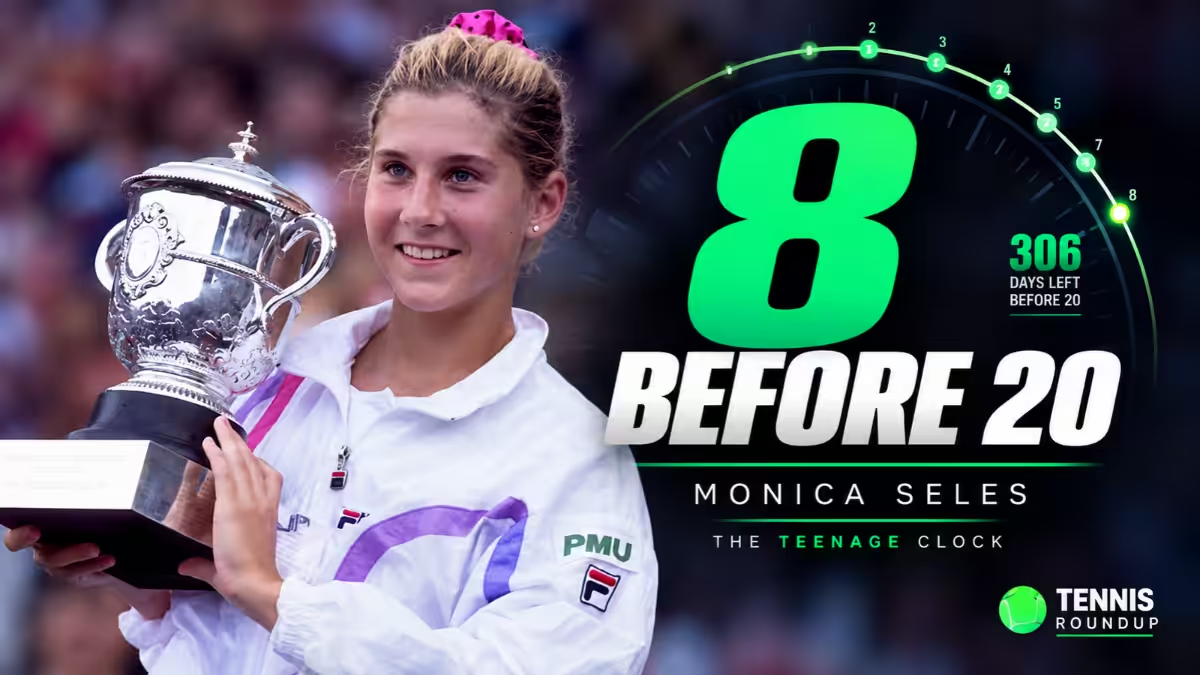
Monica Seles: How She Took the Teenage Record From Steffi Graf
Monica Seles had already won five Grand Slam singles titles.
She was 18 years old.
And on June 6, 1992, at Roland-Garros, Steffi Graf was standing across the net.
The final had reached 9–8 in the third set.
Seles had been trying to finish it for what must have felt like forever. Five match points had come and gone.
Now came a sixth.
This one she converted.
6–2, 3–6, 10–8.
After two hours and 43 minutes, Seles had won her third consecutive Roland-Garros championship.
She had also reached a number that belonged to Graf.
6
Three years earlier, Graf had finished her Teenage Clock with six Grand Slam singles championships.
Now Seles had caught her.
But Seles was only 18.
And unlike Graf’s record-breaking story, the Teenage Clock wasn’t approaching midnight.
Seles was about to push the record somewhere it had never been.
Before Eight, There Was a 15-Year-Old in Paris
The connection between Graf and Seles had begun before Seles had won a single major.
At the 1989 Roland-Garros, Seles was 15 years old and playing her first Grand Slam main draw.
She beat Ronni Reis in the opening round and continued all the way to the semifinals, defeating established players including Zina Garrison and Manuela Maleeva along the way.
Waiting in the semifinal was Graf.
Graf was 19.
She already owned the Teenage Clock record with six majors.
Seles pushed her to three sets.
Graf won 6–3, 3–6, 6–3.
At the time, it was a champion stopping an astonishing newcomer.
Only history would reveal the other story hiding inside the match.
The teenager holding the record had just played the teenager who would eventually take it from her.
But not yet.
Seles still had some losing to do.
Graf, Evert and the Lessons Before No. 1
A few weeks later, Graf met Seles again at Wimbledon.
This time there was no three-set resistance.
6–0, 6–1.
At the US Open, another great champion took her turn.
Chris Evert defeated the 15-year-old Seles 6–0, 6–2 in the fourth round. It would be Evert’s final US Open singles victory.
So Seles’s first Grand Slam season produced a semifinal in Paris—but no title.
She did not play the 1990 Australian Open.
When she returned to Paris, however, the story changed.
And once again, Graf was waiting.
No. 1 — The 16-Year-Old Who Beat Graf in Paris
On June 9, 1990, Seles reached her first Grand Slam final.
Graf was the defending Roland-Garros champion.
The first set became the critical battle.
Graf held four set points.
She converted none of them.
Seles took the tiebreak 8–6, then won the second set 6–4.
At 16 years and 189 days, Monica Seles was a Grand Slam champion.
And the youngest women’s singles champion in Roland-Garros history.
Teenage major count:
1
It was a spectacular beginning.
It did not lead immediately to No. 2.
Resistance
At Wimbledon in 1990, Seles reached the quarterfinals and faced Zina Garrison.
Seles held match point.
Garrison survived.
She eventually won 3–6, 6–3, 9–7, ending Seles’s 36-match winning streak.
Then came the US Open.
Seles was eliminated in the third round by Linda Ferrando, ranked No. 82.
6–1, 1–6, 6–7(3).
Seles later reduced it to the simplest possible explanation:
“It was just one of those days.”
One major championship had not made the rest inevitable.
Then came 1991.
No. 2 — Melbourne on the First Attempt
Seles had never played the Australian Open before 1991.
She won it on her first attempt.
Jana Novotná took the opening set of the final 7–5.
Seles answered 6–3, 6–1.
At 17 years and 55 days, she became the youngest Australian Open women’s champion at that time.
Teenage major count:
2
And now the acceleration began.
No. 3 — Paris Again
On March 11, 1991, before returning to Roland-Garros, Seles reached another milestone.
At 17 years and 99 days, she became World No. 1, displacing Graf. According to the WTA, she was the youngest player to reach No. 1 at the time, a mark Martina Hingis would later break.
Then Seles returned to Paris as defending champion.
Arantxa Sánchez Vicario awaited her in the final.
Seles won 6–3, 6–4.
Two consecutive Roland-Garros championships.
Three teenage majors.
3
But the next Grand Slam brought something different.
Seles never took the court.
The Wimbledon That Wasn’t Played
Seles withdrew before Wimbledon in 1991.
Her initial absence prompted speculation, but Seles subsequently described the problem as:
“shin splints and a slight stress fracture in my left leg.”
It became the first Grand Slam during the heart of her championship run that disappeared without a match being played.
There would be another Wimbledon story later.
First came New York.
No. 4 — After Capriati Nearly Stopped Her
The final score of the 1991 US Open can make Seles’s championship look straightforward.
It wasn’t.
Before she could play Martina Navratilova for the title, Seles had to survive Jennifer Capriati in the semifinal.
Capriati served for the match.
Twice.
Seles escaped in a final-set tiebreak.
Then she defeated Navratilova 7–6(1), 6–1 in the final.
Seles was 17 years and 279 days old.
Teenage major count:
4
The teenager who had once been stopped by Graf and Evert was now beating one of the game’s defining champions in a Grand Slam final.
And she wasn’t halfway through her remaining time.
No. 5 — Melbourne Again
At the 1992 Australian Open, Mary Joe Fernández tried to disrupt Seles with net approaches.
Seles found the answers.
6–2, 6–3.
Her second consecutive Australian Open championship became teenage major No. 5.
She was 18 years and 54 days old.
Now only one number separated her from Graf.
And Paris was waiting.
No. 6 — Six Match Points to Catch Graf
That brings us back to Roland-Garros in 1992.
Seles versus Graf.
Again.
Seles took the first set 6–2.
Graf answered 6–3.
Then came one of the defining sets of Seles’s teenage career.
The deciding set stretched beyond 6–6.
Then beyond 7–7.
Then beyond 8–8.
Seles needed six match points before finally winning it 10–8.
Afterward, she called it:
“the most emotional match I ever played.”
Graf understood what had been required to finish her off.
“She definitely is tough, and even if she is tired, she always goes for it.”
Seles had won Roland-Garros for the third consecutive year.
And under the Teenage Clock:
Graf — 6
Seles — 6
It is important not to rewrite 1992 journalism around our framework. LOVE found no contemporary account explicitly presenting this as a chase for “Graf’s teenage record.” That is Tennis Roundup’s retrospective census, built from the players’ ages and championship dates.
The record was tied.
It would remain tied for 98 days.
But first, Seles had another chance to accomplish something even larger.
Wimbledon — The Missing Piece
Seles arrived at Wimbledon in 1992 having won the Australian Open and Roland-Garros.
A calendar Grand Slam was still possible.
In the semifinal, she defeated Navratilova 6–2, 6–7(3), 6–4.
Graf awaited her in the final.
This time, Graf dominated.
6–2, 6–1.
The calendar Grand Slam was gone.
And Wimbledon remained the conspicuous missing championship in Seles’s teenage collection.
Across her Teenage Clock, Seles had four Wimbledon calendar opportunities.
She played three.
She lost to Graf in the fourth round in 1989, lost to Garrison in the 1990 quarterfinal after holding match point, withdrew before play in 1991, and reached the 1992 final before losing to Graf.
No Wimbledon title.
That gap matters.
Not because it diminishes eight.
Because it reminds us again that eight was not automatic.
No. 7 — The Record Belongs to Seles
On September 12, 1992, Seles reached the US Open final.
Across the net stood Sánchez Vicario.
Seles won 6–3, 6–3.
She was 18 years and 285 days old.
Teenage major count:
7
Graf’s record was gone.
For the first time in the Open Era, a woman had won seven senior Grand Slam singles championships before turning 20.
The progression that had begun with Evonne Goolagong’s two-title ceiling had moved again.
Graf had broken two and pushed the record to six.
Seles had caught six.
Now she had passed it.
And she still had more than a year before her 20th birthday.
No. 8 — Graf Again
January 30, 1993.
Australian Open final.
The opponent almost seems inevitable now.
Steffi Graf.
Graf won the first set 6–4.
Seles answered 6–3.
Then Seles took the third 6–2.
At 19 years and 59 days, Monica Seles had won her third consecutive Australian Open title.
It was her eighth Grand Slam singles championship.
From her first at Roland-Garros in 1990 to her eighth in Melbourne, just 966 days had passed.
The Teenage Clock now read:
8
And here is where the story becomes more complicated than the number.
Because Seles still had 306 days before turning 20.
The Clock Still Had 306 Days
Seles’s 20th birthday would not arrive until December 2, 1993.
That meant three more Grand Slam tournaments were scheduled while she remained a teenager:
Roland-Garros.
Wimbledon.
US Open.
There was time for nine.
There was time for ten.
There was even, mathematically, time for eleven.
But those are possibilities on a calendar.
They are not championships.
On April 30, 1993, while Seles was competing in Hamburg, she was stabbed during a changeover by a spectator.
She was still 19.
Her competitive season stopped.
She played none of the remaining three Grand Slam tournaments before her 20th birthday and did not return to competition until 1995.
This is where restraint matters.
We cannot award Monica Seles championships she never had the opportunity to play for.
We cannot know what would have happened at Roland-Garros.
We cannot know what would have happened at Wimbledon.
We cannot know what would have happened at the US Open.
There is no imaginary ninth.
No imaginary tenth.
No alternative history required.
There is only what happened.
And what happened was extraordinary enough.
Eight Before 20
Monica Seles won eight senior Grand Slam singles championships before turning 20.
She did it in 966 days.
Three came at Roland-Garros.
Three came at the Australian Open.
Two came at the US Open.
None came at Wimbledon.
Along the way, Graf beat her. Evert beat her. Garrison survived match point against her. Ferrando produced an upset. Injury removed one Wimbledon. Capriati came within a service game—twice—of stopping her in New York. Graf stopped her calendar Grand Slam at Wimbledon.
And still Seles reached eight.
More than 33 years later, as of this writing, no woman has equaled it. Graf’s six remains next, followed by Martina Hingis with five.
Perhaps the strangest part of the Teenage Clock is that Seles never actually reached its natural finish line on court.
Graf’s final teenage Grand Slam ended four days before she turned 20.
Seles won No. 8 with 306 days still remaining.
Three more majors were on the calendar.
History never told us what those tournaments might have added to her number.
So we won’t either.
We know only where the record stopped.
8
Not because Monica Seles ran out of time.
Because her time was interrupted.
And the record she had already made was never caught.