
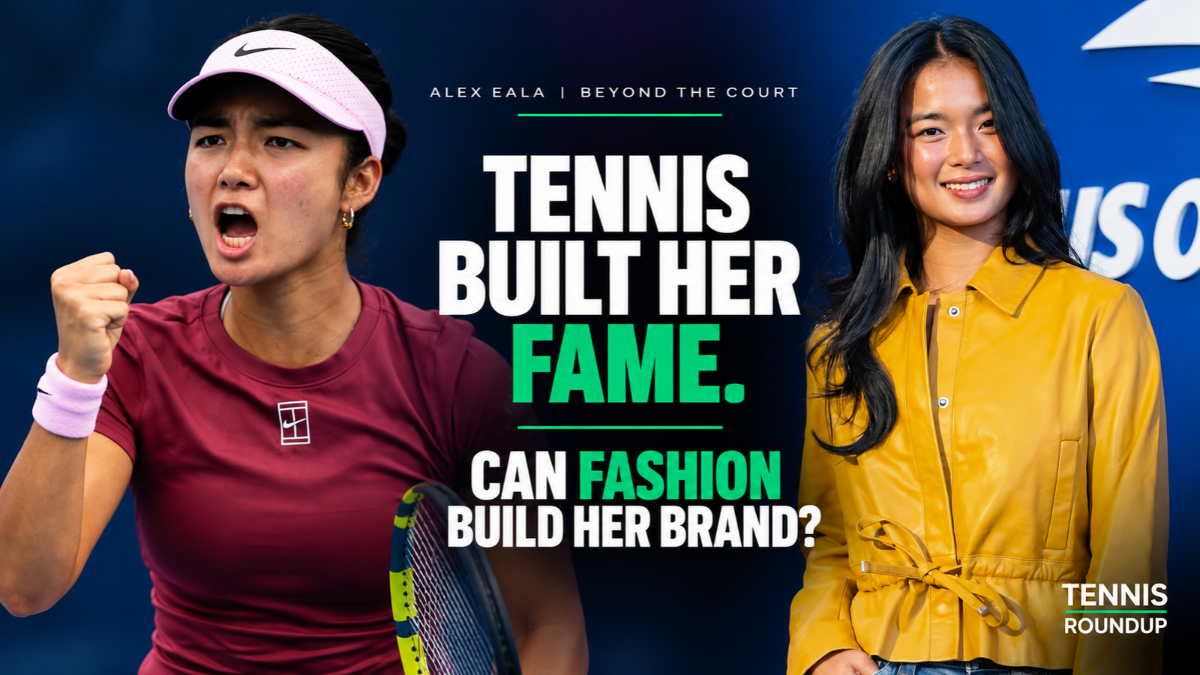
Alex Eala: Tennis Built Her Fame. Can Fashion Build Her Brand?
From Grand Slam junior champion to WTA title winner and fashion-week guest, Alex Eala is discovering opportunities beyond the tennis court. But can the visibility created by sporting success become a lasting commercial identity?
At the US Open, Alex Eala competes under the pressure of the scoreboard. At New York Fashion Week, she sits among designers, celebrities and invited guests, with cameras capturing a very different side of her public life.
In September 2026, the Filipino tennis star attended presentations by Tory Burch, Michael Kors and Calvin Klein. Less than a month later, she appeared at Chanel’s Spring/Summer 2027 show in Paris.
The contrast is striking: a professional athlete whose career depends on winning matches, increasingly visible in an industry where attention itself carries commercial value.
Yet the two worlds are not necessarily competing.
Eala’s tennis achievements helped create the recognition that makes her interesting beyond sport. Fashion offers another setting in which that recognition can grow.
The more difficult question is what happens next.
Can Alex Eala’s popularity become valuable independently of her tennis results—or will her commercial appeal always depend on what she achieves on court?
Alex Eala Tennis and Fashion: How the Two Worlds Came Together
Eala’s journey into international fashion did not begin with her recent appearances in New York and Paris.
In 2018, she moved to Spain to train at the Rafa Nadal Academy. Four years later, she won the 2022 US Open girls’ singles championship, becoming the first Filipino to claim a junior Grand Slam singles title.
Within weeks, Vogue Philippines published a fashion editorial featuring the young tennis player.
That early appearance is important because it establishes something often overlooked in the current conversation: fashion has been part of Eala’s public profile for years.
Her subsequent rise gave that profile a much larger platform.
In March 2025, Eala reached the Miami Open semifinals after defeating established names including Jelena Ostapenko, Madison Keys and Iga Swiatek. The run carried her into the WTA Top 100.
She entered the Top 50 in November 2025, reached the Wimbledon fourth round in 2026 and won her first WTA Tour singles title in Washington that August, defeating Jessica Pegula in the final.
The Washington triumph also took her into the world’s Top 20.
By October 15, 2026, Eala held a ranking of No. 19, having reached a career high of No. 18.
These milestones matter commercially.
They provide the achievements, visibility and credibility behind the athlete whose name now appears in international fashion coverage.
But they do not tell the entire story.
From the Tennis Court to New York and Paris
At New York Fashion Week in September, Eala attended shows by Tory Burch, Michael Kors and Calvin Klein.
In October, she appeared at Chanel’s Paris presentation.
The appearances attracted attention partly because they revealed a different side of a player increasingly familiar to tennis audiences.
Eala herself has spoken positively about the relationship between the two worlds.
In an interview reproduced by the WTA, she described fashion as a form of self-expression, adding:
“You’re able to show your personality in both worlds.”
Her interest is not limited to international luxury houses.
At the Laureus Awards in April 2026, Eala wore a custom Filipiniana-inspired creation by Filipino designer Rhett Eala, her uncle.
Speaking to Vogue Philippines about incorporating Filipino details into her clothing, she explained:
“It’s a way for me to pay tribute to my culture.”
These statements point toward an identity that includes personal expression and cultural representation alongside athletic achievement.
They do not establish that she intends to pursue a separate fashion career.
There is also an important commercial distinction.
Attending a fashion show is not the same as signing a paid endorsement contract.
Eala’s appearances at Tory Burch, Michael Kors, Calvin Klein and Chanel are documented. However, publicly available evidence reviewed by Tennis Roundup does not establish paid ambassadorship agreements with those four fashion houses.
The appearances demonstrate access and visibility. Their precise financial value to Eala remains undisclosed.
Why Alex Eala’s Popularity Matters to Brands
Fashion brands do not work with athletes solely because they win trophies.
Athletes can offer something valuable beyond competition: recognition, credibility, cultural relevance and an existing audience.
A tennis player may introduce a fashion house to people who would not otherwise follow its runway presentations.
In Eala’s case, her connection with Filipino supporters is especially significant.
Her rise has made her an important figure in Philippine sport, while international tournaments have provided a platform for Filipino communities abroad to follow and celebrate her achievements.
That loyalty can extend beyond a particular match.
Supporters may continue following an athlete because of what she represents, even when results disappoint.
For brands, this creates a potential opportunity.
A player with a recognizable identity and an engaged audience may offer more than temporary exposure. She may provide access to a community with a lasting emotional connection.
But emotional loyalty and commercial purchasing behavior are not identical.
A supporter who celebrates Eala’s victories does not automatically become a customer of a luxury fashion house.
Nor does international media coverage prove that Eala has already established a large audience outside tennis or beyond Filipino communities.
That would require stronger evidence, including audience data, repeat commercial partnerships and measurable consumer response.
The distinction matters because visibility creates opportunity, but visibility alone does not guarantee commercial success.
The $502,000 Fashion-Week Figure: What It Actually Means
One figure circulating around Eala’s New York Fashion Week appearances deserves particular attention.
Fashion analytics company Lefty, in a September 2026 report produced with Karla Otto, attributed approximately US$502,000 in Earned Media Value to Eala’s appearance at Calvin Klein.
The figure illustrates how fashion-industry analysts attempt to measure the publicity generated by influential guests.
But it is important to understand what the number represents.
Earned Media Value, or EMV, estimates the advertising-equivalent value of publicity exposure.
It is not a payment to the person appearing in the coverage.
The $502,000 estimate does not mean Alex Eala earned $502,000 from Calvin Klein.
It also does not establish that the brand generated an equivalent amount in sales or profit.
The underlying Eala-specific calculation could not be independently reproduced from the publicly available report.
Even with those limitations, the estimate illustrates why an athlete’s appearance can attract commercial interest.
Her visibility becomes part of the fashion event’s wider media story.
The unanswered question is how much of that attention develops into a lasting relationship between the athlete, the brand and its consumers.
Beyond the Front Row: Eala’s Existing Commercial Partnerships
Eala’s commercial activities are not limited to fashion events.
Her documented relationships include Nike, Babolat, Globe, BPI and Philippine Airlines.
Philippine Airlines (PAL) has also welcomed Eala into its brand family, connecting her international tennis journey with the identity of the Philippines’ flag carrier. The partnership’s campaign message, “Two journeys. One flag,” places Filipino pride and international representation at the center of the collaboration.
The partnership illustrates how Eala’s commercial appeal can extend beyond sportswear and fashion. For Philippine Airlines, the connection is not simply about tournament victories; it also reflects the recognition Eala has earned as a Filipino athlete competing internationally. The financial terms and duration of the partnership have not been publicly disclosed.
These provide a more substantial foundation for understanding her commercial position than photographs from fashion shows alone.
In August 2026, Forbes estimated that Eala had generated more than US$5 million in off-court earnings over the preceding 12 months, before taxes and representation fees.
That was a reported estimate, not an audited financial disclosure. It covered her broader commercial activities and should not be mistaken for fashion-specific income.
The same Forbes investigation described a longer-term commercial strategy involving Eala’s management and existing partners.
This introduces a different way to evaluate her business prospects.
A fashion-show invitation may generate immediate attention.
A recurring sponsorship, campaign or licensing arrangement can potentially create value over a longer period.
For Eala, the important question is not simply how many international fashion houses invite her to events.
It is whether those appearances lead to continuing relationships, new audiences and commercial opportunities that extend beyond a particular tournament or season.
What Happens to Alex Eala’s Brand When Tennis Results Decline?
This is where the relationship between sporting achievement and commercial popularity becomes complicated.
Eala entered October following defeats in Singapore, the Asian Games semifinals and Wuhan.
Each result carried its own competitive disappointment.
But three defeats do not establish a prolonged career decline.
Nor is there verified evidence that her fashion appearances caused those losses, interfered with compulsory training or compromised her preparation.
The more useful question is a longer-term one.
If Eala experiences an extended period of weaker results, would her commercial value necessarily decline with her ranking?
The answer is not straightforward.
Tennis results create opportunities for exposure. Deep tournament runs attract coverage, while titles and ranking milestones strengthen an athlete’s sporting reputation.
Reduced competitive success could eventually affect the attention available to an athlete and influence future commercial negotiations.
Yet public recognition does not disappear after every defeat.
A player can retain loyal supporters, established partnerships and cultural significance even when current results fall below previous standards.
That is why the distinction between sporting performance and accumulated popularity matters.
Eala’s recent achievements helped build her reputation. Whether that reputation becomes commercially durable will depend on more than the result of her next match.
What Emma Raducanu, Naomi Osaka and Serena Williams Show
Women’s tennis offers examples of athletes whose commercial influence has extended beyond periods of peak competitive performance.
Emma Raducanu’s extraordinary 2021 US Open title brought global recognition and luxury-brand opportunities, including a Dior campaign.
Despite injury-related interruptions and a significant ranking decline, Forbes estimated substantial off-court earnings for Raducanu in 2023.
Naomi Osaka, a four-time Grand Slam singles champion, developed an international commercial identity encompassing fashion, sponsorships and interests beyond tennis. Her relationship with Louis Vuitton illustrates how a champion’s influence can extend into luxury fashion.
Serena Williams represents a more developed model. After stepping away from regular competition in 2022, she remained involved in fashion and product development, including continuing work through Nike’s Serena Williams Design Crew.
These examples demonstrate that commercial relevance does not necessarily rise and fall in direct proportion to weekly rankings.
But they come with an important limitation.
Raducanu, Osaka and Williams established their commercial positions on the strength of major championship achievements. Their circumstances differ considerably from those of a young player still building her professional résumé.
Their experiences do not prove that Eala will follow the same path.
They demonstrate possibilities—not guarantees.
Can Filipino Support Give Eala’s Brand Staying Power?
One of Eala’s most distinctive commercial assets may be the relationship she has developed with Filipino audiences.
For many supporters, she represents more than an individual athlete.
Her achievements carry significance for Philippine tennis, while her international appearances create opportunities for cultural visibility.
That connection helps explain why interest in Eala can continue even when she loses.
A tournament result may be disappointing without erasing the pride supporters feel in her broader achievements.
This emotional connection can matter commercially because recognition accumulated over time may survive periods of sporting uncertainty.
But it presents another question.
Can Eala translate that loyalty into a broader audience that follows her for reasons beyond tennis?
Fashion could help.
Appearances in international magazines, collaborations with designers and involvement in cultural events may introduce her to audiences less familiar with the WTA Tour.
However, an appearance is not proof of a lasting crossover.
The more meaningful indicators would be repeated fashion appointments, sustained interest from non-tennis audiences, product collaborations and evidence that consumers engage with her commercial work independently of match results.
For now, Eala has demonstrated access to the fashion world.
Whether she can establish an independent position within it remains an open question.
The Real Test Is Still Ahead
Eala’s immediate sporting attention now turns toward the Ningbo Open, scheduled for October 19–25.
Whatever happens there, one tournament will not settle the relationship between her tennis career and her commercial future.
Her recent defeats do not erase her achievements. Her fashion appearances do not diminish them.
And her growing public profile does not remove the sporting challenges that remain.
Eala has already demonstrated that tennis can open doors beyond competition.
Her junior Grand Slam title, Miami breakthrough, first WTA Tour championship and rise into the Top 20 helped create a platform that brands and fashion publications now recognize.
The question is whether that platform can support something lasting.
Fashion may offer Eala a way to express her identity, represent her culture and reach new audiences.
But transforming those opportunities into an enduring commercial brand requires more than appearing in the front row.
It requires relationships, audience demand and value that can persist even when the scoreboard is less favorable.
Tennis built Alex Eala’s fame. Fashion may help expand it. Whether it can sustain an independent brand is a story still being written.
Related Reading
- Alex Eala — Feature Player Profile
- Alex Eala’s Asian Games Campaign: The Road to Los Angeles 2028
- Why Is Alex Eala the No. 1 Seed at the Asian Games?