
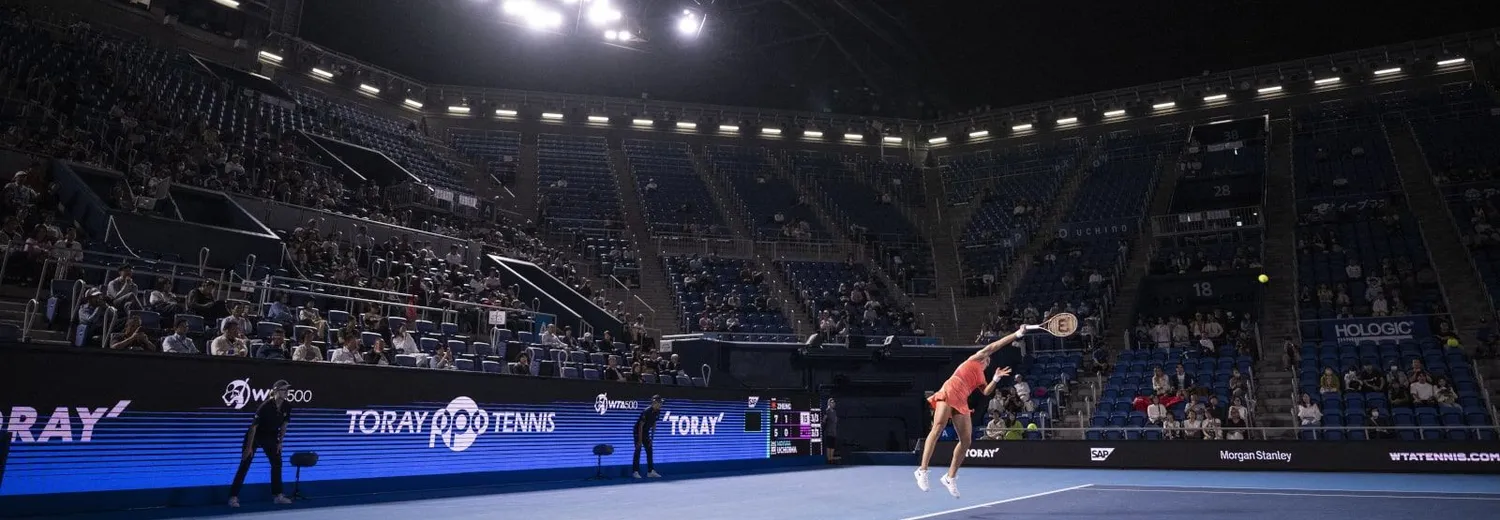
Toray Pan Pacific Open 2026 Draw: The First Tests and the Roads Ahead
Naomi Osaka will face Jasmine Paolini in the opening round of the Toray Pan Pacific Open 2026.
For a tournament featuring eight seeds, four first-round byes and several potential rematches, the draw has already produced one encounter that needs no hypothetical scenario.
Osaka, the 2019 champion, meets a two-time Grand Slam finalist who defeated her in Miami last year.
Only one can advance.
Elsewhere, newly crowned Ningbo champion Elena Rybakina and finalist Leylah Fernandez have landed in the same quarter. Defending champion Belinda Bencic awaits the winner of an intriguing first-round match, while Alexandra Eala could meet Diana Shnaider again after their recent Ningbo encounter.
And two teenagers have been drawn against each other, with an established opponent waiting in the next round.
The Toray Pan Pacific Open 2026 draw has created several possible storylines. The first matches will determine which ones survive.
Toray Pan Pacific Open 2026: The Eight Seeds
The 28-player singles draw features eight seeded players, with the top four receiving first-round byes.
| Seed | Player | First Opponent |
|---|---|---|
| 1 | Elena Rybakina | Yulia Putintseva or Maria Sakkari |
| 2 | Maja Chwalinska | Wang Xinyu or Alycia Parks |
| 3 | Diana Shnaider | Aliaksandra Sasnovich or Nikola Bartunkova |
| 4 | Belinda Bencic | Ann Li or Ekaterina Alexandrova |
| 5 | Elise Mertens | Moyuka Uchijima |
| 6 | Sorana Cirstea | Maya Joint |
| 7 | Naomi Osaka | Jasmine Paolini |
| 8 | Alexandra Eala | Mika Stojsavljevic |
Rybakina, Chwalinska, Shnaider and Bencic each need four victories to win the championship.
The remaining players must win five matches.
But a first-round bye does not necessarily mean an easier opening assignment.
For several leading seeds, the draw has already identified potentially demanding opponents.
Five Stories Emerging From the Tokyo Draw
1. Naomi Osaka vs Jasmine Paolini: The First Round Matters
Osaka returns to a tournament she won in 2019, although that championship was played in Osaka rather than Tokyo.
Her opening opponent is Jasmine Paolini.
The Italian reached the singles finals at Roland Garros and Wimbledon in 2024 and has established herself among the leading players on the women’s tour.
Their previous documented meeting adds another layer.
At the 2025 Miami Open, Paolini defeated Osaka 3–6, 6–4, 6–4.
Now they meet again on a hard court.
For Osaka, Tokyo offers another opportunity to build momentum following her three-set defeat to Karolina Muchova in Beijing.
For Paolini, the assignment provides an immediate test against a former world No. 1.
The winner will face either Tereza Valentova or Mia Pohankova.
Second seed Maja Chwalinska could await in the quarterfinals.
But first, Osaka and Paolini must settle the opening-round question.
2. Elena Rybakina and Leylah Fernandez: Ningbo’s Finalists Share a Quarter
On October 25, Elena Rybakina defeated Leylah Fernandez 6–2, 6–2 to retain the Ningbo Open championship.
The result gave Rybakina her fourth singles title of 2026.
Now both players travel to Tokyo.
And the draw has placed them in the same quarter.
Rybakina, the top seed, receives a first-round bye. She will begin against either Yulia Putintseva or Maria Sakkari.
Fernandez faces Japanese wildcard Himeno Sakatsume.
If Fernandez advances, she will meet either Moyuka Uchijima or fifth seed Elise Mertens.
That creates the possibility of another Rybakina–Fernandez encounter in the quarterfinals.
But the rematch is far from guaranteed.
Rybakina must win her opening match, while Fernandez needs two victories to reach that stage.
The same quarter also offers another Ningbo connection: Fernandez defeated Mertens in the opening round there.
Tokyo could provide another meeting between those players before any potential encounter with Rybakina.
For now, the Ningbo finalists share a section of the draw—not a scheduled match.
3. Belinda Bencic: The Defending Champion’s First Test
Belinda Bencic returns to Tokyo as defending champion.
In 2025, she defeated Linda Noskova 6–2, 6–3 to claim the title.
This year, Bencic is seeded fourth and receives a first-round bye.
But her first opponent will emerge from an intriguing contest between Ann Li and Ekaterina Alexandrova.
Li arrives after reaching the Wuhan quarterfinals and Osaka semifinals.
Alexandrova reached the Ningbo quarterfinals, where she lost to Fernandez.
Their recent results suggest that neither represents a straightforward opening assignment.
The winner will face Bencic in the second round.
Elsewhere in the quarter, sixth seed Sorana Cirstea opens against qualifier Maya Joint, while Diane Parry meets Cristina Bucșa.
A Bencic–Cirstea quarterfinal is possible if both seeds advance.
But the defending champion’s first challenge is already taking shape.
Bencic knows what it takes to win this tournament.
The draw will now test whether she can do it again.
4. Alexandra Eala and Diana Shnaider: Another Meeting Within Reach
Alexandra Eala’s Ningbo campaign ended against Diana Shnaider.
The sixth seed defeated Eala 7–5, 6–4 in the second round.
Only days later, the Tokyo draw has placed them in the same quarter.
Eala, seeded eighth, opens against 17-year-old British wildcard Mika Stojsavljevic.
If Eala advances, she will face the winner of Daria Kasatkina and Talia Gibson.
Shnaider, seeded third, receives a first-round bye and will begin against either Aliaksandra Sasnovich or Nikola Bartunkova.
A quarterfinal between Eala and Shnaider is therefore possible.
But Eala must win twice, and Shnaider once, before that meeting can happen.
For Eala, the immediate challenge is to build on her opening-round victory over Diane Parry in Ningbo and establish greater consistency across consecutive matches.
Stojsavljevic brings her own developing story.
The British teenager won the 2024 US Open junior singles championship and returns to Tokyo after making her WTA Tour debut at the tournament in 2024.
This opening match offers an experience contrast between a WTA title winner and a young wildcard.
The possibility of another Eala–Shnaider meeting adds interest.
It should not overshadow the opponent standing across the net in the first round.
5. Tereza Valentova and Mia Pohankova: A Teenage Opportunity
Not every significant first-round match involves an established star.
Tereza Valentova and Mia Pohankova have been drawn against each other in the fourth quarter.
Valentova, 19, won the 2024 Roland Garros junior singles title and reached a WTA Tour final in Osaka in 2025.
Pohankova, who turned 18 on October 21, won the 2025 Wimbledon junior singles championship.
Both are now navigating the transition into professional tennis.
Valentova earned her Tokyo main-draw place through qualifying.
Pohankova received a wildcard.
Their match offers something neither player can obtain without winning: a second-round opportunity against Osaka or Paolini.
The draw guarantees that one of these teenagers will advance, provided the match is completed without a withdrawal or walkover.
It does not guarantee a breakthrough.
But it creates a meaningful opportunity to test junior promise against established professional competition.
The Four Quarters: How the Tokyo Draw Is Shaping Up
Quarter 1: Rybakina, Fernandez and Mertens
Top seed Rybakina anchors the opening quarter.
Fernandez, Mertens and Sakkari are among the players who could influence her route.
The central question is whether Rybakina and Fernandez can navigate their early assignments to produce a Ningbo final rematch.
Mertens may have something to say about that.
Quarter 2: Bencic’s Title Defense
Defending champion Bencic leads a section containing Cirstea, Li, Alexandrova and Joint.
Bencic’s first opponent will be determined by Li and Alexandrova.
Cirstea, meanwhile, must overcome a qualifier who has already won two matches in Tokyo.
The quarter offers no shortage of potential complications for the defending champion.
Quarter 3: Eala and Shnaider
Eala and Shnaider occupy opposite ends of the third quarter.
Their Ningbo meeting provides a recent reference point, but Tokyo requires both to earn another encounter.
Kasatkina, Gibson, Sasnovich and Bartunkova could all influence how this section develops.
The quarter’s immediate story begins with Eala against Stojsavljevic.
Quarter 4: Osaka, Paolini and Chwalinska
The fourth quarter brings together Osaka, Paolini and second seed Chwalinska.
Chwalinska arrives after winning the Wuhan Open, where she defeated Sonay Kartal in the final.
She receives a first-round bye and will open against Wang Xinyu or Alycia Parks.
Osaka and Paolini must first settle their opening-round encounter.
Valentova and Pohankova provide another developing storyline in the same section.
This quarter combines established Grand Slam experience, a recent WTA 1000 champion and two emerging teenagers.
Only one player can emerge from it to reach the semifinals.
What’s Next: The Opening Day in Tokyo
The main draw begins Monday, October 26, at Ariake.
Among the confirmed opening-day assignments is Alexandra Eala’s match against Mika Stojsavljevic.
The match is scheduled fourth on Center Court, not before 5:00 p.m. Japan time.
That corresponds to 9:00 a.m. in Paris and 4:00 p.m. in the Philippines.
The published order of play does not place Osaka–Paolini on Monday.
Other first-round matches will begin determining the opponents awaiting the four players who received byes.
The draw has established the possibilities.
Now the tournament begins separating them from the results.
The Draw Is Only the Beginning
The Toray Pan Pacific Open enters its opening day with several stories already connected to recent tournaments.
Rybakina and Fernandez have barely finished their Ningbo final.
Bencic returns to defend her Tokyo championship.
Eala and Shnaider have landed in the same quarter after meeting in Ningbo.
Chwalinska arrives as the Wuhan champion.
And Osaka faces Paolini in a first-round match that will immediately eliminate one accomplished competitor.
These are not predictions.
They are the competitive questions created by the draw.
Some will develop into defining tournament stories.
Others will disappear after the opening matches.
The draw shows the possible roads ahead. The players must now decide which ones remain open.
Related Stories
- Toray Pan Pacific Open — Tournament Hub
- Introduction — Five Stories Before Tokyo Begins
- Seedings & Draw — The First Tests and Roads Ahead
- Day 1 — Bencic and Chwalinska Withdraw as Eala Advances
- Day 2 — Two Lucky Byes as the Last 16 Take Shape
- Day 3 — Eala Roars Back to Set Shnaider Rematch
- Day 4 — Rybakina Secures Year-End No. 1 as Pohankova Stuns Osaka
- Day 5 — Pohankova Reaches Her First WTA Semifinal
- Day 6 — Shnaider and Fernandez Set Up the Final
- Day 7 — Shnaider Regroups to Beat Fernandez for the Title
- Tournament Wrap-Up — Shnaider’s Title and Five Defining Stories