
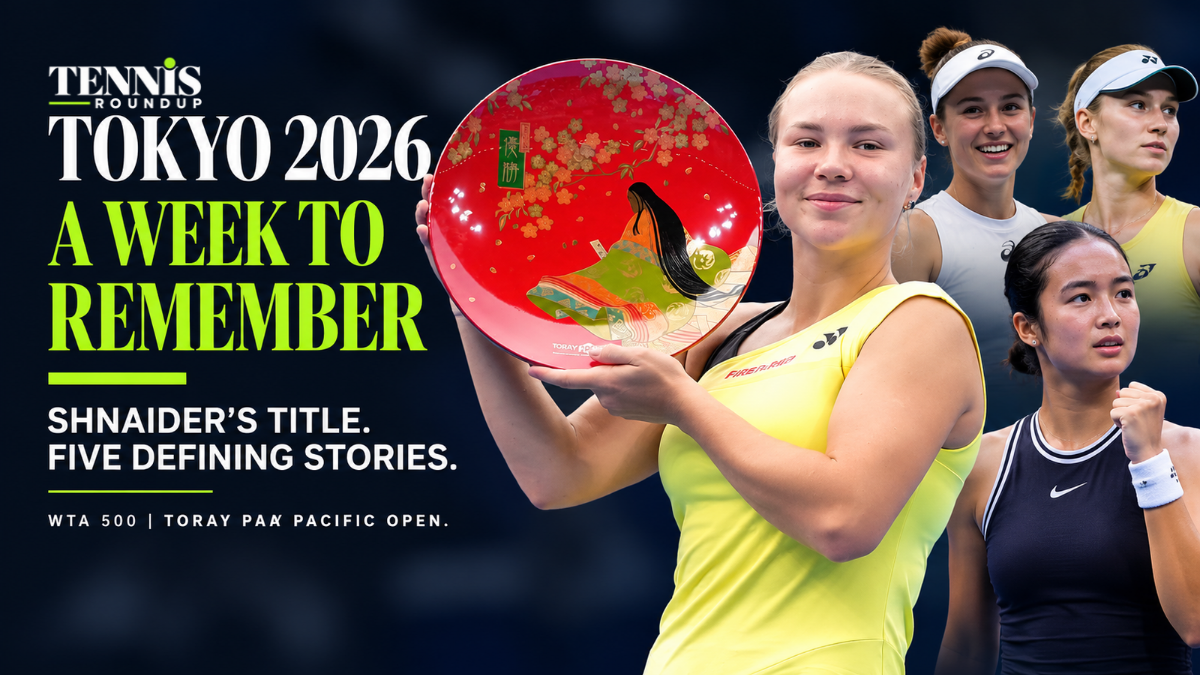
Toray Pan Pacific Open 2026 Wrap-Up: Shnaider’s Title and Five Defining Stories
Toray Pan Pacific Open 2026 Wrap-Up
The Toray Pan Pacific Open 2026 began with unexpected withdrawals, unusual opportunities, and a draw that quickly opened the door to emerging contenders.
Seven days later, Diana Shnaider stood as Tokyo champion.
The third seed defeated Leylah Fernandez 6–4, 5–7, 6–2 in Sunday’s final, securing her sixth career WTA Tour singles title and first championship of 2026.
But the tournament was about much more than its eventual winner.
An 18-year-old wildcard defeated Naomi Osaka on her way to a first WTA Tour semifinal. A lucky loser turned an unexpected entry into her first WTA 500 semifinal. Alexandra Eala pushed the eventual champion through nearly three hours of tennis.
And Elena Rybakina secured the year-end World No. 1 ranking before an injury ended her tournament.
Tokyo 2026 was a week in which opportunity changed shape—and players responded in very different ways.
Here are the five stories that defined the tournament.
Diana Shnaider: A Champion Who Had to Earn Every Step
Before revisiting the week’s other stories, the championship deserves its place.
Diana Shnaider entered Tokyo as the No. 3 seed and finished as champion, winning four matches after receiving a first-round bye.
Three of those four victories required deciding sets.
Her path was anything but straightforward.
Shnaider’s Road to the Tokyo Title
| Round | Opponent | Result |
|---|---|---|
| First Round | Bye | Advanced |
| Round of 16 | Aliaksandra Sasnovich [Q] | 6–3, 5–7, 6–3 |
| Quarterfinal | Alexandra Eala [8] | 2–6, 7–6(5), 6–4 |
| Semifinal | Mia Pohankova [WC] | 6–4, 7–6(7) |
| Final | Leylah Fernandez | 6–4, 5–7, 6–2 |
The quarterfinal against Eala tested Shnaider’s ability to recover after losing the opening set.
The semifinal against Pohankova required her to overcome an early deficit and save a second-set set point.
And Sunday’s final demanded another response after Fernandez recovered from 0–4 in the second set to force a decider.
Four played matches. Three deciding sets. One championship.
Shnaider’s Tokyo victory was her sixth career WTA Tour singles title, her third at WTA 500 level, and her first of the 2026 season.
It was also her first Toray Pan Pacific Open championship.
She has now won six consecutive WTA Tour finals after losing her first in Ningbo in 2023.
The WTA projects that the victory will return her to World No. 11, equaling her existing career-high ranking.
For a closer look at the championship match, read our Day 7 report on Shnaider’s victory over Fernandez.
Five Defining Stories of the Toray Pan Pacific Open 2026
1. Mia Pohankova: A Wildcard Opportunity Becomes a Breakthrough
Mia Pohankova arrived in Tokyo ranked World No. 144.
The 18-year-old Slovak had received a wildcard into the main draw.
It was only her fourth WTA Tour main-draw appearance and her first at WTA 500 level.
By the end of the week, she had reached her first WTA Tour semifinal.
Her journey began with a straight-set victory over qualifier Tereza Valentova.
Then came the result that brought her wider attention.
Pohankova defeated former World No. 1 Naomi Osaka 6–3, 7–5 in the round of 16.
It was a significant victory against an established champion competing in front of a home crowd.
But Pohankova’s tournament did not end there.
In the quarterfinals, she defeated Alycia Parks 7–6(3), 6–3 to reach the last four.
Three matches played.
Three straight-set victories.
And a place in the semifinals.
A Semifinal That Nearly Went Further
Against Shnaider, Pohankova again demonstrated her ability to compete with an established opponent.
She led 4–2 in the opening set before Shnaider recovered to win four consecutive games.
The second set went to a tiebreak.
Pohankova earned one set point at 6–5, but Shnaider saved it and eventually completed a 6–4, 7–6(7) victory.
The defeat ended Pohankova’s tournament.
Yet the larger story remained.
An 18-year-old wildcard had reached her first WTA Tour semifinal after defeating three opponents without dropping a set.
Pohankova had previously reached a tour-level quarterfinal in Chennai in 2025, but Tokyo marked another important career milestone.
Her week was a reminder that a wildcard can be more than an invitation.
Sometimes, it becomes the opportunity that allows a player to demonstrate how far she has progressed.
Read more about her development in our Mia Pohankova Feature Player profile.
2. Kamilla Rakhimova: The Lucky Loser Who Earned Her Place
Kamilla Rakhimova’s Tokyo journey began with a defeat.
She lost in the final qualifying round to Aliaksandra Sasnovich.
Under ordinary circumstances, that would have ended her tournament.
But the withdrawal of second seed Belinda Bencic changed the draw.
Rakhimova entered the main draw as a lucky loser, inheriting Bencic’s position and first-round bye.
She was suddenly in the round of 16 without having played a main-draw match.
But that opportunity alone did not take her to the semifinals.
Rakhimova still had to win.
And she did.
Two Victories That Changed Her Week
In the round of 16, Rakhimova defeated Ekaterina Alexandrova 6–4, 4–6, 7–6(5).
The match required three sets and a deciding tiebreak.
Then, in the quarterfinals, she defeated qualifier Maya Joint 7–5, 5–7, 6–1.
Those two victories secured Rakhimova’s first WTA 500 semifinal.
Her tournament ended with a 7–5, 6–3 defeat against Leylah Fernandez.
But the distinction between receiving an opportunity and making something of it matters.
Rakhimova inherited a bye.
She earned the semifinal through two victories on court.
Another lucky loser, Kimberly Birrell, also inherited a first-round bye following Maja Chwalinska’s withdrawal.
Birrell lost her first played main-draw match against Alycia Parks.
The two players received unusual opportunities.
Their tournament journeys ended differently.
Tokyo showed that an unexpected opening can change a player’s path—but the results still have to be earned.
3. Alexandra Eala: A Rematch That Became a Three-Hour Battle
Alexandra Eala entered Tokyo with a recent defeat still part of her competitive history.
Just days earlier, she had lost to Diana Shnaider in the Ningbo Open.
Tokyo offered another meeting.
But first, Eala had to reach the quarterfinals.
She opened with a convincing 6–1, 6–2 victory over Mika Stojsavljevic.
Then came a demanding round-of-16 encounter against Talia Gibson.
Eala lost the opening set 4–6.
She responded by winning the second 6–2.
And in the deciding set, she completed the comeback 6–0.
That victory secured another meeting with Shnaider.
A Closer Contest Against the Eventual Champion
Their Tokyo quarterfinal became one of the tournament’s most competitive matches.
Eala won the opening set 6–2.
Shnaider responded by taking the second-set tiebreak 7–5.
The deciding set remained close before Shnaider completed a 2–6, 7–6(5), 6–4 victory.
Match duration: 2 hours, 52 minutes and 59 seconds.
The official statistics showed just how closely contested the match had been.
Both players won exactly 116 points.
Eala had pushed the eventual champion through nearly three hours of tennis.
But Shnaider won the points needed to advance.
What the Rematch Actually Showed
The Tokyo encounter was closer on the scoreboard than their Ningbo meeting, which Shnaider had won 7–5, 6–4.
Eala took a set and reached 5–5 in the second-set tiebreak.
She did not hold match point.
Those distinctions matter.
The result showed a more competitive rematch, but it remained a defeat.
Whether it represents a lasting shift in their rivalry will depend on future meetings.
For Tokyo, it became one of the matches that demonstrated how difficult Shnaider’s championship journey would be.
4. Elena Rybakina: The World No. 1 Milestone Without the Trophy
Elena Rybakina arrived in Tokyo with a significant season objective still within reach.
The World No. 1 needed to secure her position at the top of the year-end rankings.
She achieved that milestone in her opening match.
On October 29, Rybakina defeated Yulia Putintseva 6–2, 6–3.
The victory confirmed that she would finish the season as the WTA year-end World No. 1 for the first time.
It was an important distinction.
Rybakina was already the current World No. 1.
Tokyo secured her first year-end No. 1 finish, rather than marking her first ascent to the top ranking.
An Injury Changes the Quarterfinals
Rybakina was scheduled to face Leylah Fernandez in the quarterfinals.
But she withdrew before the match because of a neck injury.
Fernandez advanced by walkover.
No quarterfinal was played between them.
The withdrawal ended Rybakina’s tournament, but it did not affect the ranking milestone she had already secured.
Rybakina left Tokyo without the championship trophy—but with the year-end World No. 1 ranking confirmed.
It was one of the week’s most significant achievements, even though it did not lead to a title.
The distinction also shaped the tournament’s final stages.
With Rybakina out, Fernandez advanced directly into the semifinals.
And the eventual Tokyo champion would emerge from a different path through the draw.
5. Leylah Fernandez: Two Consecutive Finals, One More Title Opportunity Missed
Leylah Fernandez arrived in Tokyo after reaching the Ningbo Open final.
She had already won the Singapore Tennis Open earlier in the season.
Tokyo became her third WTA Tour final of 2026.
Her route began with a 6–2, 6–4 victory over Japanese wildcard Himeno Sakatsume.
She then defeated fifth seed Elise Mertens 6–2, 7–6(8).
Rybakina’s withdrawal allowed Fernandez to advance through the quarterfinals without playing.
In the semifinals, Fernandez defeated Kamilla Rakhimova 7–5, 6–3, recovering from a break down in both sets.
That victory secured her place in Sunday’s final.
One More Fight Against Shnaider
Fernandez entered the championship match trailing Shnaider 3–2 in their professional head-to-head.
She had lost their previous three meetings.
And for much of Sunday’s final, another defeat appeared likely.
Shnaider won the opening set and led 4–0 in the second.
But Fernandez produced an extraordinary recovery.
She won seven of the next eight games to take the second set 7–5.
The championship would be decided in a third set.
Fernandez held serve to open the decider and created three break-point opportunities in Shnaider’s next service game.
But Shnaider saved all three.
The third seed eventually won 6–4, 5–7, 6–2.
For Fernandez, the result meant another runner-up finish.
Two consecutive tournament finals in Ningbo and Tokyo—but no additional title.
Still, her sustained run through the closing stages of the Asian swing was one of the tournament’s defining stories.
She finished Tokyo with six career WTA Tour singles titles, including one in 2026.
And her rivalry with Shnaider now stands at 4–2 in the Russian player’s favor.
The Seven Days That Shaped Tokyo 2026
The Toray Pan Pacific Open unfolded through a series of unexpected developments.
Here are the moments that changed the tournament.
| Date | Stage | Defining Moment |
|---|---|---|
| October 26 | Day 1 | Bencic and Chwalinska withdraw, opening the draw to lucky losers. Eala makes a commanding start. |
| October 27 | Day 2 | Pohankova begins her wildcard run. Osaka advances, while the round-of-16 lineup takes shape. |
| October 28 | Day 3 | Eala completes a comeback against Gibson. Shnaider, Rakhimova, and Joint also survive three-set matches. |
| October 29 | Day 4 | Rybakina secures year-end No. 1. Pohankova defeats Osaka. |
| October 30 | Day 5 | Pohankova reaches her first WTA semifinal. Shnaider survives Eala. Rybakina withdraws. |
| October 31 | Day 6 | Shnaider and Fernandez win their semifinals to set up the championship match. |
| November 1 | Day 7 | Shnaider defeats Fernandez to become Tokyo champion. |
The tournament began with changes to the draw.
It ended with a champion who had survived several demanding matches.
And between those moments, emerging players and established contenders produced stories that extended well beyond the final score.
What Tokyo 2026 Revealed
There is a temptation to explain a tournament entirely through its champion.
But Tokyo offered several stories worth remembering.
Pohankova demonstrated what a wildcard opportunity could become.
Rakhimova showed the difference between receiving a second chance and earning further progress.
Eala produced a closely contested rematch against the eventual champion.
Rybakina secured the season’s highest ranking distinction without reaching the final.
Fernandez sustained her run across consecutive tournaments, even though the Tokyo title escaped her.
And Shnaider brought those different stories together by winning the championship.
The week did not establish that every emerging player would become a future champion.
Nor did it prove that every close defeat represented a lasting change in a rivalry.
What it demonstrated was more immediate and measurable.
Players entered the tournament through different routes.
They encountered different opportunities.
And their results reflected what they accomplished when those opportunities arrived.
Tokyo 2026 was a tournament in which the draw opened unexpectedly—and the players determined what happened next.
Toray Pan Pacific Open 2026 Wrap-Up: Final-Round Results
Women’s Singles Quarterfinals
| Winner | Opponent | Result |
|---|---|---|
| Diana Shnaider [3] | Alexandra Eala [8] | 2–6, 7–6(5), 6–4 |
| Mia Pohankova [WC] | Alycia Parks [Q] | 7–6(3), 6–3 |
| Kamilla Rakhimova [LL] | Maya Joint [Q] | 7–5, 5–7, 6–1 |
| Leylah Fernandez | Elena Rybakina [1] | Walkover |
Women’s Singles Semifinals
| Winner | Opponent | Result |
|---|---|---|
| Diana Shnaider [3] | Mia Pohankova [WC] | 6–4, 7–6(7) |
| Leylah Fernandez | Kamilla Rakhimova [LL] | 7–5, 6–3 |
Women’s Singles Final
| Champion | Runner-up | Result |
|---|---|---|
| Diana Shnaider [3] | Leylah Fernandez | 6–4, 5–7, 6–2 |
Tournament Summary
| Category | Details |
|---|---|
| Tournament | Toray Pan Pacific Open 2026 |
| Category | WTA 500 |
| Location | Tokyo, Japan |
| Venue | Ariake Coliseum and Ariake Tennis Forest Park |
| Surface | Outdoor hard court |
| Main-draw dates | October 26 – November 1, 2026 |
| Singles draw | 28 players |
| Champion | Diana Shnaider |
| Runner-up | Leylah Fernandez |
| Final score | 6–4, 5–7, 6–2 |
| Final duration | 2h 18m 53s |
Conclusion: A Champion and a Week Worth Remembering
Diana Shnaider leaves Tokyo with the trophy.
Her victory over Leylah Fernandez completed a demanding championship run and secured her sixth career WTA Tour singles title.
But the 2026 Toray Pan Pacific Open will also be remembered for the players who changed the shape of the tournament.
Mia Pohankova turned a wildcard into a breakthrough semifinal.
Kamilla Rakhimova transformed a lucky-loser entry into her first WTA 500 semifinal.
Alexandra Eala pushed the eventual champion through nearly three hours of tennis.
Elena Rybakina secured her first year-end World No. 1 finish.
And Leylah Fernandez reached another final after a sustained run across two consecutive tournaments.
One player won the championship. Several others gave Tokyo its defining stories.
That is what made the 2026 edition worth following from the opening day to the final point.
And it is what makes the tournament worth remembering.
Related Reading
- Toray Pan Pacific Open — Tournament Hub
- Introduction — Five Stories Before Tokyo Begins
- Seedings & Draw — The First Tests and Roads Ahead
- Day 1 — Bencic and Chwalinska Withdraw as Eala Advances
- Day 2 — Two Lucky Byes as the Last 16 Take Shape
- Day 3 — Eala Roars Back to Set Shnaider Rematch
- Day 4 — Rybakina Secures Year-End No. 1 as Pohankova Stuns Osaka
- Day 5 — Pohankova Reaches Her First WTA Semifinal
- Day 6 — Shnaider and Fernandez Set Up the Final
- Day 7 — Shnaider Regroups to Beat Fernandez for the Title
- Tournament Wrap-Up — Shnaider’s Title and Five Defining Stories